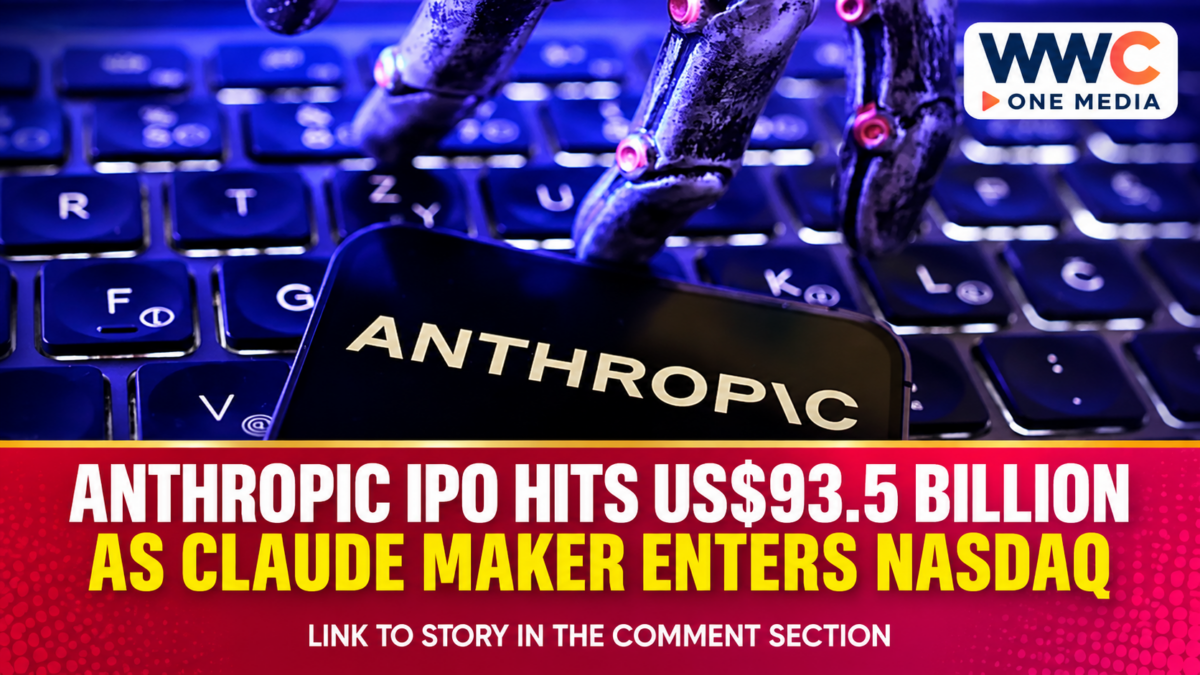
NEW YORK, Nov. 24, 2026 — The Anthropic IPO has opened a new chapter in the global artificial intelligence economy after the developer of Claude completed a US$93.54 billion public offering and a separate US$26 billion private placement.
Anthropic, PBC began trading on the Nasdaq Global Select Market on Nov. 19, 2026, under the ticker symbol ANT, with its shares initially priced at US$83 apiece.
The combined transactions, worth approximately US$119.54 billion before deductions, underscore the extraordinary amount of capital being mobilised to develop advanced artificial intelligence systems.
But beyond the headline figures lies a more consequential question for global markets: can the commercial returns from artificial intelligence eventually justify the enormous financial commitments being made today?
Anthropic IPO reaches US$93.54 billion after additional share sale
Anthropic’s completed public offering involved 1.127 billion Class A common shares, including 147 million additional shares purchased through the underwriters’ option.
Of the total shares offered, 1,103,351,354 were sold by Anthropic itself, while 23,648,646 were sold by existing stockholders.
At US$83 per share, the completed public offering generated a gross transaction value of approximately US$93.54 billion.
The company does not receive proceeds from shares sold by existing stockholders, an important distinction when assessing how much additional capital Anthropic has secured for its operations.
The transaction also introduces another dimension to the broader discussion surrounding Anthropic’s IPO and its path towards profitability.
Raising capital on this scale provides financial flexibility, but it does not automatically guarantee that the company’s investments will generate sustainable returns.
Seven technology companies participate in US$26 billion private placement
Anthropic also completed a private placement involving 313,253,007 Class N common shares at the same US$83 offering price.
The participating companies were:
- Advanced Micro Devices (AMD)
- Broadcom
- Micron Technology
- Microsoft
- NVIDIA
- TSMC Partners
The transaction generated approximately US$26 billion in additional gross proceeds.
The involvement of companies spanning semiconductor manufacturing, cloud computing and enterprise technology illustrates the interconnected nature of the artificial intelligence industry.
For chipmakers, cloud infrastructure providers and AI developers, the commercial success of advanced AI could create opportunities across multiple segments of the technology supply chain.
However, strategic investment should not be interpreted as a guarantee of future revenue, profitability or share-price performance.
Why Anthropic’s valuation is different from its IPO proceeds
One of the most important distinctions surrounding Anthropic’s Nasdaq listing is the difference between the amount raised through an IPO and the company’s overall valuation.
An IPO measures the value of shares sold through a public offering. Market capitalisation, by comparison, generally measures the value of a company’s outstanding equity using its prevailing share price.
A fully diluted valuation may also account for potential additional shares arising from convertible securities, employee equity awards and other financial arrangements.
These measures can produce substantially different figures.
For investors assessing Anthropic, the headline valuation is therefore only one part of a much larger financial picture.
The company’s ability to convert its technology into recurring revenue, manage infrastructure costs and deliver attractive long-term returns will ultimately matter more than any single trading-session valuation.
The multibillion-dollar race to finance artificial intelligence
Anthropic intends to deploy its newly raised capital across its operations, including technology infrastructure, computing resources and workforce requirements.
The challenge is balancing the need to expand computing capacity with the need to establish a commercially sustainable business.
Advanced AI developers must consider not only the cost of training new models but also the recurring expenses associated with delivering AI services to customers.
The financial implications extend beyond software companies.
WWC ONE MEDIA’s coverage of South Korea’s export performance and AI semiconductor demand explores another dimension of this increasingly interconnected technology economy.
Across Asia-Pacific markets, the success or failure of major AI investments could influence future spending on advanced processors, memory chips, manufacturing capacity and data-centre infrastructure.
Nevertheless, rising investment expenditure alone does not establish that an industry is generating adequate returns.
Wall Street faces a new test of AI investment confidence
Anthropic’s transition to public ownership gives investors another opportunity to evaluate the economics of advanced artificial intelligence through publicly available corporate disclosures.
Rather than relying exclusively on private fundraising valuations, investors will increasingly be able to assess the company’s performance through financial results and regulatory reporting.
That distinction is particularly relevant to the debate surrounding AI investment and broader Wall Street market conditions.
A successful capital raising can demonstrate demand for shares at a particular offering price. It cannot establish whether those shares will continue appreciating or whether the wider artificial intelligence sector will avoid a market correction.
Future assessments should focus on revenue quality, customer retention, cash consumption, infrastructure expenses and progress towards sustainable profitability.
These factors could determine whether public-market enthusiasm translates into lasting shareholder value.
What happens next for Anthropic?
Anthropic’s Nasdaq listing marks the beginning of a new phase rather than the conclusion of its corporate development.
The company now faces the challenge of deploying its capital effectively while balancing technological progress, financial performance and its responsibilities to investors.
Its future financial disclosures will offer opportunities to evaluate whether operating efficiencies can keep pace with demand for advanced AI services.
For businesses, technology investors and policymakers across APEC economies, Anthropic’s progress could offer useful insights into the commercial viability of large-scale artificial intelligence investment.
The IPO has demonstrated the scale of capital available to the industry.
The next test will be whether artificial intelligence can generate economic value on a comparable scale.