Thailand is moving closer to a major trade agreement with the United States involving an estimated $2.6 billion in annual American agricultural purchases, creating new opportunities for US exporters while raising questions about competition and agricultural protection in Southeast Asia.
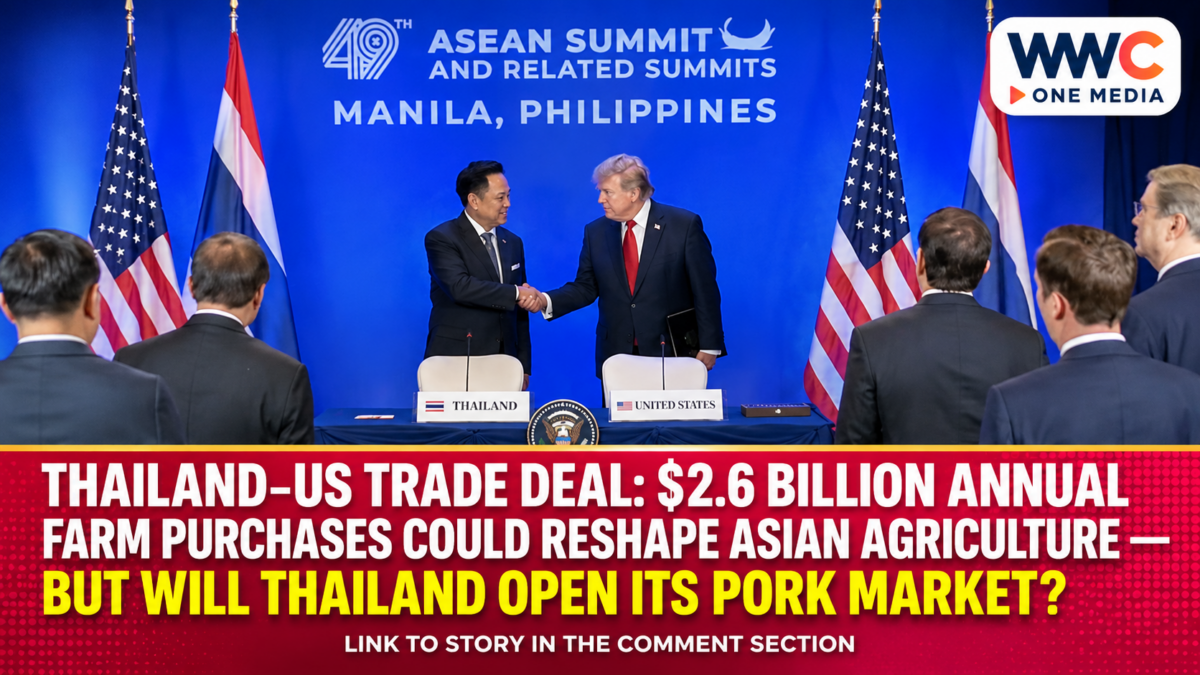
US President Donald Trump and Thai Prime Minister Anutin Charnvirakul signed a joint statement in Manila on November 17, 2026, confirming that negotiations for an Agreement on Reciprocal Trade (ART) had reached a substantial conclusion.
However, the complete agreement still requires further domestic procedures before its formal signing and implementation.
The negotiations bring into focus a difficult economic balancing act: expanding international trade while protecting domestic agricultural producers, particularly Thailand’s livestock and crop farming industries.
Thailand–US Trade Deal Puts $2.6 Billion in Farm Purchases on the Table
The proposed agricultural purchasing arrangement could give American farmers and agricultural businesses greater access to Southeast Asian buyers.
The $2.6 billion annual figure was initially included in the bilateral trade framework announced on October 26, 2025, and has since been reaffirmed by the Trump administration.
Agricultural commodities identified under the framework include:
- Feed corn
- Soybean meal
- Dried distillers grains with solubles (DDGS)
These products are important ingredients in animal feed production, connecting the proposed trade arrangement directly to the economics of livestock farming.
For American agricultural exporters, increased Thai purchases could represent an opportunity to expand sales and diversify their customer base.
For Thai feed manufacturers, additional sourcing options could improve procurement flexibility, depending on import prices, transportation costs and regulatory conditions.
However, an announced annual purchasing figure should not be confused with completed commercial transactions. Actual purchases will depend on contracts, shipment schedules and market conditions.
Similar questions surrounding announced purchasing targets and actual deliveries have emerged in China’s $17 billion US agricultural purchase plan.
US Pork Market Access Remains a Sensitive Issue
One of the most consequential questions surrounding the Thailand–US trade deal is whether American meat producers will secure wider access to Thailand’s domestic market.
The earlier bilateral framework included provisions intended to accelerate market access for US-certified meat and poultry products.
Pork market access is not a new issue between Washington and Bangkok. It was already a subject of bilateral trade discussions in 2019.
Thailand’s Ministry of Commerce clarified on November 20, 2026, that it would not permit imports of pork produced using prohibited lean-meat growth promoters.
The clarification highlights the distinction between expanding agricultural trade and removing existing food-safety restrictions.
For domestic pork producers, wider competition from imported meat could place pressure on selling prices and production margins if the final agreement permits significantly larger imports.
However, the scale of any potential impact cannot be determined without the final product-specific import conditions.
Import duties, veterinary certification, food-safety standards and permitted product categories will all be important in assessing whether American pork can compete more broadly in Thailand.
Thailand’s Tariff Plans Extend Beyond Agriculture
The agricultural purchasing arrangement forms part of a wider effort to restructure commercial relations between Thailand and the United States.
The original October 2025 framework envisaged Thailand removing tariff barriers on approximately 99% of goods, including American industrial and agricultural products.
The proposed changes also cover market access for vehicles, pharmaceuticals, medical equipment and fuel ethanol.
Nevertheless, the November 17 joint statement did not immediately implement those tariff concessions.
Thailand’s government has emphasised that signing the statement did not itself change import duties on American goods.
As outlined in the earlier Thailand–US reciprocal trade negotiations, businesses must distinguish between political commitments, completed trade agreements and legally effective customs regulations.
That distinction is particularly important for companies making long-term procurement and investment decisions.
A $71.7 Billion Trade Gap Explains Washington’s Economic Push
The proposed agricultural purchases come against the backdrop of a substantial imbalance in bilateral merchandise trade.
Official US trade figures for 2025 show:
| Trade indicator | 2025 value |
|---|---|
| Total bilateral goods trade | $110.8 billion |
| US goods exports to Thailand | $19.6 billion |
| US goods imports from Thailand | $91.3 billion |
| US goods trade deficit with Thailand | $71.7 billion |
| Total goods and services trade | $118.3 billion |
The US merchandise trade deficit with Thailand increased by 59.1% in 2025 compared with the previous year.
Expanding American agricultural exports could contribute towards narrowing that imbalance, although the $2.6 billion purchasing figure alone would not eliminate the trade deficit.
Washington’s emphasis on agricultural purchases reflects a broader approach to commercial negotiations across Asia.
Discussions surrounding US trade arrangements and market access across Southeast Asia similarly illustrate the importance of distinguishing announced commitments from enforceable trade measures.
Thai Farmers Face a Delicate Economic Balancing Act
The potential economic consequences of increased American agricultural imports will differ across Thailand’s agricultural supply chain.
Livestock businesses could benefit if competitively priced imported feed ingredients help reduce production expenses.
Domestic crop growers, however, could face additional competition if imported feed commodities enter the market during local harvesting periods.
Thailand’s government has emphasised that domestic agricultural interests must be protected and that additional feed corn imports should not undermine local growers.
The challenge is determining how to manage additional imports without creating unnecessary disruption to domestic production.
Lower feed costs do not automatically translate into cheaper retail meat. Transportation expenses, exchange rates, operating costs and market competition will influence the eventual outcome.
Similarly, increased agricultural trade does not guarantee that every participant in the supply chain will benefit equally.
What Happens Next for the Thailand–US Trade Deal?
Both governments must complete the necessary internal procedures to prepare the reciprocal trade agreement for formal signature and implementation.
Agricultural businesses will be watching for several important developments:
- Publication of the final trade agreement and tariff schedules.
- Confirmation of agricultural import conditions.
- Product-specific rules governing US pork and poultry.
- Measures intended to protect domestic agricultural producers.
- Commercial contracts and actual delivery volumes.
The broader agreement could strengthen agricultural trade between two APEC economies and influence procurement decisions throughout regional supply chains.
But its ultimate economic significance will depend on the final legal provisions and the commercial transactions that follow.
For now, Thailand’s $2.6 billion annual American agricultural purchasing plan represents a significant commercial opportunity — not yet proof that every proposed market-access concession has been implemented.