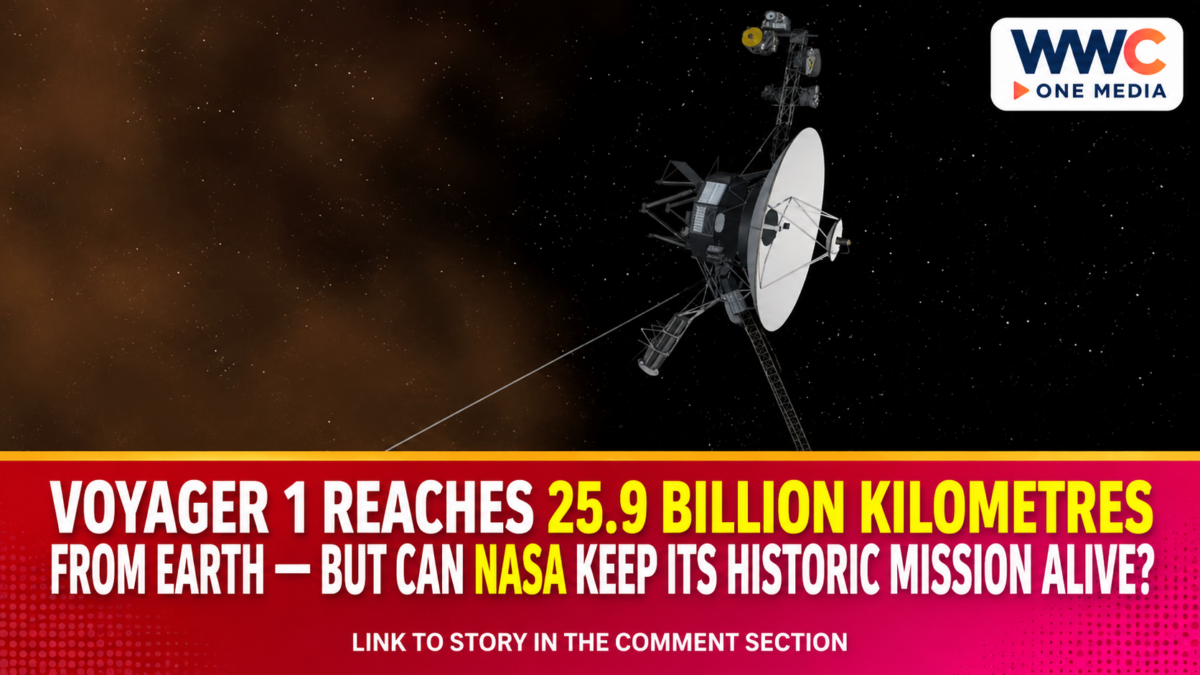
NASA’s Voyager 1 has established another record in space exploration, becoming the first human-made spacecraft to reach a distance of one light-day from Earth on Nov. 18, 2026. The American space agency confirmed the achievement the following day, marking a journey that has lasted more than 49 years.
But the historic milestone comes with an engineering challenge. NASA has been investigating an interruption in the spacecraft’s scientific and engineering data transmissions since Nov. 14.
Although Voyager 1 remains detectable through its radio signal, restoring its ability to deliver scientific measurements is now an important concern for mission engineers.
The achievement illustrates both the extraordinary endurance of space technology and the difficulties of maintaining scientific equipment billions of kilometres from Earth.
Voyager 1 reaches a distance no spacecraft has achieved before
Voyager 1 crossed the one-light-day threshold at 10:16:07 UTC on Nov. 18, equivalent to 6:16:07 p.m. Philippine time.
The spacecraft was approximately 25.9 billion kilometres from Earth at that moment.
Unlike a conventional measurement of time, a light-day describes a distance. It represents how far light travels through a vacuum over 24 hours.
For Voyager 1, that distance has an important operational consequence: engineers must account for approximately two days of communication delay when sending instructions and awaiting an immediate response.
Even a simple exchange between the spacecraft and Earth can therefore stretch across multiple working days.
The milestone does not represent a physical boundary in space. Instead, it provides a measure of how far humanity’s technology has travelled beyond its home planet.
A historic achievement arrives amid a technical problem
NASA’s celebration comes as engineers examine why Voyager 1 stopped delivering scientific and engineering information.
On Nov. 14, a Deep Space Network antenna in Canberra, Australia, detected the spacecraft’s radio transmission without receiving its accompanying data.
The continued presence of the signal provides evidence that important communications equipment remains functional.
NASA’s preliminary assessment points towards the onboard computer responsible for preparing information for transmission. However, the precise cause of the interruption has not been confirmed in the latest mission updates reviewed.
Engineers were also examining whether the problem could be connected to an earlier communications interruption in October.
The distinction between detecting a spacecraft and receiving usable information is particularly important. A functioning radio transmission does not necessarily mean every scientific instrument or computing system is operating normally.
The engineering principles involved extend to other areas of space technology, including the satellite communications research undertaken by Filipino students in Davao City.
Why Voyager’s declining electricity supply matters
Voyager 1 cannot depend on conventional solar power for its operations at such an enormous distance from the Sun.
Instead, its electrical supply comes from technology that converts heat generated by radioactive decay into electricity.
The available power gradually declines, requiring engineers to make increasingly difficult decisions about which equipment should remain operational.
During 2026, NASA replaced three operating devices with alternatives requiring less electricity.
Scientific instruments have also been deactivated over the years as part of efforts to manage the spacecraft’s diminishing energy resources.
These decisions demonstrate an important reality of long-duration space exploration: mission survival can depend on reducing capabilities rather than expanding them.
The challenges of extending spacecraft operations are also explored in WWC’s coverage of NASA’s Swift Observatory and its scientific legacy.
For Voyager 1, preserving electricity must be balanced against maintaining the instruments and communications systems needed to conduct meaningful research.
From planetary exploration to the space between stars
When NASA launched the twin Voyager spacecraft in 1977, their scientific objectives focused on exploring the outer planets.
The spacecraft subsequently delivered important observations of Jupiter and Saturn, while Voyager 2 continued towards Uranus and Neptune.
Voyager 1 entered interstellar space in 2012, opening a new chapter in its scientific mission.
Its research became increasingly focused on understanding the environment beyond the region dominated by the solar wind.
Both spacecraft also carry Golden Records containing representations of Earth’s sounds and images.
Their long journeys demonstrate how scientific equipment developed for one purpose can eventually become valuable for entirely different research objectives.
The evolution of space exploration also raises broader questions about the infrastructure needed to support astronomy. WWC has examined another dimension of this challenge in its coverage of growing satellite populations and their effects on astronomical observations.
What happens next?
NASA’s immediate challenge is to understand the interruption affecting Voyager 1’s scientific and engineering transmissions.
The spacecraft continues travelling at approximately 61,000 kilometres per hour, increasing its separation from Earth regardless of the technical investigation.
Its twin, Voyager 2, is projected to reach the one-light-day threshold in November 2035.
No guaranteed timetable for Voyager 1’s data recovery or permanent mission termination has been established in the official updates reviewed.
Even if scientific operations eventually cease, the spacecraft’s physical journey through interstellar space will continue.
For now, the significance of Voyager 1’s achievement lies not only in how far it has travelled, but also in whether engineers can continue extracting scientific value from technology developed nearly half a century ago.