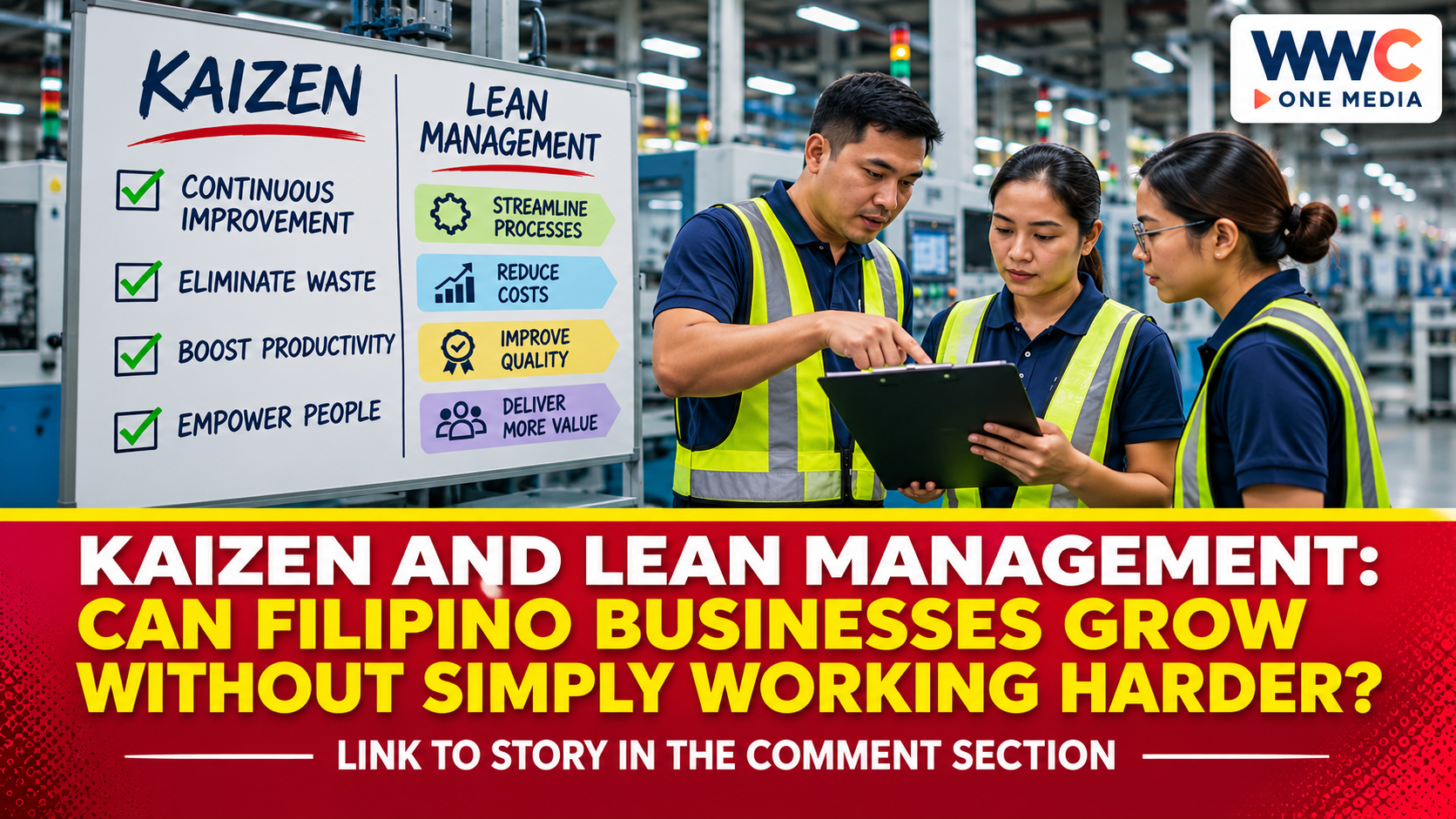
BUSINESS INSIGHTS — On April 16, 2026, the Department of Science and Technology (DOST) documented a ₱255,000 process and technology improvement project for Mar Lean Meat Products in Capiz. The project offers a practical starting point for examining how kaizen and lean management can help Philippine enterprises improve operations without relying exclusively on additional labour or machinery.
The central management question is not how to make every employee move faster. It is how to deliver more useful output from available resources while maintaining quality and safe working conditions.
For small businesses with limited capital, identifying the real constraint on production may be more valuable than immediately purchasing another machine.
Kaizen and lean management start with the process
Toyota’s published description of its production system identifies two underlying principles: jidoka and just-in-time production. It also describes kaizen, or continuous improvement, as an everyday activity involving employees throughout the organisation.
Under jidoka, equipment can stop when a fault is detected, while operators can intervene when work departs from expected conditions. Just-in-time production coordinates the flow of materials with actual requirements, including maintaining necessary stocks for replenishment.
WWC analysis: A manager who measures only the number of finished items may overlook the cost of correcting defects. A better assessment would consider how many acceptable products reach customers, how much material is consumed and whether delivery commitments are met.
Consider a hypothetical furniture workshop that repeatedly cuts boards to the wrong dimensions. Asking workers to cut faster would not resolve an inaccurate measurement procedure. Correcting the procedure could be a more productive first intervention.
The same distinction between physical operations and technology is relevant to WWC’s coverage of FAST Logistics’ cargo-loading improvements.
The Philippine case for targeted technology investment
DOST’s Small Enterprise Technology Upgrading Program, known as SETUP, offers eligible enterprises assistance that can include equipment upgrades, technical consultancy, training and product testing.
The Capiz project announced in April focuses on improvements to food processing and product quality. The agency identified vacuum-sealing equipment and packaging materials among the interventions intended to improve the handling and protection of products.
The approved project amount should not be interpreted as a measure of additional sales or profit. The announcement does not provide an independently measured financial return from the intervention.
WWC’s earlier coverage of technology assistance for a Mindoro keychain manufacturer provides another example of the kinds of production constraints smaller enterprises seek to address.
WWC analysis: Before committing capital, owners could compare the cost of an equipment upgrade with alternative improvements to scheduling, layout or quality control. The most expensive option is not necessarily the one that resolves the most important problem.
Productivity improvements need a financial scorecard
An improvement programme should have a baseline against which subsequent results can be compared. Without one, a business may struggle to establish whether a new procedure has delivered sufficient value to justify its cost.
Consider an illustrative packaging operation producing 100 acceptable units in 10 paid labour-hours. If a revised layout allows it to produce 120 acceptable units in the same time, output per labour-hour rises from 10 to 12 units, an improvement of 20%.
That does not mean company profit increases by 20%. Demand, selling prices, material costs and the expense of introducing the revised layout must also be considered.
Managers could monitor defective units, customer returns, delivery reliability and operating costs alongside output. Improvements in one measure should be examined for unintended deterioration elsewhere.
These are proposed management indicators, not results recorded at Toyota or the Capiz enterprise.
Employee participation should be part of paid work
Toyota’s production-system documentation describes developing employees’ problem-solving abilities and refining manual processes before incorporating improvements into machinery.
WWC analysis: Philippine employers adapting this approach could reserve time within ordinary paid working schedules for investigating recurring faults, documenting improvements and training colleagues.
A production target that discourages employees from reporting problems would undermine the purpose of identifying defects early. Supervisors should examine the circumstances surrounding an error rather than automatically treating a report as evidence of individual incompetence.
Similarly, management should not treat employee willingness to contribute ideas as an entitlement to unpaid labour. Improvement programmes should respect applicable employment obligations and workplace safety requirements.
A useful performance review would assess whether revised procedures make work more manageable, not just whether a team completes more tasks.
Government assistance can support smaller manufacturers
DOST’s Manufacturing Productivity Extension Program connects manufacturing enterprises with technical specialists who examine operational weaknesses and recommend changes. Its published scope includes maintenance, workplace organisation, production planning and quality systems. More advanced assistance includes lean manufacturing and Six Sigma.
The existence of these services is relevant to businesses that may not have dedicated industrial engineering teams. Access to a programme, however, does not establish automatic eligibility or guarantee commercial success.
The broader economic importance of using resources effectively is explored in WWC’s analysis of the Philippines’ productivity gap.
What happens next
Business owners considering continuous improvement could begin with a single recurring operational problem, document its cost, test a change and review the results before extending it to other activities.
For enterprises pursuing technology assistance, the next step is to discuss current eligibility and technical requirements with the relevant DOST office.
The objective is not to reproduce an automobile factory in every Filipino business. It is to adopt suitable methods for identifying problems and evaluating solutions. A genuinely productive enterprise should be able to explain where its gains came from and whether those gains can be sustained.
Frequently asked questions
What is kaizen?
Kaizen refers to ongoing, incremental improvement of work and processes.
Is lean management simply cost-cutting?
No. Its emphasis on reducing waste and improving workflow should be assessed alongside quality, safety and customer requirements.
Can small Philippine businesses obtain productivity assistance?
DOST offers technical and technology support through SETUP and MPEX, subject to the applicable programme requirements.
Does higher productivity guarantee higher profit?
No. Profit also depends on demand, prices, costs and other business conditions.