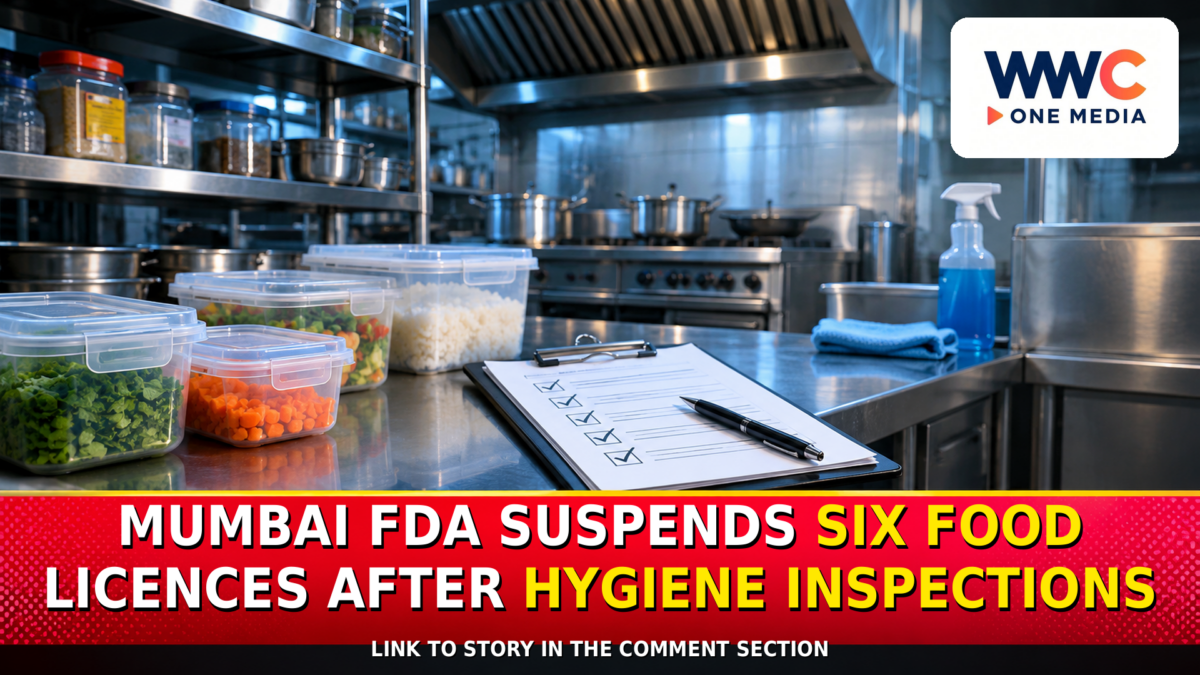
MUMBAI, India — Maharashtra’s Food and Drug Administration (FDA) reportedly suspended the licences or registrations of six food establishments in Mumbai following inspections on November 21 and 22, 2026, citing serious hygiene and sanitation concerns. The enforcement action included the National Sports Club of India (NSCI) in Worli, British Brewing Company in Lower Parel and a Crusto’s outlet operated by Curefoods India Ltd in Prabhadevi.
The reported action formed part of a wider two-day Maharashtra enforcement drive that resulted in 27 food business licences or registration certificates being suspended, according to details attributed to an FDA press note. Separately, the operator of a Mumbai University canteen in Fort paid a ₹1 lakh penalty after inspectors reportedly found that the facility was operating without a valid food business licence or registration.
NSCI licence reportedly suspended after November inspection
The National Sports Club of India’s Worli premises was inspected on November 21. The FDA’s reported findings included flies in the main kitchen, cockroaches near a wash basin and open dustbins close to food preparation areas.
Inspectors also reportedly recorded accumulated food waste in the storeroom and other parts of the premises, along with flakes falling from walls and ceilings. The press-note details cited in reporting further identified gaps in food-storage practices and documentation.
These included missing cleaning schedules, equipment-cleaning records and raw-material purchase bills. The reported findings also referred to food handlers who had not received required vaccinations and some workers who were not wearing gloves.
The club’s food licence was reportedly suspended with immediate effect on November 23.
A licence suspension is a regulatory action. It should not be confused with a criminal conviction, nor does the reported inspection account by itself establish that any customer became ill.
British Brewing Company cited over kitchen and storage conditions
British Brewing Company Pvt Ltd, a restaurant and bar at Mathuradas Mill Compound in Lower Parel, was also inspected on November 21.
The reported FDA findings included live flies inside a bag of flour and cockroaches near a drain obstructed by food waste. Inspectors also reportedly found used staff clothing hanging above food or placed on food in a storeroom.
Other recorded concerns included rusted utensils, a damaged or rusted refrigerator gasket, an oily kitchen platform and dust accumulated in the exhaust system.
The establishment’s licence was reportedly suspended on November 21 under Section 32(3) of India’s Food Safety and Standards Act, 2006.
The reported statutory reference is significant because Section 32 provides the framework for improvement notices and related action when a food business operator fails to comply with the Act or its regulations. The precise legal grounds and conditions imposed in this case should be checked against the actual suspension order before publication.
Curefoods-operated Crusto’s outlet among the other businesses named
The reported list of affected Mumbai businesses also included Crusto’s – Cheese Burst Pizza By Olio in Prabhadevi, operated by Curefoods India Ltd.
Other establishments identified in the reporting were Maratha Chicken Suppliers in Borivali East, Velvet Fine Chocolates in Govandi, and Shane-Ilahi Bakery and Store, also in Govandi.
The reported statewide tally was six suspended licences or registrations in Mumbai and 21 in Pune Division, bringing the total to 27.
The detailed findings for each of the other businesses were not consistently available across the accessible reports. It would therefore be inappropriate to assign specific violations to those establishments without their individual inspection records or suspension orders.
Mumbai University canteen operator paid ₹1 lakh
The FDA also reportedly took action against a canteen at the University of Mumbai’s Fort campus.
The canteen was said to have been operating without a valid food business licence or registration. Inspectors reportedly identified food stored improperly in refrigerators, open garbage bins near food-storage areas and cleaning materials kept close to food-preparation areas.
The reported findings also included inadequate separation of vegetarian and non-vegetarian food, poor separation of food and non-food items, utensils kept directly on the floor and food handlers without the required uniforms or protective clothing.
The operator paid a ₹1 lakh penalty by challan, according to the reported account.
The case illustrates that food-safety compliance is not limited to restaurants and commercial dining venues. Institutional kitchens and canteens are also expected to maintain appropriate licences, safe storage arrangements and hygienic food-handling procedures.
What Section 32 means for food businesses
India’s Food Safety and Standards Act, 2006 establishes the legal framework for regulating food businesses. The Act and its accompanying regulations cover licensing, registration, hygiene, food handling and enforcement.
Section 32 deals with improvement notices. Where an authorised officer considers that a food business operator has failed to comply with the law, the officer may issue a notice requiring specified improvements within a stated period. The law also provides for suspension or cancellation of a licence in circumstances set out in the provision.
The distinction matters because a suspension is not necessarily the final stage of a regulatory case. The actual order determines the reasons for the action, the requirements imposed on the operator and what must happen before the business can resume the relevant activity.
The Maharashtra FDA’s official website identifies the department as the state authority responsible for enforcing food and drug laws. Its public services include food licensing information and a channel for submitting grievances.
What happens next
The next important records are the individual suspension orders, any improvement notices, and any subsequent FDA inspection or compliance decisions. Those documents would establish the exact legal basis for each action and whether any establishment later secured permission to resume operations.
The accessible reporting attributes the inspection findings and enforcement figures to an FDA press note. However, the underlying November 2026 orders were not independently available in the official FDA pages reviewed for this report. The reported findings should therefore be understood as regulatory findings described in that press-note account, rather than as independently examined inspection records.
For consumers, the episode is a reminder that food safety depends on conditions that are often invisible from a dining area: storage temperatures, pest control, clean drains, staff hygiene and accurate records.
For operators, the reported suspensions underline the importance of maintaining valid licences and being able to demonstrate compliance during inspections. A business’s reputation or size does not replace its responsibility to meet food-safety requirements.
The central issue now is not simply how many establishments faced action, but whether the regulatory process produces documented corrective measures and sustained improvements in the kitchens and food premises inspected.
Frequently asked questions
Which Mumbai establishments were named in the reported FDA action?
The reported list included NSCI in Worli, British Brewing Company in Lower Parel, Crusto’s in Prabhadevi, Maratha Chicken Suppliers in Borivali East, Velvet Fine Chocolates in Govandi, and Shane-Ilahi Bakery and Store in Govandi.
How many food licences or registrations were reportedly suspended across Maharashtra?
The reported total was 27: six in Mumbai and 21 in Pune Division.
Why was the Mumbai University canteen operator fined?
The reported FDA account said the canteen was operating without a valid food business licence or registration and had several hygiene and food-storage deficiencies. The operator reportedly paid ₹1 lakh.
What law was cited in the British Brewing Company action?
The reported suspension was made under Section 32(3) of the Food Safety and Standards Act, 2006. The actual suspension order should be consulted to confirm the precise legal basis and conditions.
Have the establishments been convicted of an offence?
The reported licence suspensions are regulatory actions, not proof of a criminal conviction. Any further legal proceedings or final findings would need to be confirmed through official records.