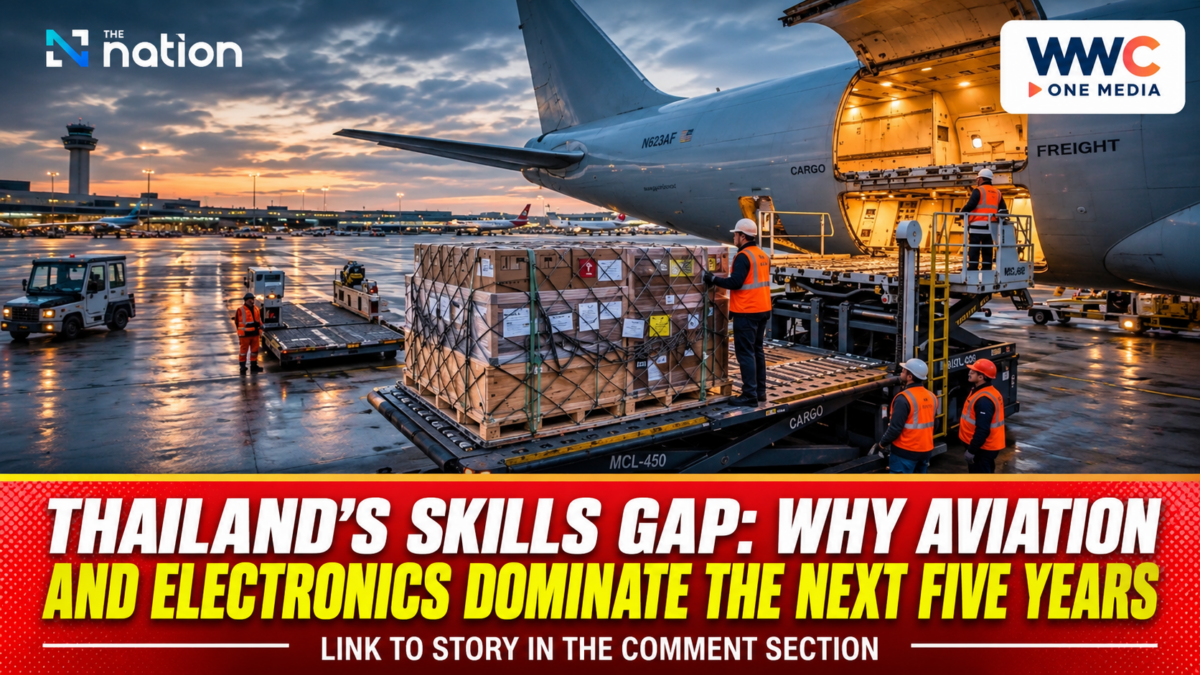
Thailand’s industrial ambitions are creating a growing demand for specialised workers, with aviation, logistics and advanced electronics accounting for the largest share of projected high-skilled positions through 2029. A government-backed workforce study estimates that 10 priority industries will require 1,087,448 high-skilled positions over the five-year period.
The figure is not a count of vacant jobs waiting to be filled. It is a forecast of workforce demand that gives Thailand’s universities, training institutions and employers a substantial task: prepare people for the technical and professional roles that its targeted industries expect to need.
The challenge is particularly important as Thailand confronts an ageing population, rapid technological change and competition for specialised talent. Its ability to turn that forecast into a capable workforce may influence whether investment in future industries translates into sustained economic activity.
Aviation and logistics account for the biggest share
The largest projected requirement is in aviation and logistics, with 440,573 high-skilled positions identified for 2025–2029. That represents about 40.5% of the total demand across the 10 industries.
Smart electronics and industrial robotics rank second, with 226,423 positions. Digital industry comes third at 87,568.
Together, these three sectors account for 754,564 positions, or about 69.4% of the projected total. The concentration shows how strongly Thailand’s workforce planning is tied to transport networks, technology-intensive manufacturing and digital business.
The remaining sectors also point to a broad industrial transformation. Next-generation automotive has projected demand of 77,652 positions, followed by the medical industry at 71,207 and high-value tourism and health tourism at 60,004.
Creative industries account for 54,521 positions, while food processing and future food require 47,579. Biofuels, biochemicals, biotechnology, the circular economy and green economy account for 13,372, with agriculture and biotechnology at 8,649.
These figures are not interchangeable job categories. Aviation operations, industrial robotics, medical services and biotechnology require different qualifications, practical experience and professional standards. A general increase in the number of graduates will not automatically meet all of them.
The forecast is based on employer input
The workforce estimate comes from Thailand Talent Landscape 2025–2029, a study launched by the Office of the National Higher Education, Science, Research and Innovation Policy Council (NXPO) in collaboration with Iris Consulting on June 26, 2025.
The study combined interviews with representatives from more than 300 organisations, covering large, medium and small enterprises, with quantitative information collected through questionnaires.
Its analysis examined future job positions, the competencies required for different roles and average starting salaries for new graduates. This makes the report more than a simple headcount projection: it is also intended to guide education and training decisions.
The approach places employers in a central position. Businesses identify the capabilities they expect to need, educational institutions develop programmes to produce those competencies, and government agencies help coordinate the system.
That arrangement matters because a university course can take years to design and complete, while technology and business requirements can change much faster. If employers and educators work separately, graduates may enter the labour market with qualifications that do not match available opportunities.
Thailand is trying to connect education with actual work
NXPO’s workforce strategy places greater emphasis on cooperation between universities and businesses. Its recommendations include industry-linked curricula, work-integrated learning, practical training and professional skills standards.
The policy direction also recognises that technical knowledge is not enough by itself. Workers need adaptability, communication, teamwork and the ability to apply what they have learned in real workplaces.
In November 2026, NXPO highlighted the Thailand Skill Bridge initiative as a way to improve coordination among universities, ministries and other institutions. The programme is intended to support interdisciplinary learning and give people of different ages opportunities to develop skills throughout their working lives.
The agency has also described Skill Bridge as a mechanism for helping workers move from traditional industries into emerging sectors. For example, employees whose experience is tied to internal-combustion vehicle production may need pathways into areas where electronics and other advanced technologies are becoming more important.
This direction reflects a broader issue for employers: training new graduates is only one part of workforce development. Existing workers may also need retraining if the industries that employ them change.
The skills challenge is not limited to new graduates
Thailand’s workforce policy is being shaped by demographic pressure as well as technological change. NXPO has identified the country’s ageing population and the prospect of a declining future workforce as major concerns.
In an August 2026 policy statement, the agency argued that improving productivity and upgrading workers’ capabilities would be important responses to these pressures. It also discussed the use of technology to help people identify skill gaps and plan training for future occupations.
The proposed approach includes a Skill Mapping mechanism using artificial intelligence and big data to connect existing capabilities with skills required by future jobs. The intention is to help individuals, universities and businesses make better-informed training decisions.
This could be especially relevant to people already employed in manufacturing, transport, administration and other sectors facing technological changes. A worker may not need to begin an entirely new career, but may need additional qualifications or practical experience to move into a more specialised role.
For businesses, the issue is equally practical. Investment in advanced equipment or digital systems can create demand for technicians, engineers and other specialists who can operate, maintain and improve those systems.
WWC has previously examined Thailand’s effort to prepare workers for emerging industries in its report on the Skill Bridge initiative and its workforce targets. The wider question is whether training capacity can keep pace with the needs of employers.
The Philippines also has a stake in the regional skills race
Thailand’s workforce plans are relevant beyond its borders. Southeast Asian economies compete for investment, technology projects and workers with specialised capabilities.
The Philippines, for example, is also pursuing a larger role in technology-related employment. WWC has reported on a Philippine technology firm’s plan to develop artificial intelligence engineering talent, illustrating how companies and training initiatives are responding to demand for advanced digital skills.
The two countries are not pursuing identical workforce strategies, and their labour markets should not be treated as interchangeable. But both face the challenge of ensuring that education and training produce capabilities that employers can actually use.
The regional competition is not simply about producing more graduates. It is about developing people who can work with advanced equipment, analyse information, solve technical problems and adapt as industries evolve.
That issue also connects with the Philippines’ wider digital readiness. WWC’s coverage of the country’s position in global digital and AI competitiveness examined the workforce constraints that can affect technology adoption.
What happens next
The projected demand provides a planning benchmark, but the actual outcome will depend on how employers, universities and government agencies respond.
Thailand will need to translate industry forecasts into updated courses, credible training programmes, practical workplace experience and recognised skills assessments. Employers will also need to communicate their requirements clearly and participate in training rather than leaving the responsibility entirely to schools.
The next important measure will be whether training produces workers who can secure and perform the roles identified by industry. That requires more than counting course enrolments or certificates. Employment outcomes, job retention and the relevance of workers’ skills will help show whether the system is closing the gap.
The 1,087,448-position estimate is therefore best understood as a signal of where Thailand expects its economy to need specialised capabilities. It is not a guarantee that every projected position will become a job, nor that the country will automatically have enough qualified workers to fill them.
Frequently asked questions
How many high-skilled positions does Thailand project for 2025–2029?
Thailand’s Talent Landscape study identifies demand for 1,087,448 high-skilled positions across 10 target industries during the five-year period.
Which industry has the highest projected demand?
Aviation and logistics lead with 440,573 positions, followed by smart electronics and industrial robotics with 226,423.
Does the forecast mean Thailand currently has 1.09 million job vacancies?
No. It is a projection of workforce demand across the target industries, not a live count of advertised vacancies.
What is Thailand Skill Bridge?
It is a workforce-development initiative intended to improve coordination among universities and government institutions, promote interdisciplinary learning and help people develop skills for changing industry requirements.
Why is Thailand changing its education and training approach?
The country is responding to projected industry needs, technological change, an ageing population and concerns that existing skills may not fully match the requirements of future jobs.
What the numbers ultimately show
Thailand’s forecast is large, but its most important message is about the type of workforce the country is trying to build. The strongest demand is concentrated in transport, logistics, electronics and digital industries, where technical competence and practical experience matter.
The test will be whether education and training can turn those projected requirements into real capabilities—and whether workers can access the opportunities created by the country’s industrial plans.