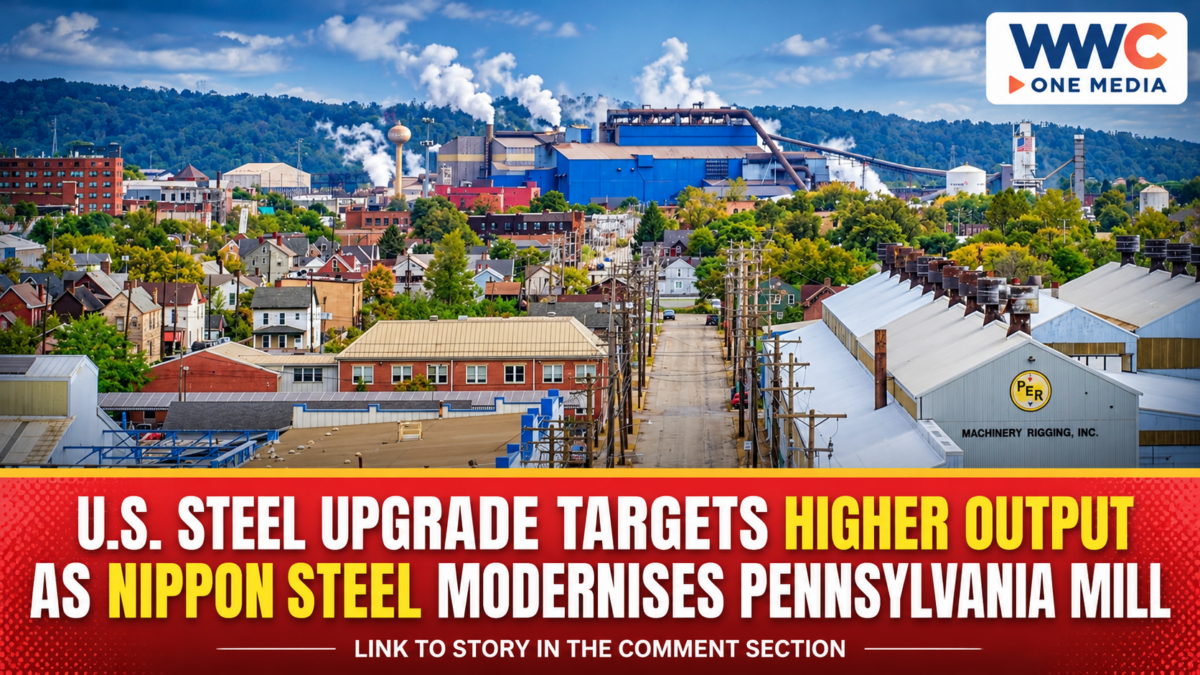
A nearly US$3 billion investment approved for U.S. Steel’s Mon Valley operations is set to replace ageing rolling equipment and expand the facility’s production capabilities, marking a major step in Nippon Steel’s effort to strengthen its American steel business. The project centres on the Edgar Thomson Plant near Pittsburgh, where construction is scheduled to begin in 2027 and initial production is expected in the second half of 2029.
The U.S. Steel upgrade is part of a wider investment programme that Nippon Steel plans to carry out across its American subsidiary. Beyond adding capacity, the project is designed to improve manufacturing efficiency, product quality and the company’s ability to supply higher-grade steel to customers in industries such as automotive manufacturing, household appliances and energy.
The scale of the investment also highlights a broader industrial question: can Japanese manufacturing technology and capital help an established American steelmaker compete more effectively while keeping production rooted in the United States?
U.S. Steel Upgrade Will Replace Equipment Dating Back Decades
The new hot strip mill will be built at the Edgar Thomson Plant, part of U.S. Steel’s Mon Valley Works in western Pennsylvania.
Nippon Steel’s November 2026 financial presentation identifies the project as a modernisation of a hot strip mill that has been operating since 1938. The plan also involves changes to steelmaking facilities at Edgar Thomson and improvements to pickling facilities at the nearby Irvin Plant.
A hot strip mill is an important stage in steel production. It takes heated steel slabs and rolls them into thinner, flatter products that can subsequently undergo further processing for industrial applications.
The planned installation is designed to increase annual production capacity from approximately 2.2 million tons to approximately 3.5 million tons. The company says the expanded system will support a broader range of steel products, including higher-strength materials.
The investment includes equipment such as new walking beam furnaces and an in-line slab sizing press. These technologies are intended to improve productivity, energy efficiency, material yield and consistency in finished steel quality. Nippon Steel Corporation+2
The changes also involve reorganising parts of the production process between the two Mon Valley facilities. Nippon Steel’s presentation describes the relocation of hot-rolling operations to Edgar Thomson, alongside upgrades to downstream processing at Irvin.
This means the project is not simply about installing a larger machine. It is intended to improve how different stages of the steelmaking operation work together.
The Investment Is Part of Nippon Steel’s Wider American Strategy
The Mon Valley project forms part of Nippon Steel’s commitment to invest approximately US$11 billion in U.S. Steel by the end of 2028.
The Japanese company completed its acquisition of U.S. Steel on June 18, 2025, establishing the American producer as a wholly owned subsidiary. The transaction gave Nippon Steel a larger manufacturing presence in the United States and expanded its access to the American market.
The investment programme covers more than the Pennsylvania facility.
Nippon Steel’s November 5 financial presentation said approximately US$6.7 billion in strategic investments across the United States had been approved as of November 2026. These include projects involving blast furnace upgrades, steelmaking improvements, direct reduced iron production and specialised steel pipe manufacturing.
Among the other major projects is a planned US$1.9 billion direct reduced iron facility at Big River Steel in Arkansas. The company expects that project to support the supply of raw material for electric arc furnace operations.
The investments reflect a strategy of strengthening different parts of the production network rather than relying on a single facility to deliver the expected improvements.
Nippon Steel has also identified operational technology, equipment technology, product technology and decarbonisation technology as four areas where it intends to apply its expertise. Its presentation outlines eight strategic pillars and 66 initiatives for improving U.S. Steel’s operations. Nippon Steel Corporation+2
For a wider look at how trade restrictions and industrial policy are changing steel production decisions, WWC ONE MEDIA previously examined the global steel industry’s shift towards regional manufacturing.
Why Higher-Grade Steel Matters to American Manufacturers
The new mill is intended to serve customers across several major industrial markets.
Automotive manufacturers require steel with specific strength, formability and quality characteristics. Appliance producers also depend on consistent sheet steel, while energy companies use specialised steel products in equipment and infrastructure.
The ability to manufacture a wider range of products can help a steelmaker compete for customers that require more than standard commodity steel.
Nippon Steel says the upgraded facilities will improve its ability to manufacture high-grade products, including high-tensile-strength steel. Better process control and more consistent production can also reduce material losses and improve the quality of finished products.
These improvements matter because steelmakers compete on several factors at once: production costs, product specifications, delivery reliability and the ability to meet customers’ technical requirements.
For U.S. Steel, the investment could strengthen its position in markets where customers need reliable domestic production capacity.
However, the planned increase in capacity does not guarantee that the company will sell every additional ton. Actual performance will depend on customer demand, production costs, competing suppliers and the company’s ability to bring the new equipment into operation as planned.
The wider industrial environment is also changing. As WWC ONE MEDIA explored in its report on America’s expanding industrial supply chain for artificial intelligence infrastructure, demand for steel and other manufactured components can extend beyond traditional construction and automotive markets.
The Financial Test Behind the Modernisation
Large industrial investments require more than construction funding. They must eventually produce enough operational and commercial benefits to justify their cost.
Nippon Steel’s March 18, 2026 announcement said it had completed the permanent financing arrangement for the U.S. Steel acquisition. The company disclosed approximately ¥900 billion in new co-financing involving the Japan Bank for International Cooperation and major Japanese financial institutions.
The financing helped repay bridge loans used for the acquisition. Nippon Steel said the entire bridge loan, approximately ¥2 trillion, had been repaid through the financing arrangements it had put in place.
The company also outlined its intention to invest US$11 billion in U.S. Steel and transfer advanced operational, equipment and product technologies to strengthen the American business. Nippon Steel Corporation
Its November financial presentation provides another indication of the expected operational benefits. Nippon Steel reported that it was targeting approximately US$300 million in operational synergies for fiscal 2026, with improvements involving productivity, quality, fuel consumption, energy efficiency and raw-material use.
The presentation also identified approximately 100 dispatched personnel, including short-term assignments, as part of its effort to transfer expertise and support operational improvements. 日本製鉄株式会社+1
The financial picture should be interpreted carefully. A projected synergy figure is not the same as a guaranteed profit, and the benefits of the Pennsylvania investment will depend on the project being completed and operating successfully.
The wider financing challenge is also relevant to Japan’s overseas investment strategy. WWC ONE MEDIA has previously examined how Japan’s NEXI loan-insurance framework supports financing for US projects.
What the Project Could Mean for Pennsylvania
For the Mon Valley region, the proposed investment represents a substantial commitment to maintaining and upgrading industrial production.
Nippon Steel has said the project is intended to support local economic development and maintain and create employment opportunities. However, the public announcement does not provide a specific number of new jobs attributable to the Pennsylvania mill.
That distinction matters. A multibillion-dollar investment does not automatically translate into an equivalent number of permanent positions. Modern equipment may increase output and efficiency without requiring a proportional increase in staffing.
The project will also need to move through the relevant permitting and construction stages. U.S. Steel has said construction will begin after the necessary permits are received, while Nippon Steel’s November presentation identifies 2027 as the planned construction start.
For the surrounding communities, the practical results will depend on how the project affects employment, supplier activity, production levels and the long-term operation of the Mon Valley facilities.
The company’s stated objective is to strengthen the competitiveness of the site. Whether that translates into a lasting regional industrial recovery will become clearer only after the new equipment enters service.
What Happens Next
The immediate milestone is the permitting and preparation process for construction at Edgar Thomson.
Nippon Steel’s November 2026 presentation schedules construction to begin in 2027, with start-up expected in the second half of 2029. The company has also identified improvements at Irvin as part of the wider Mon Valley project.
Investors and customers will have several indicators to monitor: whether construction proceeds on schedule, whether the new equipment achieves its planned production capacity, and whether the upgrades improve cost efficiency and product quality.
The wider US$11 billion investment commitment will also be judged by progress at other U.S. Steel facilities.
For now, the Pennsylvania project is an approved investment with a defined production objective and timetable. Its eventual success will depend on execution—not simply the amount of money committed.
Frequently Asked Questions
How much is Nippon Steel investing in the Pennsylvania steel mill?
The new hot strip mill project at U.S. Steel’s Mon Valley Works involves approximately US$3 billion in capital expenditure.
Where will the new hot strip mill be built?
It will be built at the Edgar Thomson Plant in western Pennsylvania, near Pittsburgh.
How much will production capacity increase?
The announced annual production capacity is expected to rise from approximately 2.2 million tons to approximately 3.5 million tons.
When is the new mill expected to begin operating?
Construction is scheduled to begin in 2027, with initial production expected in the second half of 2029.
Is U.S. Steel still an American company?
U.S. Steel remains a US-incorporated company and is a wholly owned subsidiary of Japan’s Nippon Steel Corporation following the acquisition completed on June 18, 2025.