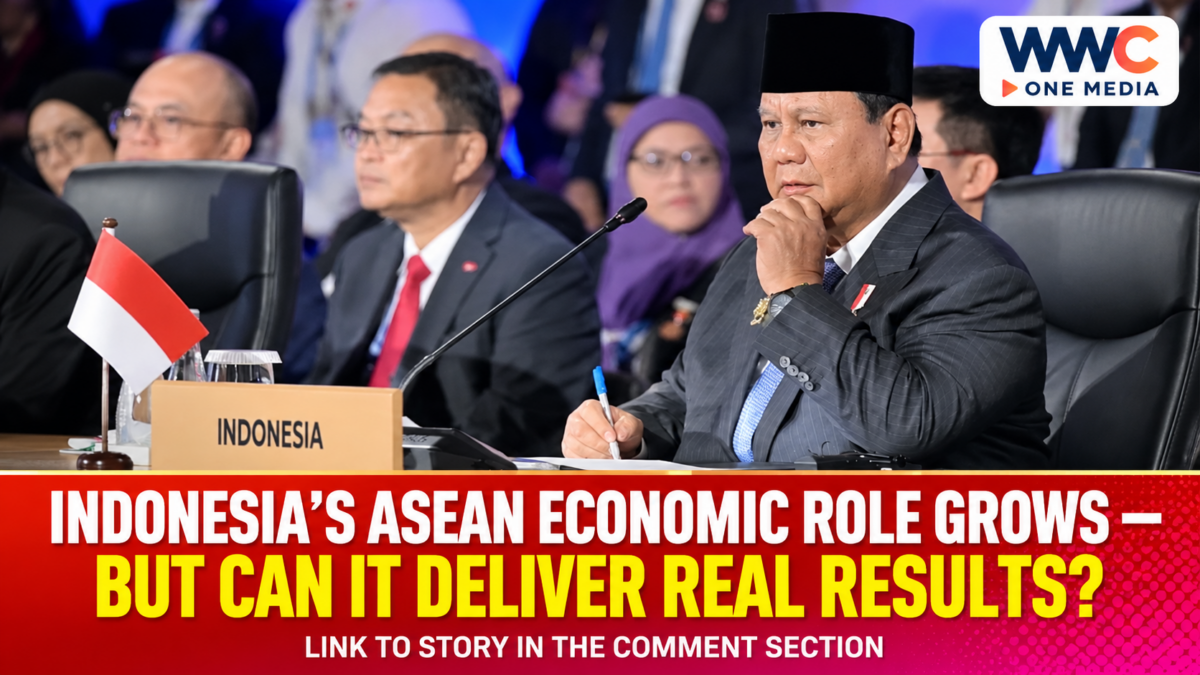
MANILA, Philippines — Indonesia’s ASEAN economic role is under renewed scrutiny after regional leaders completed the 49th ASEAN Summit in Manila on Nov. 17, 2026. The meetings came as Southeast Asian governments began implementing the ASEAN Economic Community Strategic Plan 2026–2030, with trade resilience, digitalisation and investment among its priorities.
The question for Jakarta is practical: can regional cooperation make it easier for businesses to sell, invest and receive payments across borders? Official ASEAN and central-bank records offer evidence of progress, but they also show why announced policies should not be confused with completed commercial results.
ASEAN economic role comes with a regional implementation test
The ASEAN Economic Community’s new five-year strategy contains six strategic goals, 44 objectives and 192 measures. It seeks deeper market integration while addressing sustainability, technological change and uneven access to economic opportunities.
Indonesia is part of that collective programme, not its sole decision-maker. The plan’s success requires action by multiple governments, regulators and commercial participants. A regional objective becomes useful to a small exporter only when the rules, logistics and services needed to trade are actually working.
ASEAN’s economic ministers reported in September that the region grew by 4.9% in 2025 and projected growth of 4.5% for 2026. Those numbers describe the region’s aggregate outlook; they are not proof that any one government’s summit proposals caused the expansion.
Economic weight may help Jakarta champion cooperation, but results depend on participation across ASEAN.
Digital payments show what practical cooperation looks like
A working example comes from Bank Indonesia’s cross-border QRIS programme. Its published service information describes payment links involving Thailand, Malaysia and Singapore, alongside an outbound arrangement involving Japan.
The system allows participating Indonesian travellers to use domestic payment applications at compatible merchants abroad. Eligible foreign visitors can also make QR payments at participating Indonesian businesses, subject to their payment provider’s capabilities.
These arrangements are more concrete than a general promise to improve connectivity: users can make specified transactions through linked payment systems. They may benefit small merchants and tourists, although that does not establish that every merchant is connected or that every transaction is cheaper.
Bank Indonesia has also signed a cooperation memorandum with the central bank of Timor-Leste covering payments and digital financial innovation. The September 2026 announcement described exploration of cross-border QRIS connectivity, rather than confirmation that a new bilateral service was already operating.
This payment agenda complements the wider investment relationship examined in WWC ONE MEDIA’s coverage of Singapore–Indonesia cooperation. Payment access and investment projects are different tools, but both depend on follow-through after diplomatic announcements.
ASEAN investment growth raises a harder question
An ASEAN investment update published in November reported that the region attracted US$245.7 billion in foreign direct investment in 2025, up 10.1% from 2024. It also recorded nominal regional output of US$4.3 trillion and merchandise trade of US$4.4 trillion.
Those are substantial regional totals. Yet the same official update noted uneven performance among member states in governance, workforce readiness and institutional capacity. It also identified improvements in Indonesia’s investment administration, including its Online Single Submission system and monitoring arrangements.
For investors, administrative reform can matter as much as a high-level declaration. Faster, clearer approvals may reduce uncertainty, but the existence of a new procedure does not by itself prove that a project has received financing or begun operations.
This is why trade and investment announcements should be judged alongside actual market access. WWC’s report on unfinished ASEAN–EU trade agreements provides a separate illustration of the gap between commercial interest and concluded arrangements.
What the Manila summit added to the economic agenda
ASEAN’s November summit documentation includes declarations addressing artificial intelligence for micro, small and medium enterprises, strategic trade management and critical minerals. Their publication establishes that these subjects were formally placed on the bloc’s collective agenda.
The meeting followed the ASEAN Economic Community Council’s Nov. 14 review of supply-chain security, the Philippines’ priority economic deliverables and implementation of the 2026–2030 plan. Digital transformation and sustainability were also part of the council’s discussions.
For Indonesia, potential economic value lies in helping turn these collective priorities into workable regional arrangements. Digital standards, predictable trade procedures and coordinated investment rules could lower friction for firms that operate across several ASEAN markets.
But a declaration alone cannot verify an increase in factory output, a new investment disbursement or a fall in household prices. Such claims require project records and subsequent data, not simply summit language.
Indonesia’s wider connectivity priorities also connect with WWC’s separate examination of the ASEAN–India maritime proposal involving Sabang. That proposal remains distinct from ASEAN’s already established payment infrastructure and economic strategy.
Why the Philippines has a stake in Indonesia’s progress
Regional integration is not an abstract issue for Philippine companies. A business that buys materials from one ASEAN country, processes goods in another and sells elsewhere benefits when payment arrangements, customs procedures and investment rules are predictable.
Countries compete for manufacturing and digital investment while benefiting from shared standards and reliable supply chains.
WWC’s report on Philippine renewable-energy targets examines a related implementation question: whether stated policy ambitions turn into projects. That same distinction applies to cross-border energy and industrial cooperation.
WWC analysis: Indonesia’s strongest contribution may be to help standardise the systems businesses use rather than seek credit for every regional announcement. Progress should be assessed through accessible payment services, functioning trade procedures, transparent approvals and evidence of projects reaching operation.
What happens next
ASEAN’s next chairmanship will pass to Singapore on Jan. 1, 2027, under the theme “Deeper Integration, Wider Partnerships”. That provides a new political setting for assessing continuity in the economic programme launched for 2026–2030.
The next meaningful indicators will be implementation reports, updated cross-border payment coverage, investment figures and official accounts of which summit commitments have moved into operation. As of Nov. 22, 2026, the records support a story of genuine economic cooperation alongside significant unfinished work—not a guarantee of a regional breakthrough.
Frequently Asked Questions
What is Indonesia’s ASEAN economic role?
Indonesia participates in regional decisions on trade, investment, payments and economic integration. Its contribution must be assessed within ASEAN’s collective decision-making framework.
What is the ASEAN Economic Community Strategic Plan 2026–2030?
It is ASEAN’s five-year economic roadmap, organised around six goals, 44 objectives and 192 strategic measures to deepen integration and strengthen resilience.
Can Indonesian QR payments work in other countries?
Yes, through participating applications and compatible cross-border QR payment arrangements. Bank Indonesia lists Thailand, Malaysia and Singapore among its partner markets, with Japan outbound connectivity also described.
Did the Manila summit guarantee new investments or cheaper goods?
No. The declarations and planning records establish policy commitments, not guaranteed investment disbursements or consumer-price outcomes.
What should businesses watch in 2027?
Businesses should look for published implementation milestones, expanded service coverage, regulatory changes and verified trade and investment results as Singapore assumes the ASEAN chairmanship.