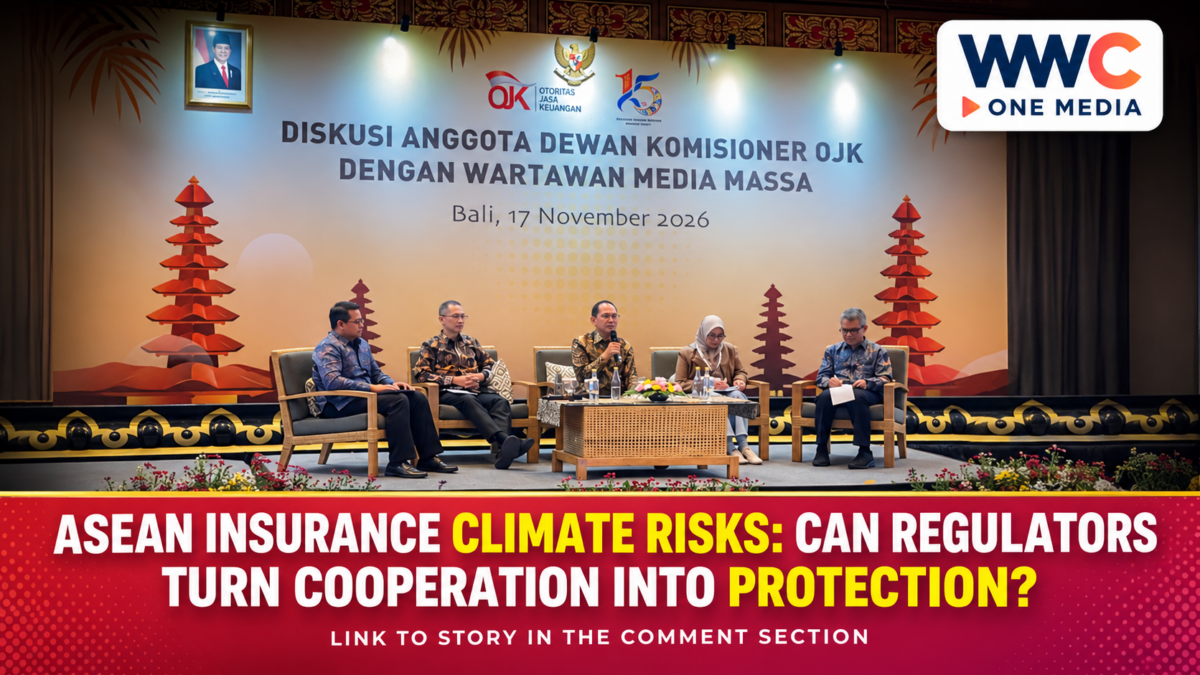
BALI, Indonesia — Nov. 22, 2026. Indonesia’s Financial Services Authority (OJK) brought ASEAN insurance regulators and industry representatives together for regional meetings in November, placing the resilience of insurance systems back on the regional agenda. The discussions came weeks after OJK launched a domestic sustainable-finance roadmap covering insurance, guarantee institutions and pension funds through 2030.
The important question is not whether policymakers recognise the risks. It is whether regional cooperation and national supervision can help insurers remain reliable when disasters become costly and financial services move increasingly online. There is a difference between a shared agenda and a rule that changes what happens when somebody files a claim.
ASEAN Insurance Climate Risks Meet a National Roadmap
On Oct. 29, OJK unveiled its Sustainable Finance Development Roadmap for the insurance, guarantee and pension-fund sector, covering 2026–2030. Its stated direction is to improve sustainability-risk management, business resilience and the sector’s contribution to sustainable economic development.
The roadmap is an Indonesian national programme, not a uniform ASEAN insurance code. That distinction matters. A regional meeting can create opportunities to compare supervisory approaches, but a national regulator must still determine how its own industry should act within its legal framework.
OJK described insurers and related institutions as both long-term investors and absorbers of risk. That dual role makes climate exposure complicated: financial institutions must examine what they insure while also assessing the investments that help support their obligations to customers.
From Climate Commitments to Practical Supervision
OJK’s roadmap sets out four pillars: stronger sustainable-finance regulation and development, more capable personnel, cross-sector collaboration, and strengthened supervision of implementation. These pillars suggest that climate resilience is not merely an exercise in public commitments.
An insurer exposed to major weather-related losses may need to consider the concentration of risks, the adequacy of its financial resources and the availability of reinsurance. These are examples of the practical questions that supervisors could examine; the roadmap itself should not be read as announcing a new ASEAN-wide capital requirement.
The wider Philippine context reinforces the importance of maintaining claims capacity after severe weather. WWC’s earlier report on storm damage and its economic consequences provides a separate illustration of the pressures that disasters can place on households and businesses. It is not evidence that any specific ASEAN insurance arrangement has already solved those pressures.
Digital Transformation Creates a Second Test
Digital distribution may make insurance easier to discover, compare and purchase. It can also make responsibility harder to understand if marketing, payment collection, policy administration and customer support occur through different providers or across national borders.
For regulators, the central questions should be concrete. Can a customer identify the licensed insurer? Are exclusions and claims conditions understandable? Who handles a complaint if a digital intermediary becomes unresponsive? How will personal information remain protected as technology changes?
These are issues for supervisory design and consumer education rather than proof that digital insurance is inherently unsafe. Regional dialogue may help authorities share approaches, but it should not be confused with the launch of a single ASEAN insurance licence, common claims portal or automatically transferable policy.
Why Insurer Resilience Matters Beyond Climate
Insurance is valuable only when a promise on paper can be supported by a functioning institution. Financial strain, poor governance or unclear policy conditions can weaken public confidence even without a natural disaster.
WWC’s coverage of US insurers facing policyholder concerns concerns a different market, but it shows why assessing the strength of institutions is separate from promoting the availability of products. A customer needs to understand both what is covered and the institution responsible for honouring it.
Competition also matters. An expanding insurer may want to serve new customers or commercial markets, but growth plans are not a substitute for resilient underwriting and capital management. WWC previously examined an Indonesian insurer’s expansion ambitions; that company-specific commercial story should not be mistaken for an ASEAN regulatory outcome.
Indonesia’s Timetable Offers a Measure of Progress
OJK’s roadmap divides implementation into three stages. It calls for strengthening foundations during 2026–2027, increasing collaboration during 2028–2029, and accelerating growth alongside stronger supervision in 2030.
This timetable offers a more useful basis for evaluating Indonesia’s work than the mere occurrence of regional conferences. An editor, policyholder or insurer can ask whether the regulator later publishes identifiable supervisory measures, industry guidance, relevant training programmes or evidence of implementation.
The roadmap also emphasises prudence, the relationship between investment risks and returns, liquidity and the interests of policyholders. These considerations belong together. A transition strategy would be incomplete if it encouraged new investments while neglecting the ability to meet existing obligations.
For the Philippines, the analytical lesson is straightforward: policy cooperation is potentially valuable, but no cross-border consumer benefit should be assumed without a definite rule, operational mechanism or published supervisory action. That is a test for future disclosures, not a claim about changes already in force.
What Happens Next
The next meaningful developments would be published decisions that specify who is responsible, what institutions must do, and when the changes take effect. A common reporting approach, supervisory guidance or enforceable consumer safeguard would provide firmer evidence of progress than a broad statement of shared intentions.
Until such steps are documented, the Bali meetings should be viewed as regulatory coordination, while Indonesia’s 2026–2030 roadmap remains a national programme with its own timetable. Neither should be presented as a guarantee of lower premiums, universal disaster coverage or quicker claim payouts.
Frequently Asked Questions
What are ASEAN insurance climate risks?
They are risks that climate-related events and economic changes may create for insurers, customers and the financial resources supporting insurance promises. Managing them can involve underwriting, investment decisions and supervision.
Did the Bali meetings create a single ASEAN insurance policy?
No such single regional policy is established by the official records reviewed for this update. Insurance obligations must be assessed under the applicable national framework and the actual contract.
What is OJK’s 2026–2030 sustainable-finance roadmap?
It is Indonesia’s plan for strengthening sustainable-finance practices in insurance, guarantee institutions and pension funds. It outlines four strategic pillars and a phased implementation timetable through 2030.
Will digital insurance automatically make claims faster?
Not necessarily. Digital tools may improve processes, but actual claims handling depends on policy conditions, insurer capabilities and the applicable requirements. The reviewed records do not promise a particular payout time.
What should readers watch for in 2027?
Look for specific supervisory guidance, implementation milestones and consumer-protection changes rather than assuming that regional discussions have already changed insurance contracts.