
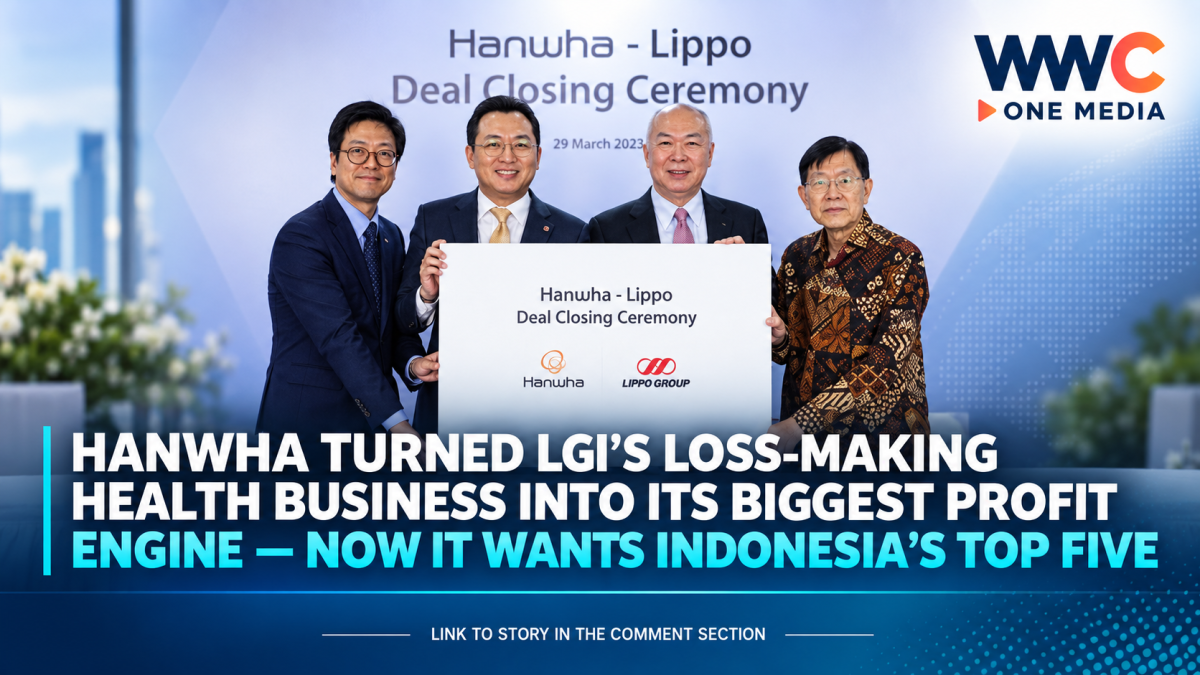
JAKARTA/SEOUL — South Korea’s Hanwha is trying to turn an Indonesian insurer it acquired three years ago into one of the country’s five biggest general-insurance players — and its first major proof point is a business line that used to lose money.
Lippo General Insurance, or LGI, is aiming to break into Indonesia’s top five general insurers within three to five years, President Director Agus Benjamin told The Korea Herald.
LGI ranked ninth among 69 general insurers in 2025, with roughly 3.5% market share, according to figures cited by the newspaper. Gross written premiums reached a record Rp4 trillion, or about US$226 million.
But Benjamin says simply becoming bigger is not the objective.
The company is trying to expand without abandoning the profitability discipline introduced after Hanwha took control — a strategy that has already transformed LGI’s health-insurance operation from a drag on earnings into its largest profit contributor.
That makes the next stage much more ambitious.
LGI now wants to push deeper into industrial property, marine cargo, cyber insurance, directors-and-officers liability, trade credit and eventually mass-market retail coverage, while using Hanwha’s growing Indonesian banking, life-insurance, securities and asset-management network to find customers.
The bigger question is whether a turnaround built on tighter underwriting can survive a rapid expansion into much larger and more complex risks.
Hanwha’s Indonesian insurance bet began in 2023
Hanwha entered LGI in 2023.
At the time, Hanwha Life Indonesia and Hanwha General Insurance jointly acquired 62.6% of Lippo General Insurance. Hanwha Life took 47.7%, while Hanwha General initially held 14.9%.
The transaction gave the Korean financial group an immediate foothold in Indonesia’s non-life insurance sector alongside Hanwha Life’s existing life-insurance business.
Then the structure changed again.
In December 2025, Hanwha General Insurance bought a 46.6% stake from Hanwha Life Indonesia, raising its direct ownership of LGI to 61.5% and making the Indonesian company its consolidated subsidiary. The shares cost Hanwha General about 82.3 billion won.
That internal transfer was more than an accounting change.
It placed LGI directly under Hanwha’s Korean general-insurance specialist, giving it access to underwriting expertise in areas such as industrial property and marine coverage.
The health business went from problem to profit engine
When Hanwha arrived, one of LGI’s priorities was fixing health insurance.
Benjamin said management focused on premium pricing, renewals, claims controls and portfolio selection rather than simply chasing sales.
The effect was significant.
In 2025, LGI’s health-insurance operation generated Rp292 billion in insurance-service profit, making it the company’s largest profit contributor. That profit helped offset losses in some other insurance lines.
LGI recorded overall insurance-service profit of Rp121 billion and pretax profit of Rp169 billion for the year.
Its bottom-line numbers also improved sharply.
The company says 2025 gross written premiums reached Rp3.97 trillion, up 17.41%, while net profit surged 125.69% to Rp144.73 billion.
That growth stands out against Indonesia’s wider general-insurance industry.
The Indonesian General Insurance Association, or AAUI, said industry gross premiums in 2025 reached about Rp112.81 trillion, up 4.8% year over year.
LGI therefore grew its gross written premiums considerably faster than the overall market last year, although company and industry figures are not perfectly identical accounting measures.
The turnaround has continued into 2026
LGI says the momentum did not stop at year-end.
In the first half of 2026, the insurer reported revenue growth of 17.5% under IFRS 4 and 33.9% under IFRS 17, while pretax profit rose 17% and 10.2%, respectively, from a year earlier.
Its capital position has strengthened as well.
LGI reported a 304% risk-based capital ratio at the end of 2025, well above Indonesia’s regulatory minimum.
Independent rating agencies have also upgraded or reaffirmed the insurer.
AM Best in August maintained LGI’s A- Financial Strength Rating, with a stable outlook, saying its balance-sheet strength remained strong and noting support from Hanwha Life and Hanwha General Insurance.
Then in September, Fitch upgraded LGI’s Indonesian National Insurer Financial Strength Rating to AAA(idn) from AA+(idn), also with a stable outlook.
Those ratings do not guarantee future earnings, but they strengthen LGI’s position as it pursues bigger commercial accounts.
Now Hanwha wants LGI insuring power plants and steel mills
The next stage moves well beyond health insurance.
Before the Hanwha acquisition, LGI’s property business was heavily connected to conventional risks within the Lippo Group ecosystem — including shopping centres, residential buildings and hospitals.
It is now moving into much larger industrial exposures such as power plants, chemical facilities and steel mills.
Those policies can generate substantial premiums.
They also carry much larger potential losses.
Benjamin said the company therefore wants to expand selectively rather than simply accumulate as many industrial risks as possible.
That approach reflects one of the central lessons of the health-insurance turnaround: premium volume alone does not make an insurance business profitable.
Pricing, claims, reinsurance and risk selection matter just as much.
Cyber, marine and executive liability are next
LGI also sees opportunities in specialty insurance.
The company plans to broaden products including:
- directors-and-officers liability insurance, which protects executives against certain claims arising from their management decisions;
- cyber insurance, covering specified losses related to cyberattacks and data incidents;
- marine cargo insurance, used by companies moving goods through domestic and international supply chains; and
- trade-credit insurance, which can protect companies when commercial customers fail to pay eligible debts.
For trade credit, LGI plans to cooperate with global credit insurer Coface, initially targeting Korean businesses operating in Indonesia.
That strategy gives Hanwha another potential advantage.
South Korean manufacturers, suppliers and other companies already operating in Indonesia may be more receptive to an insurer backed by a major Korean financial group.
Hanwha is building an entire financial network around LGI
Insurance is only one part of Hanwha’s Indonesian expansion.
Its network now extends across banking, life insurance, general insurance, securities and asset management.
LGI intends to use those connections to distribute more products.
One example is Nobu Bank, where Hanwha Life became a strategic investor. LGI is looking to expand bancassurance through the lender — effectively using bank relationships and distribution channels to sell insurance products.
The insurer is also examining cross-selling opportunities with Hanwha Life Indonesia and financial businesses associated with Ciptadana.
Benjamin said the objective is broader than simply pushing more policies.
The idea is to give customers access to several financial services through the same group network.
That model is common among large Asian financial conglomerates because distribution can be one of the most expensive and difficult parts of growing an insurance business.
Owning or partnering with banks and other financial companies can lower that barrier.
Indonesia’s underinsured consumers may be the bigger prize
Corporate customers are only the first phase.
LGI is also preparing for a longer-term push into individual and retail insurance.
Indonesia’s size makes the opportunity obvious.
The country has more than 280 million people, yet general-insurance penetration remains low relative to many mature economies. The Korea Herald cited penetration of only around 0.5% of GDP.
Benjamin said LGI’s consumer business remains at an early stage and will be built gradually, initially with middle- and upper-middle-income households among the potential customer groups.
The company does not yet want to lock itself into one particular retail product.
Instead, it plans to build distribution, products and its customer base according to where demand develops.
That caution is understandable.
Retail insurance can produce enormous scale, but it also requires different marketing, digital systems, claims handling and distribution economics from corporate insurance.
Indonesia’s insurance market is growing — but competition is intense
LGI’s top-five goal will not be easy.
Indonesia’s general-insurance sector remains fragmented, with dozens of competitors and no single company holding an overwhelming share.
AAUI data show industry premiums grew 4.8% in 2025 to Rp112.81 trillion. Property insurance was the largest segment, while motor and credit insurance were also major contributors.
The market also experienced contrasting performance across product categories.
Property and credit premiums expanded, while motor insurance contracted, demonstrating why insurers need diversified portfolios rather than depending on a single business line.
For LGI, reaching the top five from ninth place therefore requires more than organic market growth.
It must gain share from competitors while preserving the underwriting discipline that produced its turnaround.
Hanwha has already moved LGI dramatically up the ladder
There is evidence that LGI has already increased its relevance within Indonesia.
When Hanwha announced its initial acquisition in 2023, it described LGI as the 14th-largest Indonesian non-life insurer, based on the earlier industry data available to it.
The Korea Herald now places the company ninth for 2025.
Rankings can vary depending on the premium metric, company classification and reporting period used, so those two positions should not be treated as a perfect like-for-like comparison.
Still, the broader direction is clear: LGI has expanded materially since Hanwha entered.
One overlooked advantage: LGI now has stronger ratings
Large industrial companies care deeply about the financial capacity of the insurer promising to cover them.
A factory owner may be willing to buy a small policy from a lesser-known provider.
Insuring a power plant or chemical complex is different.
Customers, brokers and reinsurers want confidence that an insurer has the capital and claims-paying ability to survive large losses.
That makes LGI’s recent ratings strategically important.
AM Best’s A- rating reflects what the agency calls strong balance-sheet strength, while Fitch’s AAA(idn) rating represents the highest category on Fitch’s Indonesian national scale.
The ratings are not equivalent — they use different scales — but both add credibility as LGI pursues larger commercial risks.
The bigger test is whether growth stays profitable
Insurance companies can grow quickly by cutting prices.
They can also discover years later that those premiums were far too cheap to cover the claims they promised to pay.
That is why Benjamin’s repeated emphasis on profitability matters.
LGI says its health turnaround came from stricter pricing, renewal management, claims controls and portfolio selection.
Those same disciplines become even more important when moving into power stations, chemical plants, cyber liability and marine cargo.
The risks are larger.
The losses can be more complex.
And climate disasters, cyberattacks and supply-chain disruptions can create claims across many policyholders simultaneously.
Hanwha’s international risk-management expertise may therefore become as important as its capital

Leave a Reply