
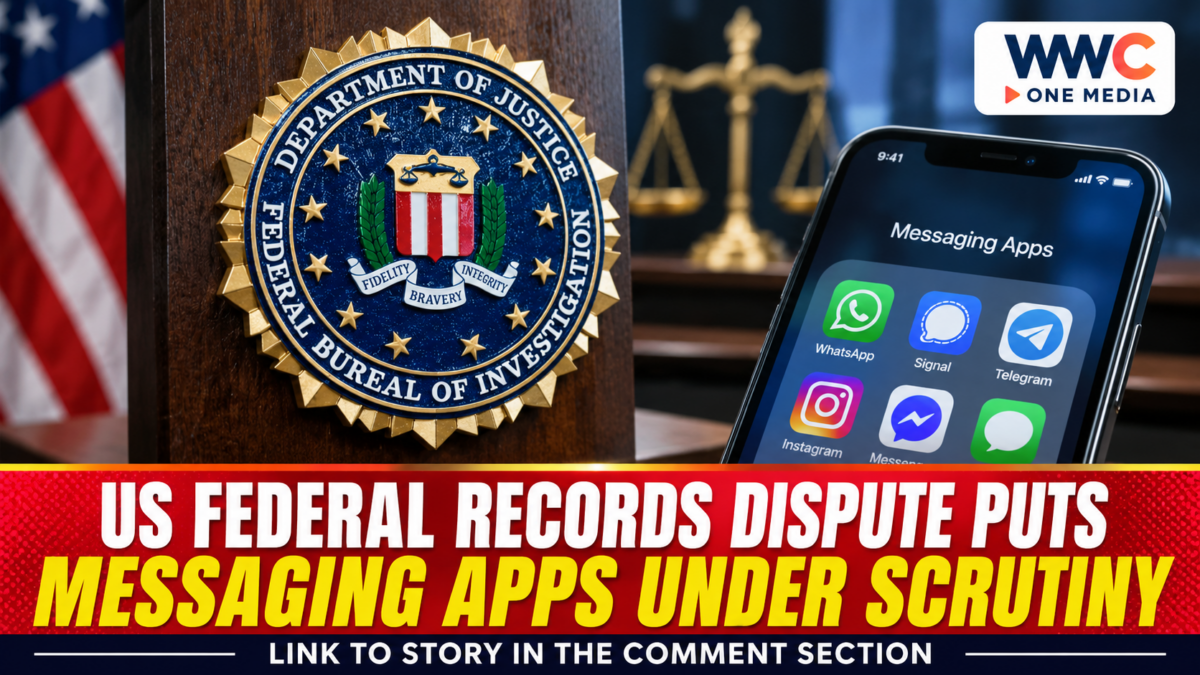
WASHINGTON, November 22, 2026 — Five US government agencies have been asked to preserve official communications exchanged through third-party messaging applications as a congressional inquiry examines whether government records may have been improperly deleted.
The requests were issued by Representative Jamie Raskin, Ranking Member of the House Judiciary Committee, in letters dated November 19 and made public on November 20, addressed to the Department of Justice, Federal Bureau of Investigation, Department of Homeland Security, Immigration and Customs Enforcement, and Bureau of Prisons. U.S. House Judiciary Committee Democrats+5
The development highlights a significant issue in digital government: communications conducted through private or commercial applications can still become official government records when they document agency business.
The immediate concern is not simply which messaging platform federal employees use. It is whether government decisions, instructions and other important communications remain available for lawful preservation, oversight and public accountability.
1. Five Agencies Face a Congressional Records Preservation Request
Raskin’s letters ask five agency heads to preserve communications involving official government business, including messages created through applications that are not operated by the government.
The agencies receiving the requests are the DOJ, FBI, DHS, ICE and BOP.
The letters cover communications stored on both government-issued and personal devices when those devices are used for official agency business.
They also request inquiries into potentially deleted records and steps to recover available information, including backups and associated metadata. U.S. House Judiciary Committee Democrats+4
Raskin asked the five agencies to provide compliance certifications by 5 p.m. on December 3, 2026.
The requested responses are intended to explain what steps the agencies have taken to preserve records, identify potentially missing communications and prevent future recordkeeping problems. U.S. House Judiciary Committee Democrats+1
Importantly, these letters represent a congressional oversight demand. They do not establish that all five agencies have independently opened formal investigations or that every employee targeted by the requests has violated federal law.
2. Why Signal Messages Became Part of the Dispute
One particular communication is highlighted in the documents.
Raskin’s letter to Attorney General Todd W. Blanche identifies an alleged Signal conversation involving Samuel Ramer, identified in the document as FBI General Counsel, and Drew Lynch, described as an associate of Donald Trump Jr.
The letter describes the conversation as concerning a potential or ongoing investigation involving an individual wanted by federal authorities on healthcare fraud and related charges.
It also states that the attached exchange appeared to show messages configured to disappear automatically after one week. U.S. House Judiciary Committee Democrats+1
These details are allegations and representations contained in the congressional letter, not independent findings of criminal wrongdoing.
The significance of the exchange lies in the recordkeeping question it raises.
If communications document government decisions, investigative activities or official responsibilities, their preservation may be required regardless of whether employees exchanged them through email, text messages or a commercial messaging platform.
The concern becomes more serious when automatic deletion settings prevent records from being captured before they disappear.
However, the existence of an automatic deletion setting alone does not establish that a particular message was unlawfully destroyed. Its status depends on the content, applicable retention requirements and whether the communication was properly preserved.
3. What the Federal Records Act Says About Messaging Apps
The National Archives and Records Administration addressed this issue directly in its May 2, 2025 memorandum, AC 23.2025, which covers recordkeeping requirements for third-party messaging applications such as Signal and WhatsApp.
The memorandum explains that federal employees may conduct official business through third-party messaging applications, but the communications remain subject to federal records requirements.
It also explains that employees using personal accounts for official business must either copy their official account when creating or sending the message or forward a complete copy to an official account within 20 days. National Archives
The rules also distinguish between records that must be retained and temporary communications that may be eligible for disposal.
For agencies following General Records Schedule 6.1, the memorandum identifies permanent retention for Capstone officials and retention periods of three to seven years for non-Capstone officials, depending on the agency’s implementation.
Other approved records schedules may apply where an agency has not adopted that schedule. National Archives
This distinction is important because not every message exchanged by a government employee automatically requires permanent storage.
Routine scheduling messages, reminders and certain administrative communications may qualify as temporary records. Messages documenting agency decisions, policies, commitments or legal obligations may require different treatment.
The National Archives also warns that automatic deletion functions can create recordkeeping violations if they prevent employees from identifying and preserving messages that qualify as federal records. National Archives
4. Earlier Pentagon Findings Show the Issue Is Not New
The latest congressional requests come after an earlier Department of Defense Inspector General review examined the use of commercial messaging applications for official government business.
In a December 2, 2025 report, identified as DODIG-2026-022, the Inspector General made six recommendations concerning the use of messaging services not controlled by the Department of Defense.
The recommendations included developing government-controlled communication capabilities, improving training for senior officials, clarifying waiver procedures and assessing how extensively personnel were using non-DoD-controlled messaging systems. oversight.gov+4
The report’s recommendations also addressed the need for systems that can support operational communication while meeting information security and official-record preservation requirements.
A separate evaluation, DODIG-2026-021, examined the reported use of Signal by the Secretary of Defense and other personnel, including compliance with classification and records-retention requirements. oversight.gov
These earlier evaluations demonstrate that the challenge involves more than one messaging platform or one government department.
Federal institutions must balance communication flexibility with the need to maintain secure, accessible and properly managed official records.
5. Why Government Messaging Practices Matter Beyond Washington
The issue has wider relevance as governments increasingly depend on digital platforms to manage internal operations, communicate with employees and deliver public services.
The Philippines is also expanding its use of digital government systems, making cybersecurity, information management and institutional accountability important considerations.
WWC previously examined Cebu’s three-year digitalisation roadmap and its proposed cybersecurity safeguards, which highlights the importance of access controls, encryption, backups and employee responsibilities.
The country’s experience with digital security also deserves attention in light of reported data breach notifications involving 10 Philippine government agencies.
Separately, questions surrounding government technology contracts and digital public services demonstrate why reliable documentation and transparent institutional processes matter when public agencies depend on technology.
These Philippine developments are separate from the US congressional inquiry, but they illustrate a shared governance challenge: digital transformation requires more than adopting new applications.
Public institutions must also establish clear rules on who can access information, how communications are stored, how long records are retained and how missing information can be recovered.
For citizens, proper recordkeeping helps ensure that government decisions can be examined even when the original discussions take place through digital channels.
What Happens Next
The immediate deadline identified in Raskin’s letters is December 3, 2026.
The five agencies have been asked to certify their compliance and describe the measures taken to preserve relevant records, examine potentially deleted communications and prevent future problems.
The next significant development will be whether the agencies provide the requested information and whether their responses identify any records that require recovery.
As of November 22, the congressional documents establish that the preservation requests have been issued. They do not establish a completed investigation, a final finding of unlawful destruction or criminal charges against the individuals mentioned.
The distinction matters because an allegation, a request for investigation and a formal finding of wrongdoing are separate stages of an accountability process.
Ultimately, the dispute raises a broader question for modern government: when official decisions are made through digital conversations, can institutions guarantee that those records will still exist when the public, investigators or oversight bodies need them?
Frequently Asked Questions
1. Why are five US government agencies being asked to preserve messaging app records?
Representative Jamie Raskin sent preservation requests to five agencies, asking them to protect official communications and examine whether relevant messages may have been improperly deleted.
2. Which US agencies received the letters?
The Department of Justice, FBI, Department of Homeland Security, Immigration and Customs Enforcement, and Bureau of Prisons.
3. Is using Signal for government business illegal?
Not automatically. The National Archives permits official business through third-party messaging applications, provided applicable federal records requirements are followed.
4. What is the December 3, 2026 deadline?
It is the requested deadline for the five agency heads to certify compliance and describe their preservation and investigation measures.
5. Does the congressional inquiry prove that FBI officials committed a crime?
No. The letters contain allegations and request further action. They do not constitute a criminal conviction or final determination of wrongdoing.










