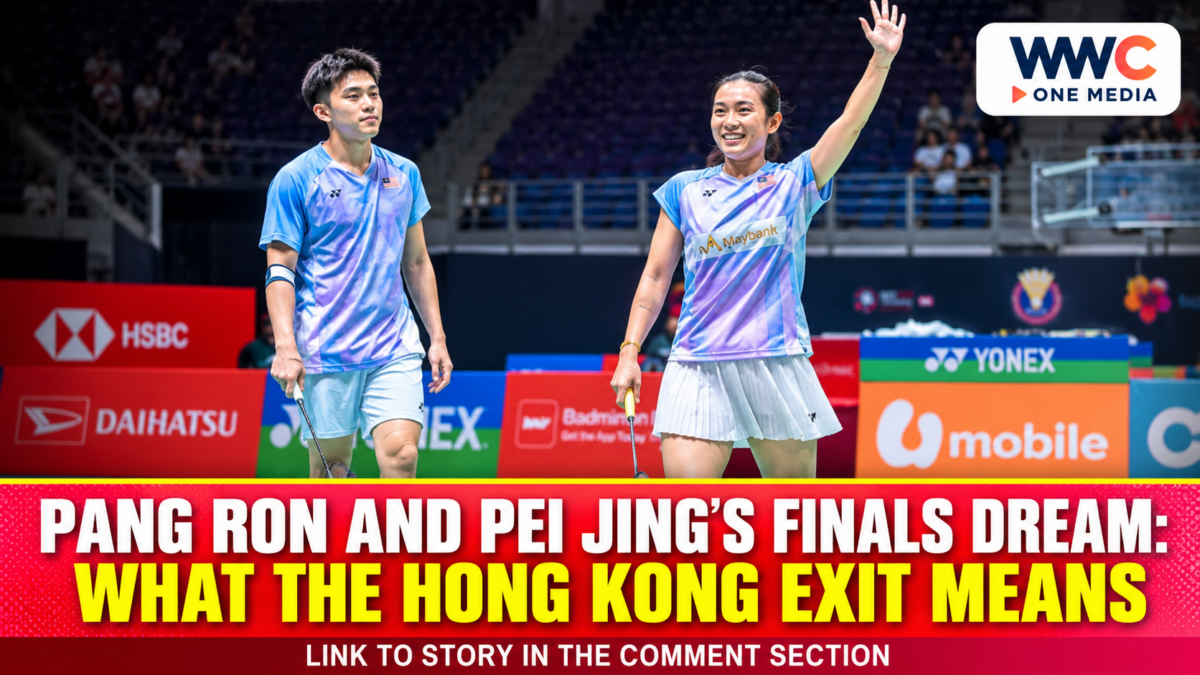
HONG KONG — Malaysian mixed doubles pair Hoo Pang Ron and Lai Pei Jing exited the Hong Kong Open on Nov. 19, 2026, after losing their second-round match against China’s Jiang Zhenbang and Wei Yaxin. The result came during the final stretch of the season’s race for places at the BWF World Tour Finals.
The defeat closed one tournament opportunity for the Malaysian pair, but the wider significance lies in how the World Tour qualification system works. A player’s tournament performance, ranking position and eligibility under the Finals rules all affect whether a place in the season-ending competition is secured.
For Pang Ron and Pei Jing, the Hong Kong result highlights the narrow margin between remaining in contention and falling outside the qualification places. It also offers a useful reminder that a successful season cannot be measured by one tournament alone.
Hong Kong Open: The Match That Ended Their Run
The mixed doubles second-round result listing records Jiang Zhenbang and Wei Yaxin defeating Hoo Pang Ron and Lai Pei Jing in three games, 14–21, 21–8, 21–13.
The result sent the Chinese pair through to the next round and ended the Malaysian combination’s campaign in Hong Kong. It was a difficult finish for a pair attempting to make the most of the final opportunities to collect ranking points before the season-ending event.
The result also placed their recent performances in perspective. The pair had remained active across the international circuit, where every tournament offered another chance to earn points and improve their standing.
However, a tournament exit does not automatically explain a player’s final qualification position. That requires the official standings and the applicable BWF eligibility rules to be considered together.
What BWF Finals Qualification Actually Requires
The BWF World Tour Finals are not simply awarded to the winners of individual tournaments. Qualification is determined through the World Tour ranking system and the specific eligibility provisions for the season-ending competition.
The BWF regulations distinguish between the general World Tour competition structure and the additional rules governing the Finals. This means a player’s position in a ranking list should not automatically be treated as confirmation of qualification.
The regulations also matter when several players or pairs from the same badminton association are positioned near the qualification cutoff. The applicable country or member-association limits can affect which entries are eligible.
For readers, the distinction is important: a pair may be close to the top group in a ranking table but still need the official qualification list to confirm its place.
That is why the final BWF standings, rather than an unofficial projection, should be treated as the decisive reference.
Why One Tournament Can Change the Picture
The closing stages of a World Tour season can create pressure for players who are trying to improve their ranking positions.
A strong run can bring valuable points, while an early exit removes the opportunity to add more points at that particular event. When several pairs are competing around the qualification cutoff, even small differences can matter.
This is part of the challenge of international badminton. Players must manage travel, match preparation and recovery while competing against opponents who are also trying to secure their own season targets.
Malaysia has several established names across the international badminton circuit. Readers following the country’s wider campaign can also look at Malaysia’s men’s singles preparations for the Asian Games, which provide another perspective on the demands facing Malaysian players at major competitions.
The mixed doubles race, however, has its own qualification calculations. Results in one discipline cannot be used to predict the final outcome in another.
The Bigger Picture for Malaysian Badminton
The Hong Kong exit should be viewed as one result within a much longer international season.
For a national badminton programme, consistent representation across tournaments is important. Players need opportunities to compete against leading international opponents, gain experience and build ranking points over time.
Malaysia’s badminton coverage has included both established international names and emerging players. The country’s wider competitive environment was also visible at the Kumamoto Masters, where Japanese and international players contested titles across several disciplines. WWC previously examined the tournament’s broader results in its report on Akane Yamaguchi’s Kumamoto Masters victory.
The development of mixed doubles deserves attention because it requires coordination between two players with different roles and responsibilities on court. Results depend on more than individual ranking positions; partnership consistency and the ability to respond to different playing styles are also important.
For Pang Ron and Pei Jing, the next assessment should focus on their confirmed ranking position, tournament entries and plans for the coming season rather than assumptions based on one defeat.
A Competitive Season Is Not Defined by One Result
A missed qualification target, if confirmed, would be disappointing. It would not erase the work required to compete across a demanding international calendar.
Badminton careers are built through repeated tournament participation, adjustments to playing strategy and the ability to respond after setbacks. A pair’s progress should therefore be judged through a wider set of performances rather than one result.
That broader perspective is also relevant to other international players. Singapore’s Loh Kean Yew, for example, has experienced the pressure of high-level knockout competition, as explored in WWC’s coverage of his World Championships campaign against Canada’s Victor Lai.
For Malaysian badminton followers, the important question now is what the official season-end standings show and how the pair responds in the next competitive cycle.
What Happens Next?
The next step is the publication or confirmation of the official BWF World Tour Finals qualification list. That record will establish which mixed doubles pairs have secured places in the season-ending competition.
The Malaysian pair’s next tournament participation should also be checked against official entry information. A tournament appearing on the international calendar does not automatically confirm that a particular player or pair has entered.
The distinction matters for the Malaysian Open scheduled for January 2027. Until an official entry list is available, Pang Ron and Pei Jing’s participation should not be described as confirmed.
For now, the Hong Kong result is a completed tournament outcome. Their final qualification status requires confirmation through the official BWF standings.
Frequently Asked Questions
1. Did Hoo Pang Ron and Lai Pei Jing lose at the 2026 Hong Kong Open?
The tournament results listing records a three-game second-round defeat against China’s Jiang Zhenbang and Wei Yaxin on Nov. 19, 2026.
2. What was the score of the match?
The listed score was 14–21, 21–8, 21–13 in favour of Jiang and Wei.
3. Does losing in the second round automatically end a pair’s BWF Finals qualification chances?
Not necessarily. Qualification depends on the applicable World Tour standings and the official eligibility rules. The final qualification list is needed to establish the outcome.
4. How are places in the BWF World Tour Finals determined?
The competition uses the BWF World Tour ranking and specific qualification provisions. The official regulations and final standings determine which players and pairs are eligible.
5. Is the pair confirmed for the 2027 Malaysian Open?
Their participation should not be treated as confirmed until an official tournament entry list or announcement identifies them.