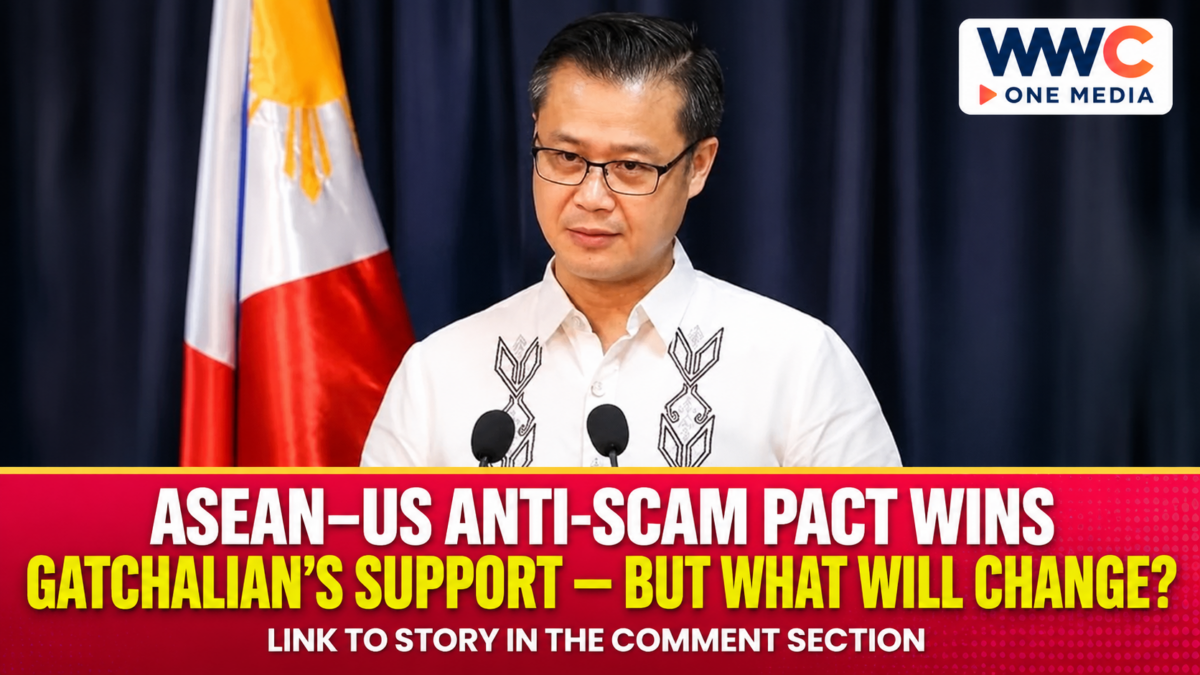
MANILA, Philippines — Senate President Sherwin Gatchalian has welcomed the ASEAN–US anti-scam pact following its adoption at the ASEAN–United States Special Summit in Manila on Nov. 17, 2026. In a statement released on Nov. 19, Gatchalian expressed support for stronger regional cooperation against online fraud while indicating the Senate’s readiness to examine agreements reached during the regional meetings.
The agreement establishes 10 public-private partnership principles covering cross-border investigations, financial monitoring, information sharing and victim protection.
For the Philippines, the important question is no longer simply whether governments recognise online scams as a regional threat. It is whether the new commitments will produce faster coordination among regulators, law-enforcement agencies, banks and technology companies.
Why Gatchalian Supports the ASEAN–US Anti-Scam Pact
Gatchalian connected regional economic cooperation with the need for a safer digital environment.
His Nov. 19 statement welcomed the outcome of the ASEAN–US Special Summit and singled out the adoption of the 10 principles as an important development.
He also referred to his previous legislative work targeting transnational scam hubs, cyber-fraud networks and Philippine offshore gaming operators, or POGOs.
His position reflects a broader economic concern: online fraud does not affect only individual victims. It can also undermine confidence in electronic payments, digital platforms and commercial transactions.
The Senate leader expressed optimism that deeper economic partnerships could support investment, growth and employment, while emphasising the importance of protecting Filipino families from financial exploitation and trafficking.
That distinction matters. Gatchalian expressed support for the regional initiative, but his statement did not announce that a new Philippine law had been passed or that the agreement had already created additional domestic enforcement powers.
What the 10 Principles Actually Cover
The ASEAN–US statement identifies online scams as an issue requiring coordinated attention from governments and businesses.
Its provisions encourage participating countries and relevant industries to pursue cooperation across several areas.
These include treating major scam operations as a regional security concern, improving cooperation in investigations, protecting victims, monitoring suspicious financial activity and sharing threat information.
The framework also promotes public education, stronger regulatory approaches, regional coordination, technology-assisted fraud detection and clearer accountability.
One significant provision encourages information sharing about fraudulent websites, phishing domains and accounts associated with suspicious financial activity.
Another addresses cooperation among banks, financial technology firms and relevant authorities, subject to domestic laws and confidentiality requirements.
The framework does not prescribe a single enforcement system for every participating country.
Instead, it recognises that implementation depends on national legislation, institutional responsibilities and available resources.
That makes the agreement a policy framework rather than an immediate guarantee that online scams will decline.
Why Banks and Technology Platforms Matter
Online scams often involve several stages, from initial contact with a potential victim to movement of funds through financial accounts.
The ASEAN–US principles recognise that different organisations may hold separate pieces of information about suspicious activity.
A digital platform might identify an impersonation account or fraudulent link. A telecommunications provider may detect suspicious communications, while a financial institution may identify unusual payment patterns.
Closer cooperation could help connect these warning signs more quickly.
The agreement encourages financial institutions to review customer-identification and due-diligence procedures and consider appropriate information-sharing arrangements.
However, the provisions expressly preserve relevant legal requirements concerning privacy, confidentiality and data protection.
For consumers, this balance is important. Better fraud detection should not mean unrestricted access to personal banking records or private communications.
The challenge for regulators will be designing practical systems that allow lawful investigations while maintaining safeguards against inappropriate disclosure.
The wider importance of protecting digital information was also examined in WWC ONE MEDIA’s coverage of reported cybersecurity incidents affecting Philippine government agencies.
How the Pact Connects to Philippine Scam Enforcement
The regional framework arrives amid continuing Philippine concerns about cyber-fraud operations and the exploitation of people associated with suspected scam facilities.
Gatchalian previously sought an investigation into online romance scams and the possible use of cryptocurrencies in fraudulent activities.
His February 2025 Senate statement called for cooperation with international partners to identify and prosecute offenders operating across borders.
The new ASEAN–US principles address similar coordination difficulties but do not replace existing investigations or judicial procedures.
They specifically recognise the importance of protecting individuals affected by trafficking and forced criminal activity.
This creates an important distinction between investigating organisers of suspected scam operations and determining the circumstances of people found inside those facilities.
Those individuals should not automatically be treated as offenders without an assessment of the available evidence and applicable law.
WWC ONE MEDIA has separately examined alleged scam operations uncovered in a Pasay facility, illustrating the practical questions investigators face when assessing suspected organised fraud.
The regional agreement provides a common direction for cooperation, but individual criminal cases will still require evidence, lawful investigation and appropriate court proceedings.
What the Agreement Does Not Guarantee
The statement includes an important limitation: its principles are not intended, by themselves, to establish new institutions, staffing requirements or financial commitments.
Participating countries must determine whether additional arrangements or resources are appropriate.
This means the agreement should not be interpreted as the immediate creation of a new ASEAN police authority, a common regional fraud database or a guaranteed compensation fund for victims.
Nor does Gatchalian’s endorsement automatically make every provision enforceable through Philippine legislation.
Different forms of international cooperation may require different domestic procedures, depending on their legal character and existing statutory authority.
The policy also leaves room for countries to build on mechanisms already operating within ASEAN.
That approach may reduce duplication, but it makes transparent implementation especially important.
The broader discussion of digital regulation is reflected in WWC ONE MEDIA’s examination of the ASEAN digital economy agreement, which explores a separate regional initiative affecting electronic commerce and consumer safeguards.
The two initiatives are distinct, although both highlight the importance of trust in cross-border digital activity.
What Happens Next
The next stage will be implementation rather than another declaration of intent.
Philippine authorities and their regional counterparts will need to determine how existing institutions can exchange relevant information, coordinate lawful investigations and support victims.
For banks and technology companies, the practical questions involve reporting procedures, suspicious-account detection, information security and cooperation with regulators.
For lawmakers, the task is to assess whether existing laws provide adequate tools for addressing cross-border scam networks while protecting legitimate users.
Progress should ultimately be measured through documented enforcement cooperation, stronger preventive safeguards and transparent outcomes—not simply through the number of agreements announced.
The ASEAN–US statement establishes shared priorities. Whether those priorities translate into measurable protection for Filipino consumers will depend on the decisions that follow.
Frequently Asked Questions
What is the ASEAN–US anti-scam pact?
It is a statement adopted in Manila on Nov. 17, 2026, setting out 10 public-private partnership principles for cooperation against online scams.
Why did Sherwin Gatchalian support it?
Gatchalian welcomed closer cooperation against cyber-fraud networks and linked consumer protection with a secure environment for investment and economic development.
Does the agreement immediately create new anti-scam laws?
No. The statement recognises the role of existing national laws and requires countries to determine any additional implementation arrangements.
Will banks share customer information across borders?
The principles encourage appropriate cooperation concerning suspicious activity, but any information sharing must comply with applicable privacy, confidentiality and other legal requirements.
Can scam victims automatically recover their money under the pact?
No. The agreement supports cooperation on asset recovery and victim protection, but it does not establish an automatic reimbursement or compensation system.