
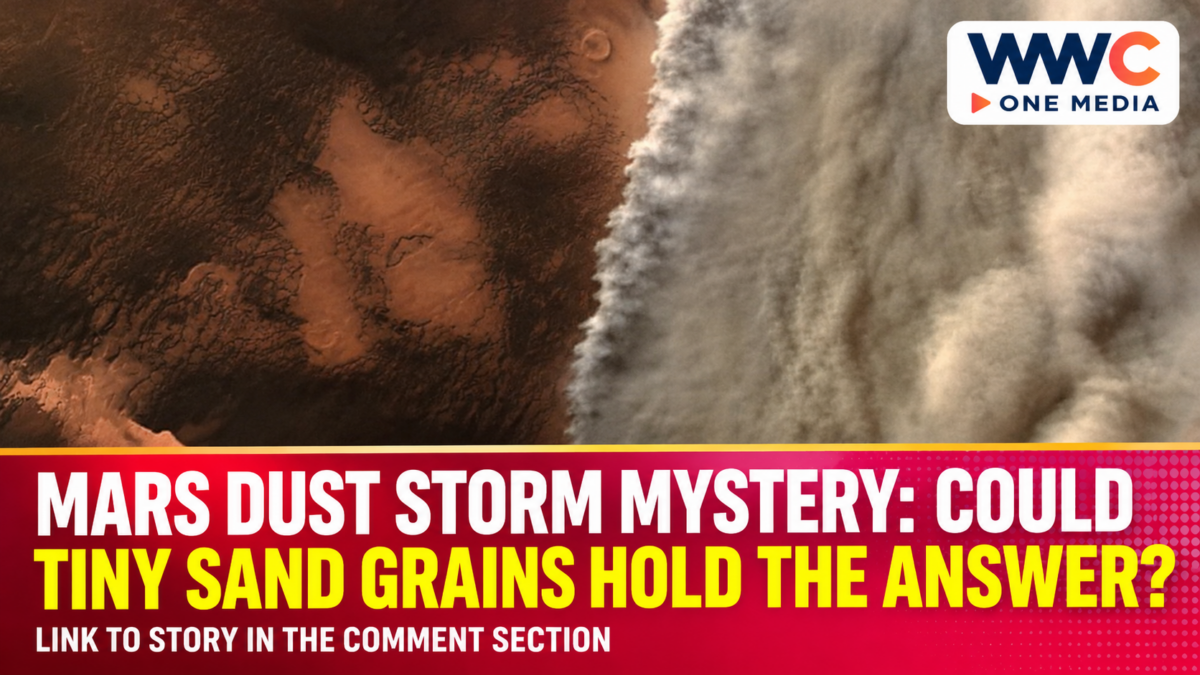
An international research team has identified a possible missing ingredient in understanding Mars dust storms: the uneven distribution of fine dust and larger particles across the planet’s surface. The study, published in Geophysical Research Letters on June 2, 2026, suggests that these differences could help explain why some storms spread around Mars while others do not.
The finding is relevant to future exploration because global dust events can dramatically reduce sunlight reaching solar-powered spacecraft. But the work is a modelling advance, not proof that scientists can now predict when the next planet-encircling storm will begin.
Mars dust storms may depend on the ground beneath them
The researchers — Demetrius Ramette, Lena Noack, Jonathan P. Merrison and Kerstin Schepanski — examined how surface particle sizes influence the release of dust into the atmosphere. Their central question was whether treating Mars as a patchwork of different ground conditions would produce a better explanation than assuming a more uniform surface.
The distinction matters because the amount of dust present does not automatically determine how much becomes airborne. Wind must first overcome forces holding particles on the ground. A surface dominated by very fine dust can behave differently from one containing particles large enough to move and strike the ground.
The paper describes global dust events as occurring in some Martian years but not others. Explaining that variation is difficult because seemingly similar seasonal conditions do not always produce storms of comparable scale.
Why bouncing grains can unlock fine dust
One of the study’s building blocks is saltation: wind-driven particles hop across the surface. When these moving particles land, their impacts can dislodge finer material. That smaller dust can then enter the atmosphere and be carried farther by atmospheric motion.
This produces a counterintuitive possibility. A location covered with abundant fine dust does not necessarily release it easily. The small grains may be held together by cohesive forces, and there may be too few mobile, intermediate-sized particles to disturb them.
The researchers discussed particles around 100 micrometres in diameter as important mobile grains in their Martian framework, while much finer particles — below 10 micrometres — can be lifted after those impacts disrupt the surface. These are model-relevant scales, not a claim that all Martian ground consists of just two particle sizes.
A new map changes the modelling question
Rather than impose one dust-release behaviour everywhere, the team linked dust mobilisation thresholds and emission efficiency to a Dust Cover Index derived from remote-sensing observations. The index helps distinguish surfaces with different amounts of fine material.
The researchers combined that surface information with simplified scenarios of wind stress representing conditions associated with a global dust event and a quieter year. Their calculations examined how much dust could leave the ground under those assumptions.
The model suggested that incorporating geographic variation can help reproduce the contrast between relatively quiet conditions and episodes capable of rapidly increasing atmospheric dust. It also indicated that the threshold separating those outcomes may respond to comparatively small natural changes in wind conditions.
That does not mean one grain starts a planet-wide storm. The proposed mechanism operates through many interactions between surface material and winds, and the study did not demonstrate an operational forecasting system.
Why one storm still matters to space missions
NASA’s Opportunity rover supplies a real example of the risk from extreme Martian dust. NASA records show that the rover stopped communicating during a severe Mars-wide storm in June 2018. Its last signal arrived on June 10, and NASA announced the end of the mission in February 2019 after unsuccessful recovery attempts.
Opportunity had operated for almost 15 years, far beyond its planned lifetime. The storm reduced the sunlight available to its solar panels, illustrating why atmospheric dust can be an engineering concern rather than merely a scientific curiosity.
Understanding these conditions is relevant to the wider programme of planetary exploration. WWC has also covered Japan’s plans to collect samples from the Martian moon Phobos, a different mission whose objectives underscore the varied challenges of working around Mars.
What the results do — and do not — establish
The paper explicitly acknowledges important limits. Its simplified wind-stress scenarios cannot simply be transferred, unchanged, into a fully interactive climate model. The researchers reported that one interactive setup underestimated dust emissions in southern mid-latitudes, leaving simulated atmospheric dust levels below those expected in global events.
They therefore called for better global circulation models, improved measurements of Martian surface particles and experiments using materials resembling Martian soil. They also proposed examining geographic variation together with changes in surface dust over time.
This is a familiar challenge in computational research: a model may reveal a plausible physical mechanism without yet achieving dependable predictions. WWC’s coverage of asteroid deflection modelling similarly examines why promising simulations still need careful validation.
For Philippine readers, the distinction also echoes WWC’s reporting on AI-assisted weather forecasting: better models can improve scientific understanding, but performance must be tested before predictions guide consequential decisions. The Mars study concerns a different atmosphere and should not be treated as a direct forecast for conditions on Earth.
What happens next
The next scientific test is whether more complete Martian climate simulations can reproduce global dust events while representing the different kinds of ground identified in the study. Observations and laboratory measurements will be needed to check whether the assumed dust-release thresholds are realistic.
If that work succeeds, researchers could have a stronger basis for assessing when a regional disturbance might grow into a global event. For now, the most defensible conclusion is that the composition and distribution of Mars’ surface may be as important to the problem as changing winds above it.
Frequently asked questions
What causes Mars dust storms?
Martian winds can move loose particles and lift fine dust. The new study examines how the mix of particle sizes and the geographical distribution of dust may affect whether an event intensifies.
Can sand grains cause a planet-wide storm on Mars?
Moving sand-sized grains can help dislodge finer dust, but the research does not say individual grains independently cause a global storm. Large events arise from interacting surface and atmospheric processes.
Have scientists solved the mystery of Mars dust storms?
Not completely. The 2026 paper proposes a promising mechanism, while identifying modelling biases and additional validation still needed.
Did a Mars dust storm end NASA’s Opportunity mission?
Opportunity lost communication during the 2018 planet-wide storm. NASA made further attempts to restore contact before formally ending the mission in February 2019.










