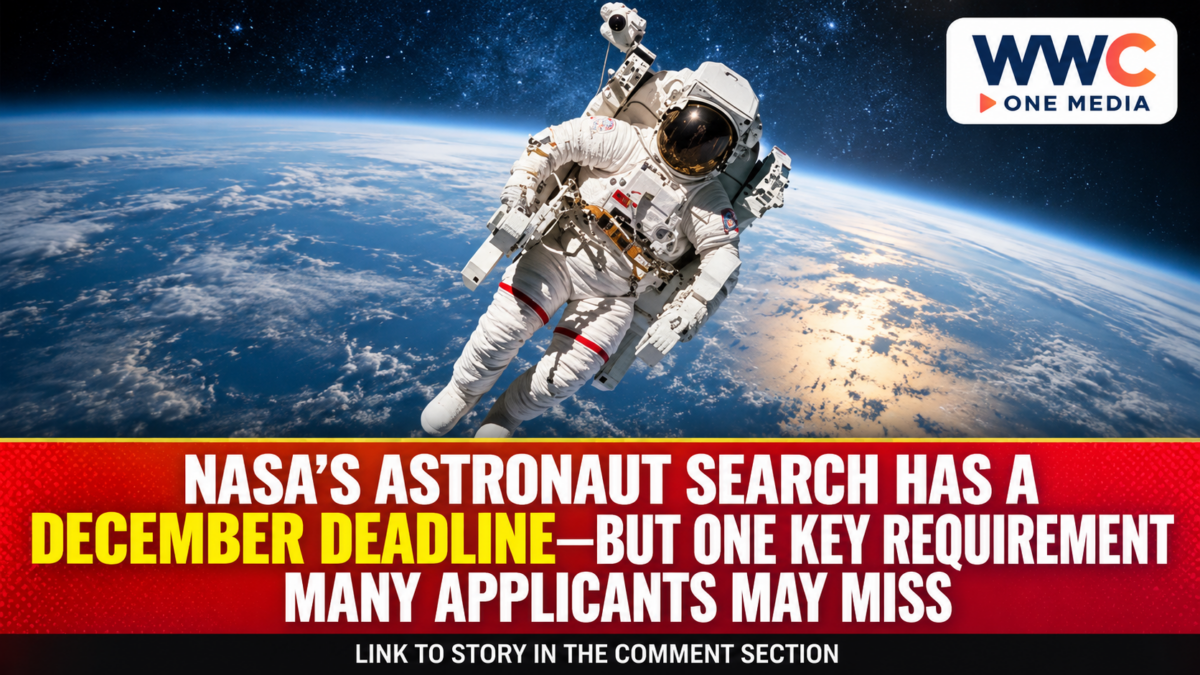
NASA has opened applications for its next astronaut candidate class, giving eligible US citizens until December 3, 2026, to submit their applications. The recruitment drive follows a selection cycle in which more than 8,000 people applied and 10 candidates were chosen in 2025.
The opportunity comes as the agency prepares for a new phase of human space exploration, including missions connected to the Moon and the longer-term goal of sending astronauts to Mars. But the vacancy has a major limitation for international applicants: US citizenship is a basic requirement, alongside specific academic, professional and medical qualifications. NASA+1
For readers in the Philippines, the announcement offers a useful look at the qualifications NASA values in its astronaut corps—and how space science is developing beyond the United States.
NASA astronaut applications are open until December 3
NASA opened the application window on November 7, 2026. Its published selection timeline lists December 3 as the closing date, followed by an application review period running from December 2026 through April 2027.
The agency plans to bring initial interviewees to Johnson Space Center in spring 2027. Final interviews and selection assessments are scheduled for summer, with the next astronaut candidate class expected to be announced in fall 2027. The selected candidates are scheduled to report to Johnson Space Center in winter 2027–2028. NASA
NASA cautions that the schedule is tentative and may change depending on the number of applications. Applicants are expected to receive notification after the selections are announced.
The deadline is therefore only the first stage of a lengthy process. Submitting an application does not guarantee an interview, selection or a future flight assignment.
Who can apply—and what qualifications are required?
The first requirement is nationality. NASA says applicants must be US citizens to be considered for its astronaut corps.
Applicants must also hold a qualifying master’s degree in a STEM field from an accredited institution. NASA identifies engineering, biological science, physical science, computer science and mathematics among the relevant fields. NASA
However, a conventional master’s degree is not the only route. NASA recognises several alternatives, including at least two years of work towards a doctoral programme in a related technical field, certain medical qualifications, and completion of a nationally recognised test-pilot school programme under the stated conditions.
The professional experience requirement is at least three years of related work after completing the qualifying degree. Pilots may meet the experience requirement through specified flight-hour qualifications instead. For example, NASA lists 750 hours of pilot-in-command time in high-performance jet aircraft as one route. NASA+1
Applicants must also pass NASA’s long-duration astronaut flight physical. The agency identifies leadership, teamwork and communication as additional skills expected of candidates. NASA
These standards show why astronaut selection involves more than academic achievement. NASA is recruiting people expected to work in technically demanding environments, operate complex equipment and cooperate closely with other crew members.
Why the previous selection attracted thousands
NASA’s previous application cycle opened in 2024. More than 8,000 applications were received, and the agency selected 10 candidates for its 2025 astronaut class.
NASA introduced the 10 candidates on September 22, 2025, at Johnson Space Center in Houston. The group included military personnel, engineers, scientists and other professionals with technical backgrounds. They were selected through a competitive process and began a training programme expected to last nearly two years. NASA+1
The numbers illustrate how selective the process can be. Ten candidates from a pool of more than 8,000 applications is a small final group, although the figures alone do not explain how many applicants met every minimum qualification or advanced through each stage.
NASA’s selection process includes reviewing applicants’ qualifications and inviting a smaller group for further assessment. Its astronaut recruitment information describes interviews and evaluations at Johnson Space Center before final candidates are selected. NASA
The process is designed to identify people who can meet the demands of astronaut training and future missions—not simply those with the strongest academic credentials on paper.
What the next astronaut class could be preparing for
NASA says its next astronaut candidates will join an agency pursuing human exploration of the Moon, development of a Moon Base and preparations for future crewed missions to Mars.
The agency expects astronauts to train for operations on the lunar surface and work beyond Earth. Its announcement places the recruitment effort within the wider Artemis-era programme and the ambition to establish a more sustained human presence on the Moon. NASA+1
That mission context helps explain the emphasis on technical expertise, medical fitness and teamwork. Astronauts may need to conduct scientific work, operate equipment and respond to demanding conditions far from Earth.
For the public, the distinction is important: being selected as an astronaut candidate does not mean someone is immediately assigned to a spaceflight. Candidates first undergo training before becoming eligible for future flight assignments.
What the announcement means for the Philippines
The NASA vacancy is not open to Filipino citizens solely on the basis of their qualifications. Still, the broader development of space science has relevance for the Philippines, where schools, universities and government agencies are building local capabilities.
For example, five students from Davao City recently gained an opportunity to test their CubeSat-related research at the University of the Philippines Diliman after winning a national space science competition. Their project examined how satellite rotation and antenna alignment can affect communication signals. The work illustrates how students can take part in space-related research without entering an astronaut recruitment programme. WWC’s report on the Davao students’ CubeSat experiment.
The Philippines is also pursuing international cooperation in space technology. Discussions involving India and the Philippine Space Agency have included potential cooperation in areas such as satellite capabilities and applications for communications, weather forecasting and disaster management. WWC’s report on the Philippines’ discussions with India.
These developments are different from NASA’s astronaut recruitment, but they point to the wider range of ways people can contribute to space science. Research, engineering, satellite development, data analysis and communications all support space-related work.
Public interest also extends beyond professional programmes. Philippine readers following astronomy events can explore WWC’s coverage of November’s Beaver Moon and Leonid meteor shower, which looks at how skywatching connects people with space science.
What happens next
NASA’s application period closes on December 3, 2026. The agency’s current timeline places application reviews between December 2026 and April 2027, followed by interviews and assessments later in the year.
The next astronaut candidate class is expected to be announced in fall 2027. Those selected are scheduled to report to Johnson Space Center during winter 2027–2028, although NASA says the timetable may change.
For applicants, the immediate task is to check the official eligibility rules and submit complete materials before the deadline. For everyone else, the recruitment offers a glimpse of the people and skills NASA is seeking as it prepares for its next stage of human space exploration.
Frequently asked questions
When is the NASA astronaut application deadline?
NASA lists December 3, 2026, as the closing date for applications for its next astronaut candidate class.
Can Filipino citizens apply for this NASA astronaut vacancy?
No. NASA lists US citizenship as a basic requirement for this astronaut recruitment. Filipino qualifications alone do not meet that requirement.
Does NASA require a master’s degree?
NASA requires a qualifying STEM master’s degree or an accepted alternative, such as specified doctoral study, certain medical qualifications or qualifying test-pilot school training.
How much professional experience does NASA require?
The general requirement is at least three years of related professional experience after completing the qualifying degree. Pilots may qualify through specified flight-hour requirements.
When will NASA announce its next astronaut class?
NASA’s current timeline lists fall 2027 for the announcement of its next astronaut candidate class. The agency says the schedule may change.