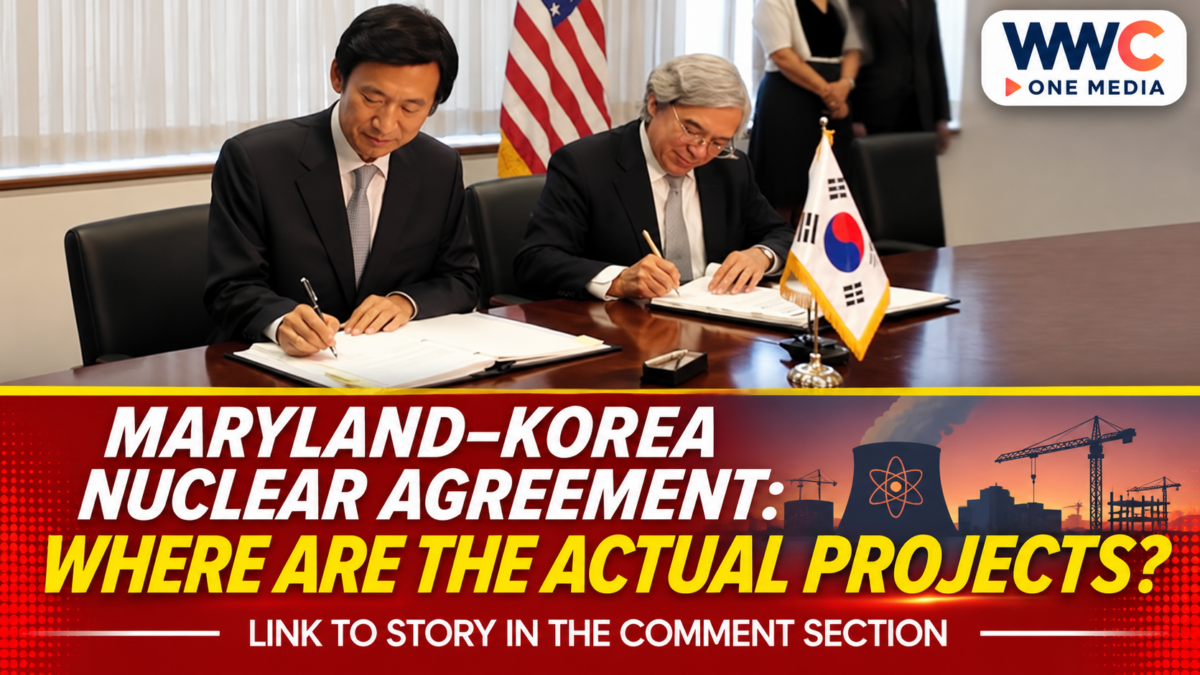
ANNAPOLIS, Maryland — Nov. 21, 2026. Maryland Governor Wes Moore’s administration announced on Nov. 17 an expanded partnership with South Korea’s Gyeongsangnam-do province covering nuclear power, small modular reactors and industrial supply chains. The Maryland Korea nuclear agreement establishes a framework for identifying joint projects, but the announcement does not name a reactor to be built, a construction contract or a guaranteed reduction in electricity bills.
That difference is central to judging what the memorandum of understanding can achieve. The state and province have outlined a process for turning business and technical discussions into possible work; the question now is whether that process produces documented investments and approvals.
Maryland Korea Nuclear Agreement: What Was Signed?
The Nov. 17 announcement describes an expansion of a sister-state relationship that began in 1991. Maryland’s archived original agreement, signed in Annapolis on Nov. 18 of that year, provided for exchanges in business, education, environmental protection and other fields. The latest arrangement adds nuclear-power policy and small modular reactor (SMR) supply-chain development to that long-running relationship.
Gyeongsangnam-do Governor Park Wan-su signed the new memorandum at the Korea SMR International Conference in Changwon on Nov. 17. Moore signed the document separately the previous week. Maryland Commerce Assistant Secretary John Gilstrap represented the state at the conference.
The state describes business consultations and technological exchanges as ways to identify projects and support investment and companies entering overseas markets. Those are defined cooperation channels, not evidence that a developer has already selected a site or secured financing.
A Working Group Is the First Measurable Commitment
The agreement provides for a joint working group with three to five members from each side, meeting at least twice a year. Its assignment is to identify priority cooperation tasks and action plans.
That is a useful early test. A working group can connect manufacturers, research organisations and prospective customers, but a meeting schedule alone cannot deliver a functioning power station. Meaningful progress would require public information on the projects selected, responsible organisations, expected costs and subsequent contractual steps.
Analysis: The clearest near-term outcome may be industrial cooperation rather than new electricity generation. Supply-chain relationships could emerge before any reactor project is judged commercially or technically feasible.
WWC ONE MEDIA has examined South Korea’s wider discussions about investment in the US nuclear industry. Those national-level investment discussions are separate from this state–province memorandum and should not be counted as projects created by it.
Why Small Modular Reactors Are Part of the Plan
SMRs are nuclear reactors designed around smaller generating units than traditional large power stations, with some designs intended to use factory-produced components. That makes manufacturing expertise, engineering capability and specialised suppliers relevant to the industry even before a reactor enters service.
Maryland’s announcement points to companies already based in the state. It identifies Baltimore-headquartered Constellation Energy as a nuclear operator and Rockville-based X-energy as an SMR technology company with a test and training facility in Frederick. The governor’s office also says the state’s nuclear industry employs more than 5,000 full-time workers.
These existing capabilities explain why the state wants international industrial contacts. They do not show that either company has entered a new contract under the memorandum. Similarly, participation by companies at the Changwon conference should not be interpreted as a purchase order.
The same technology questions are relevant elsewhere in Asia. WWC’s review of small-reactor proposals for Philippine island grids explored the gap between an attractive design concept and a fully financed, licensable electricity project. Maryland’s partnership remains on the cooperation side of that distinction.
Maryland’s Energy Policy Creates a Potential Market
The new agreement arrives alongside the state’s domestic energy initiatives. Maryland says its Public Service Commission is developing a zero-emission credit procurement programme to support new or expanded nuclear generation facilities serving the state, under the 2025 Next Generation Energy Act.
The governor’s office expects the programme to be ready to receive project bids in 2027. That is a state policy timetable; it is not an award to a Korean company or an assurance that any proposed nuclear plant will pass subsequent review.
The administration also cites its $200 million Megawatts for Maryland clean-energy auction programme as part of efforts to expand generation. That initiative is separate from the Gyeongsangnam-do memorandum and should not be described as financing for an SMR under the new agreement.
Electricity affordability is a stated aim of Maryland’s wider energy policy. Nevertheless, no new electricity tariff, retail saving or operating date is established by the memorandum itself.
What Separates Cooperation From a Licensed Reactor?
A new nuclear project in the United States faces federal safety and licensing requirements in addition to business negotiations. The Nuclear Regulatory Commission’s published licensing guidance describes the authorisations and reviews involved in construction and operation, including safety and environmental submissions.
This matters because an industrial partnership, a proposed investment and an approved generating facility are three different milestones. A company could participate in equipment development without building a reactor in Maryland. A reactor developer could also explore a site without obtaining permission to construct or operate.
Singapore’s nuclear planning offers another regional comparison. WWC previously examined Singapore’s cautious approach to advanced nuclear technologies, where technical cooperation did not amount to a decision to deploy nuclear power. The common lesson is that agreements to study or cooperate should not be reported as completed projects.
What Happens Next
The first meaningful checkpoints will be the formation of the joint working group, its scheduled meetings and any published action plan. Readers should then look for named commercial partners, project scopes, procurement decisions and—where a US reactor is proposed—applicable federal licensing records.
The memorandum could help Maryland companies and Gyeongsangnam-do manufacturers find opportunities in nuclear equipment and technology. Whether it creates new generating capacity, jobs or lower electricity costs remains a question for later evidence, not an outcome already established on Nov. 17.
Frequently Asked Questions
1. Did Maryland sign an agreement with South Korea on nuclear power?
Maryland expanded its existing sister-state partnership with South Korea’s Gyeongsangnam-do province through a memorandum announced on Nov. 17, 2026. It covers nuclear policy, SMRs and supply chains.
2. Does the agreement approve construction of a nuclear reactor?
No reactor construction approval, named plant or financing commitment is identified in the governor’s announcement. Any actual US nuclear facility would require separate development and regulatory steps.
3. What will the joint working group do?
Each side is to appoint three to five members. The group will meet at least twice yearly to identify priorities and action plans.
4. Why is Maryland interested in South Korean nuclear cooperation?
The state is seeking industrial and technical cooperation while pursuing additional reliable electricity generation and economic opportunities. The memorandum does not guarantee particular commercial results.
5. When could projects become clearer?
The initial indicators will be working-group actions and public project announcements. Separately, Maryland expects its nuclear-related zero-emission credit programme to begin accepting bids in 2027.