
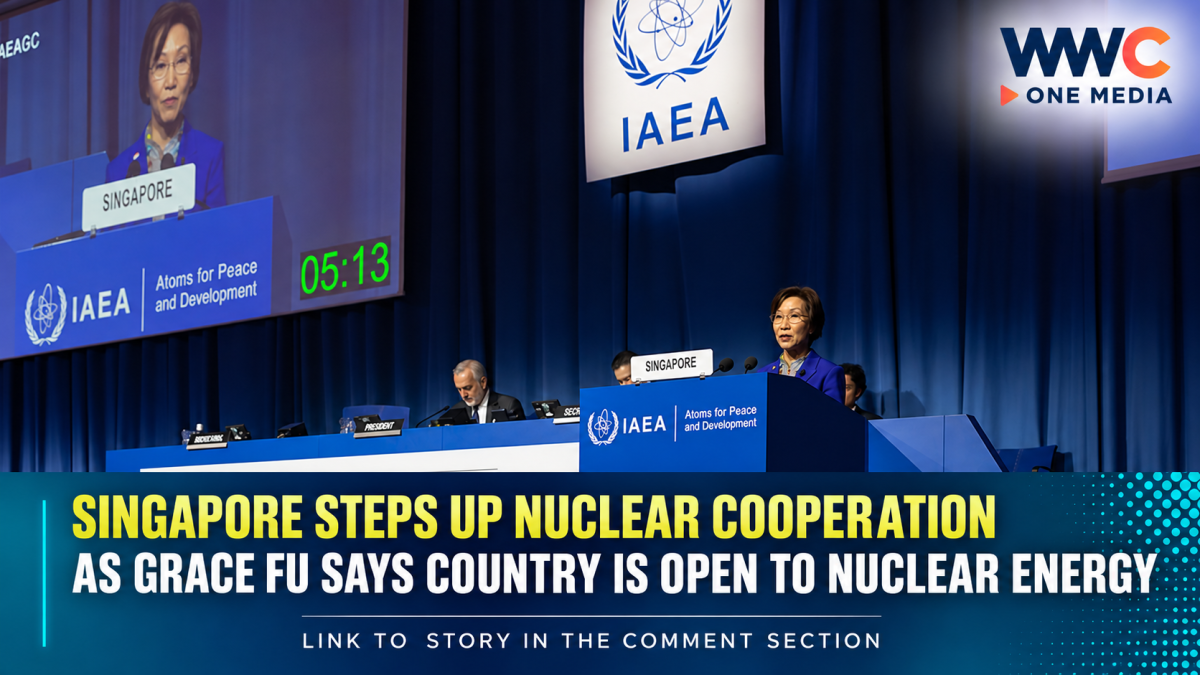
Singapore is strengthening its nuclear safety and technical capabilities while keeping the door open to nuclear energy as the city-state explores options to meet its long-term energy and climate goals.
Speaking at the 70th International Atomic Energy Agency General Conference in Vienna on Sept 14, Minister for Sustainability and the Environment Grace Fu said Singapore’s commitment to nuclear safety, security and safeguards remains firm, stressing that any nuclear incident could have consequences far beyond national borders.
Fu said Singapore is approaching nuclear energy with an “open mind” but acknowledged the country’s unique constraints as a small, densely populated city-state with limited alternative energy options.
The government is studying advanced nuclear technologies, including small modular reactors, but Fu stressed that no decision has been made to deploy nuclear power.
Instead, Singapore’s approach will be deliberate, structured and rigorous, with any future assessment considering nuclear safety, security and safeguards, environmental sustainability, economic viability, public confidence and the country’s international obligations.
Singapore is also building up the scientific, technical, institutional and regulatory capabilities needed to assess nuclear technologies independently.
A major step will come in 2027, when Singapore undertakes the first phase of an Integrated Nuclear Infrastructure Review with the IAEA.
The review will benchmark Singapore’s capabilities against the IAEA’s internationally recognised Milestones Approach, which examines areas including nuclear safety, radioactive waste management, emergency preparedness, regulatory systems and institutional capacity.
Fu stressed that the review should not be interpreted as a decision to build a nuclear power plant.
Instead, it will help Singapore determine whether it has the expertise, institutions and regulatory frameworks required to make an informed decision about nuclear energy.
The move comes as nuclear power gains renewed attention across Asia as countries seek reliable, lower-carbon electricity while facing rising energy demand and the challenges of reducing dependence on fossil fuels.
For Singapore, nuclear energy presents both potential opportunities and significant challenges because of its limited land area, dense population and lack of conventional sites for large-scale reactors.
That has increased interest in newer technologies such as small modular reactors, which are designed to be more compact and potentially easier to deploy than traditional large nuclear plants. However, their commercial readiness, economics, safety requirements and suitability for Singapore would still need to be assessed.
Fu also highlighted the importance of regional cooperation as Southeast Asian countries increase their interest in nuclear technology.
Singapore plans to work with ASEAN countries and the IAEA to improve emergency preparedness, strengthen regional protocols, expand radiation monitoring networks, increase information sharing and conduct joint exercises.
The proposed ASEAN-IAEA Strategic Partnership on Nuclear Energy, Safety and Governance could provide another platform for countries in the region to coordinate their approaches.
Singapore’s nuclear cooperation with the IAEA also extends beyond electricity generation.
Since 2000, Singapore has worked with the agency through the Singapore-IAEA Third Country Training Programme to share expertise in areas including nuclear medicine, radiotherapy, radiation protection, radiochemistry, environmental monitoring and climate-related measurements.
Singapore General Hospital and the National Cancer Centre Singapore are also set to be designated as a Rays of Hope Anchor Centre, strengthening regional capabilities in the peaceful applications of nuclear science.
Fu announced that Singapore would again pledge its full target contribution to the IAEA’s Technical Cooperation Fund for 2027. Singapore’s target share is about €465,000, or roughly S$683,000.
The minister also used her address to raise concerns about the impact of conflicts on nuclear safety.
She warned that attacks on nuclear power plants could create significant risks and called on all parties to respect the IAEA’s seven indispensable pillars for nuclear safety and security.
Singapore remains concerned about unresolved questions surrounding Iran’s compliance with its nuclear safeguards obligations and warned that unaccounted nuclear material could create proliferation risks.
Fu also pointed to North Korea’s continued development of nuclear weapons and ballistic missiles as a serious threat to regional and global peace and security.
Her remarks come at a particularly sensitive moment for the international nuclear system, with the IAEA facing heightened pressure over nuclear safety in conflict zones and disputes surrounding nuclear programmes in several countries.
Singapore will take on the ASEAN chairmanship in January 2027, giving it a larger regional role just as Southeast Asian governments face growing questions about nuclear safety, energy security and the possible adoption of advanced nuclear technologies.
For Singapore, the message remains cautious but significant: nuclear energy is not yet a commitment, but the country is building the expertise and international partnerships needed to decide whether it could eventually become part of its energy future.


Leave a Reply