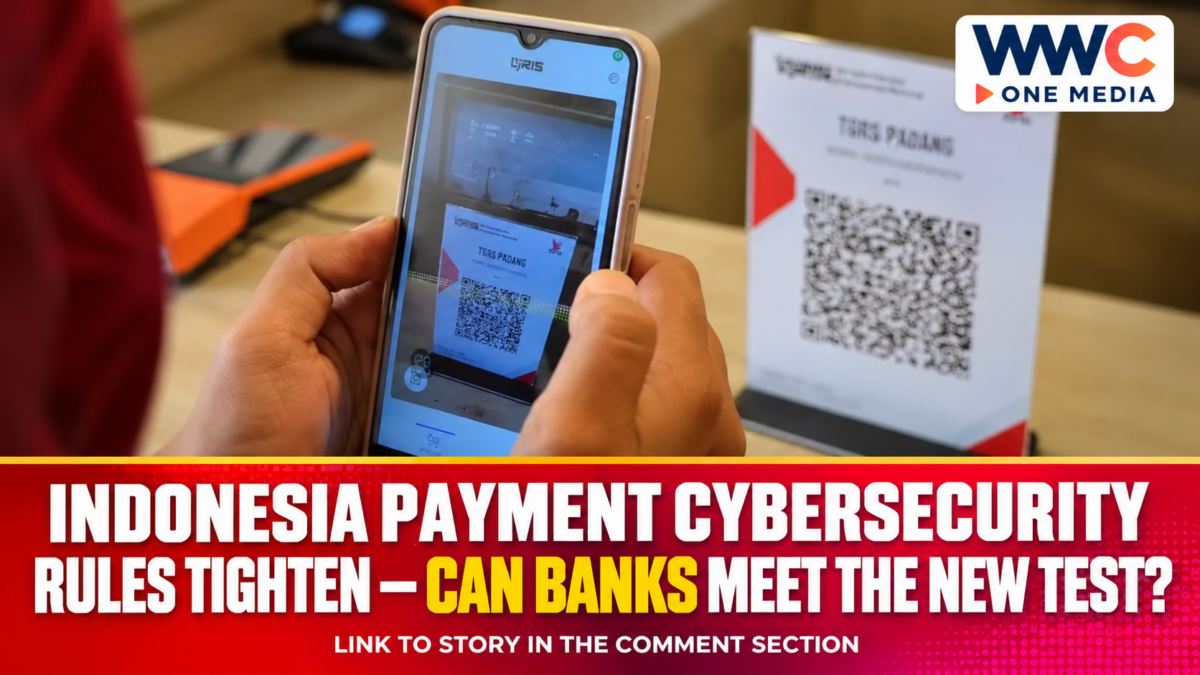
JAKARTA, Indonesia — Nov. 21, 2026. Bank Indonesia has sharpened its cybersecurity oversight of payment-system operators through an amendment that took effect on Sept. 25, 2026. The measure clarifies deadlines and penalties for incident reporting while refining how the central bank identifies vital financial information infrastructure.
A disrupted payments network can prevent ordinary transactions from reaching their destination, while a delayed incident notice can leave supervisors with less time to assess possible spillovers. The latest amendment places greater emphasis on whether regulated operators communicate problems promptly and maintain records that permit effective supervision.
Indonesia Payment Cybersecurity: What Actually Changed?
The September measure is Board of Governors Regulation No. 29 of 2026, an amendment to Regulation No. 24 of 2024. The earlier implementing regulation supports Bank Indonesia Regulation No. 2 of 2024, which established the broader information-system security and cyber-resilience framework for payment providers, money-market and foreign-exchange participants, and certain other supervised parties.
It would therefore be misleading to describe the September amendment as the first cybersecurity rule for Indonesian digital payments. The underlying obligations existed earlier. What changed is the precision of the reporting and administrative-sanctions provisions and the criteria used to designate vital information infrastructure.
Their stated scope reaches several types of institutions and infrastructure supervised by the central bank. This matters because an interruption at a shared system can affect services that customers encounter through different brands.
A One-Hour Notification Threshold Raises Accountability
Under the amended provisions, a regulated operator faces a specified administrative payment obligation if its initial notification is made more than one hour after it becomes aware of a cyber incident. A corresponding provision applies when an incident report is submitted more than three calendar days after the incident occurs.
The prescribed amount is Rp5 million per report for the applicable late or missing incident notification or report. Those two deadlines serve different purposes: the initial message alerts the supervisor quickly, while the subsequent report allows more information about the event to be communicated.
The rule does not establish that every cyber incident results in stolen money or personal-data exposure. Nor is a reporting deadline proof that a system can be fully restored within an hour. Notification and technical recovery are separate responsibilities.
For providers, the practical challenge is recognising an incident, escalating it internally, and identifying who is authorised to notify the regulator. Those are operational questions that become more urgent when the regulatory clock starts running.
Annual Reports Now Carry a Clear Escalation Path
The amended regulation sets Jan. 31 as the annual reporting deadline for the previous reporting year. A report received after Jan. 31 but by Feb. 15 is classified as late; one not received by Feb. 15 is classified as not submitted. The obligation to submit remains even after that classification.
The consequences are graduated. Late submission brings a written warning, while non-submission carries an Rp5 million payment obligation per report. More than three consecutive years of non-submission can lead to temporary suspension of some or all activities, including cooperation arrangements. More than five consecutive years can lead to licence or approval revocation.
These are administrative consequences tied to reporting failures, not an automatic finding that a provider has been hacked. That distinction protects against overstating the impact of the regulation or treating compliance processes as a substitute for actual cyber defences.
The earlier framework also calls for assessments of cybersecurity maturity and identification of vital information infrastructure. Routine reporting gives supervisors a way to assess readiness before an incident becomes a public disruption.
Why Critical Infrastructure Is Part of the Story
Bank Indonesia’s amendment clarifies how it identifies vital financial information infrastructure. It may designate regulated operators, applications or information-technology infrastructure, and protection road maps. The considerations include size, interconnectedness, substitutability and complexity, with protection planning informed by cybersecurity maturity.
Consider the difference between an isolated service and an infrastructure component used by many providers. A failure in the latter could make recovery more difficult because multiple services rely on the same component. This is an illustration of interconnected-system risk, not a claim that any particular Indonesian operator has failed.
The older implementing framework requires cybersecurity governance, risk identification, protection and detection, response planning, testing and recovery measures. It also addresses information sharing and cooperation. The September amendment reinforces that structure rather than replacing it.
The regional relevance is clear. WWC ONE MEDIA has separately examined how digital wallets seek to maintain payment access in difficult connectivity conditions. Availability and resilience are related, but a feature that works with limited connectivity is not, by itself, evidence of protection against a cyberattack.
A Separate Payment-Data Rule Adds Another Layer
Bank Indonesia also introduced Regulation No. 10 of 2026 on payment-system data, effective Oct. 29, 2026. This is a separate legal instrument, not another name for September’s cybersecurity amendment. Its provisions cover data processing, exchange, access, fraud management and the proposed functions of payment-system data infrastructure.
The data regulation explicitly addresses unauthorised transactions, manipulation of payers into making payments, misuse of customer information or payment systems, and fraud connected to other payment-provider products. It also requires payment-service providers to establish fraud-management policies and risk controls.
Cybersecurity and fraud prevention overlap, but they are not identical. A provider might keep its servers running and still face scams in which a person is persuaded to authorise a payment. WWC’s coverage of RCBC’s anti-fraud partnership explores that customer-facing distinction, while its analysis of Singapore’s proposed controls for AI-initiated banking activity shows another emerging authentication concern.
These are comparisons, not claims that Philippine or Singaporean rules govern Indonesian providers.
What Happens Next
The immediate test is implementation. Regulated operators must organise incident escalation, meet the reporting calendar and maintain the underlying controls expected under the existing framework. Supervisors, meanwhile, need enough information to distinguish an isolated technical problem from a risk that could spread through connected payment infrastructure.
For customers, the rules should not be read as a guarantee against outages, fraud or losses. They establish regulatory obligations; the strength of actual protection depends on how systems and procedures work when challenged.
the real measure of this tightening will be whether it improves preparedness, timely disclosure and continuity of payment services—not merely whether firms complete their compliance forms.
Frequently Asked Questions
What changed in Indonesia’s payment cybersecurity rules in 2026?
Bank Indonesia amended its existing implementing regulation to clarify annual-report deadlines, cyber-incident reporting penalties and the designation of vital financial information infrastructure.
How quickly must a cyber incident be reported?
The amendment specifies a penalty for an initial notification made more than one hour after the operator becomes aware of an incident, and for a cyber-incident report submitted more than three calendar days after the incident occurs.
What is the penalty for a late incident report?
The amendment specifies an administrative payment obligation of Rp5 million per applicable late or missing incident notification or report.
Does the regulation guarantee that digital wallets are safe?
No. It establishes compliance and supervisory requirements but does not eliminate cybersecurity threats, service outages or payment scams.