MANILA, PHILIPPINES — November 11, 2026 | WWC ONE MEDIA | Philippine Business, Financial Technology, Digital Payments and Consumer News
Imagine buying food, paying for a purchase or catching a train without worrying whether your phone has mobile data or a cellular signal.
For millions of Filipinos who depend on GCash for everyday transactions, that possibility could soon become more widely accessible.
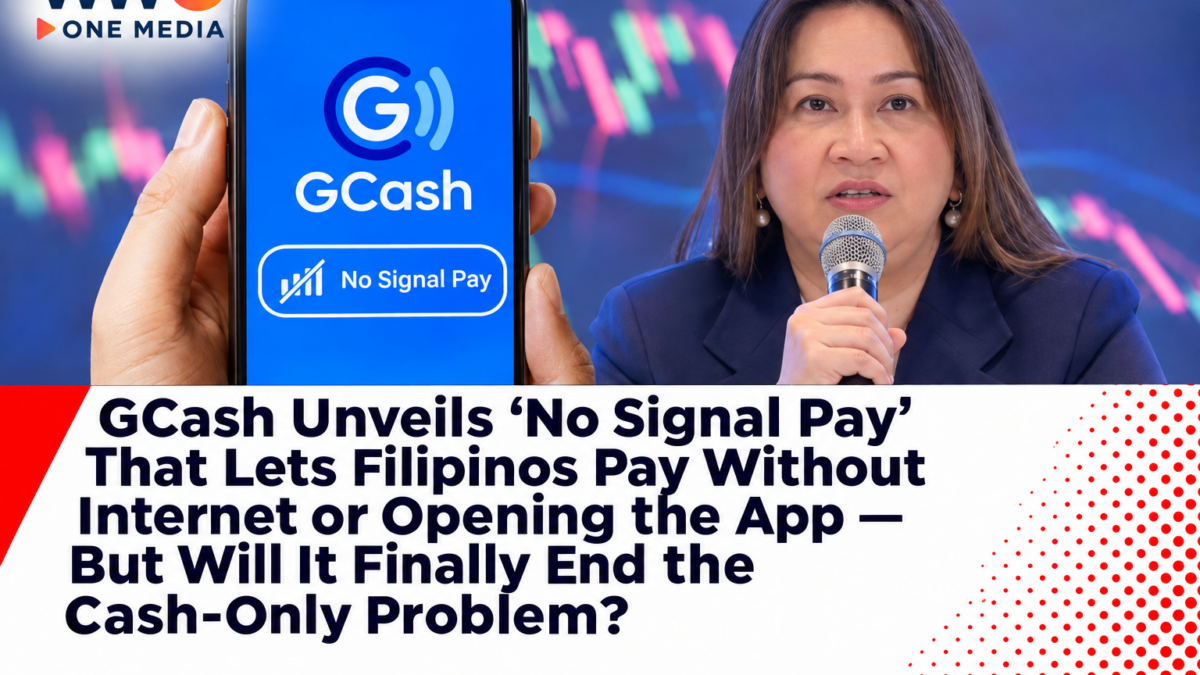
GCash is preparing to introduce No Signal Pay, a contactless payment feature designed to let customers pay even when their smartphones have weak or no mobile internet connectivity.
The technology was unveiled by Mynt president and chief executive officer Martha Sazon during the company’s third-quarter earnings briefing on November 10, 2026.
According to InsiderPH, the service uses near-field communication (NFC) and tokenization, allowing customers to unlock their smartphones and tap them against compatible payment terminals without opening the GCash application.
GCash also says the feature is designed to work during application downtime, provided the customer has enough funds in their wallet.
The announcement comes as the digital payments company pushes to expand financial access beyond major cities and reach underserved Filipinos.
But while the technology promises greater convenience, important questions remain.
GCash has not disclosed a specific launch date, a complete list of compatible smartphones or the merchant locations that will support the service.
Could No Signal Pay make digital transactions more reliable for millions of Filipinos—or will phone compatibility and limited payment-terminal availability prevent it from reaching the people who need it most?
GCash Announces No Signal Pay During November 10 Earnings Briefing
Sazon introduced No Signal Pay as part of GCash’s effort to overcome one of the country’s persistent digital-payment problems: unreliable connectivity.
Although mobile wallets have become widely used, completing a payment can still be difficult when a customer’s phone cannot access mobile data.
Problems may occur inside buildings, in crowded transportation areas or in locations with weak telecommunications infrastructure.
In conventional app-based payments, users may need internet access to log in, generate or scan a QR code and authorize a transaction.
No Signal Pay is designed to remove that dependency from the contactless payment experience.
Sazon explained that customers would be able to unlock their phones and tap a compatible NFC terminal without opening the GCash application.
She also described the feature as capable of functioning when the main GCash app is experiencing downtime.
However, the announcement does not establish that every type of GCash transaction will work offline.
The company’s statements specifically concern the proposed NFC-enabled payment functionality.
Sending money, transferring funds to banks, paying bills and other app-based services may continue to have different connectivity requirements.
How Does GCash No Signal Pay Work?
No Signal Pay combines two technologies commonly used in modern contactless payments.
The first is near-field communication, or NFC.
NFC allows compatible devices to exchange information across a very short distance.
The technology is already used in contactless bank cards, mobile wallets and some transportation payment systems.
The second technology is tokenization.
Tokenization allows a payment system to use a substitute digital credential rather than transmitting a sensitive account identifier directly during a transaction.
This approach can help reduce the exposure of underlying payment information.
Under the experience described by GCash, the customer would unlock their smartphone and hold it near an NFC-enabled terminal.
The device and payment terminal would then exchange the information required to initiate the transaction through the supported payment system.
The customer’s phone would not need an active mobile-data connection for the NFC interaction.
However, the absence of mobile internet on the customer’s phone does not necessarily mean the merchant’s terminal can operate without its own payment-network connectivity.
The precise merchant-side processing arrangements for No Signal Pay have not yet been fully disclosed.
GCash has also not announced all activation, security and authentication requirements for the upcoming service.
Can GCash Really Work Without Internet?
The short answer is yes—for the specific contactless payment capability being announced, subject to the requirements of the service.
But that does not mean the entire GCash platform becomes fully functional without internet access.
Users should distinguish between different activities.
A supported NFC payment may be possible without the customer’s phone connecting to mobile data.
Checking updated account balances, reviewing transaction histories or using other GCash products may still require connectivity.
The feature also does not create additional wallet funds.
GCash explicitly says customers must have sufficient balance to complete a transaction.
If the available balance is inadequate, the payment may be declined.
Likewise, the service does not guarantee that every store or payment terminal will support NFC.
A merchant using only a printed QR code would not automatically become compatible with No Signal Pay.
GCash has not yet confirmed the complete list of supported devices, merchant terminals or rollout locations.
Is No Signal Pay Different From GCash Tap to Pay?
One important detail deserves attention.
GCash’s official Help Center already documents a contactless feature called Tap to Pay.
According to those instructions, eligible customers can use NFC-enabled Android or Huawei smartphones to make supported payments, including through an offline mode that does not require the GCash app to be open.
The service requires an eligible device and a fully verified GCash account.
GCash describes biometric authentication as part of the existing offline payment process.
The newly announced No Signal Pay shares several characteristics with that functionality.
However, the company has not clearly established whether No Signal Pay represents a rebranding, an expansion, a different implementation or an additional offering.
It would therefore be misleading to claim that GCash is introducing offline NFC payments for the first time.
The confirmed development is that GCash is promoting No Signal Pay as an upcoming capability aimed at making contactless transactions more convenient and widely accessible.
Consumers should wait for GCash’s official rollout instructions before assuming the requirements will be identical to existing Tap to Pay arrangements.
Why GCash Wants to Reach Filipinos With Poor Connectivity
No Signal Pay is part of Mynt’s broader financial inclusion strategy.
Sazon said the company wants to expand services to Filipinos who remain outside the formal banking system.
Unreliable connectivity presents a practical obstacle to financial inclusion.
Even consumers with smartphones and digital wallets may have difficulty using those services consistently when telecommunications coverage is weak.
For small businesses, unreliable connectivity can also interfere with customer payments.
A digital wallet is less useful if a customer cannot complete a transaction at the moment of purchase.
By supporting compatible payments without requiring mobile data on the customer’s phone, GCash hopes to reduce one of those barriers.
The potential applications include market purchases, food transactions and transportation.
Sazon specifically mentioned scenarios involving meals and the Metro Rail Transit.
However, these were examples of possible uses—not a confirmed announcement that all MRT gates, food stalls or other businesses are already equipped for No Signal Pay.
The service’s real impact will depend on the number of eligible users and participating merchants once it becomes commercially available.
The Philippines Is Already Moving Toward Digital Payments
GCash’s announcement comes as the Philippines experiences a major shift away from cash-only transactions.
According to Bangko Sentral ng Pilipinas figures cited in recent financial reporting, digital payments accounted for approximately 64.7% of retail payment transactions by volume in 2025.
That means nearly two out of every three measured retail transactions were conducted electronically.
In related reporting, WWC ONE MEDIA examined how digital payments reached 64.7% of Philippine retail transactions and why merchant acceptance, transaction fees and cybersecurity remain major challenges.
The growth reflects increased adoption of mobile wallets, electronic fund transfers and QR-based payment systems.
But the figures do not mean that nearly 65% of Filipino businesses accept digital payments.
Nor do they establish that the same percentage of the total peso value of retail spending is electronic.
The measurement concerns transaction volume.
The country still has significant differences in digital access between communities and businesses.
No Signal Pay could help address one part of that gap, particularly where customers have NFC-compatible phones but unreliable mobile connectivity.
GCash’s Tourism Partnership Shows Its Wider Cashless Ambitions
GCash is also working with government agencies to expand merchant acceptance.
On November 3, the Department of Tourism signed an agreement with GCash operator G-Xchange Inc. to support digital payment adoption among tourism-related micro, small and medium enterprises.
The initiative targets businesses such as homestays, small shops, market vendors and tourism service providers.
The partnership is separate from the announced No Signal Pay feature.
But both developments illustrate GCash’s broader strategy of increasing the usefulness of digital payments in everyday commerce.
A successful cashless ecosystem requires consumers and merchants to participate.
Making payment easier for only one side of a transaction is not enough.
No Signal Pay’s long-term success may therefore depend as much on merchant adoption as on smartphone compatibility.
GCash Is Already Turning Cash Transactions Into Digital Wallet Activity
The company’s existing products also demonstrate its efforts to connect traditional cash commerce with digital payments.
In September, GCash introduced GSukli, a service that allows qualifying shoppers to receive small amounts of change directly into their digital wallets.
GSukli and No Signal Pay address different customer needs.
GSukli helps convert cash change into electronic money.
No Signal Pay aims to make certain digital payments possible without mobile-data connectivity on the customer’s phone.
Together, these services reflect efforts to reduce practical barriers that discourage people from using digital wallets.
But they also show that cash is unlikely to disappear overnight.
Consumers may continue using physical money alongside digital options based on convenience, acceptance and personal preference.
GCash’s Business Is Growing as It Expands Beyond Basic Payments
The No Signal Pay announcement coincided with a major earnings milestone for Mynt, the parent company behind GCash.
Mynt reported net income of approximately ₱16.5 billion for the first nine months of 2026, representing 17.4% year-over-year growth.
Adjusted revenue increased to approximately ₱67.1 billion.
The company reported 42.1 million monthly active users during the third quarter.
Its payment solutions business processed approximately ₱15.1 trillion in gross transaction value over the first nine months.
In related coverage, WWC ONE MEDIA examined Mynt’s earnings expansion, its ₱79.3-billion loan portfolio and the challenges of sustaining profitability following its historic Philippine stock-market debut.
These figures show that GCash is operating at substantial scale.
However, the ₱15.1 trillion in processed payments is not equivalent to revenue or profit.
It represents the gross value of transactions processed through the relevant business.
Similarly, the new feature has not yet been assigned a public revenue target.
Mynt has not disclosed how much No Signal Pay will cost to develop or how much additional payment volume it expects the service to generate.
Its contribution to future earnings therefore remains uncertain.
Could No Signal Pay Help Small Businesses?
For merchants, the potential advantage is straightforward: fewer payment interruptions caused by a customer’s poor phone reception.
A compatible terminal could allow customers to complete purchases without loading the GCash app or generating a QR code.
That could be useful in busy stores, food establishments and transportation environments.
However, merchants may need compatible NFC-enabled payment equipment.
GCash has not yet published the complete merchant eligibility requirements or any new terminal-related fees specifically associated with No Signal Pay.
Small businesses should therefore avoid assuming that their existing QR-only setup will automatically support the feature.
They should also wait for official guidance about settlement procedures, transaction confirmation and troubleshooting.
The commercial opportunity is promising, but the details will determine how practical the service becomes for neighborhood retailers and provincial businesses.
What About Security and Fraud Protection?
The use of tokenization is intended to support more secure payment processing.
Rather than relying solely on transmitting sensitive account credentials, tokenization substitutes protected payment information during the transaction.
However, tokenization does not eliminate every form of payment fraud.
Lost phones, unauthorized device access, social engineering and merchant-related scams can still create risks.
GCash’s existing NFC payment instructions include device eligibility and authentication requirements.
The final security controls for No Signal Pay should be confirmed when the company releases its official operating guidelines.
Consumers should continue protecting their devices, account credentials and verification information.
They should also review transaction histories and promptly report unauthorized activity through official channels.
Five Questions GCash Must Answer Before Launch
1. When will No Signal Pay become available?
GCash has announced that the feature is coming, but no specific commercial launch date has been disclosed.
2. Which smartphones will support it?
NFC hardware will be necessary. The complete compatibility list for No Signal Pay remains unannounced.
3. Which stores and terminals can accept it?
The service requires a compatible payment terminal, and GCash has not released a full merchant list.
4. Will customers pay additional fees?
GCash has not published a complete fee schedule specifically for the upcoming No Signal Pay offering.
5. How does it relate to existing GCash Tap to Pay?
The company has not fully clarified whether the new branding represents an expansion of existing NFC functionality or a separate product implementation.
These questions will be important in determining how widely the service can be adopted.
The Bottom Line: GCash Wants Payments to Work Even When Phone Signals Do Not
GCash’s No Signal Pay announcement represents another step toward making digital transactions more convenient for Filipinos.
By combining NFC technology with tokenized payment credentials, the company aims to let customers make compatible contactless purchases without relying on mobile data or a cellular signal on their phones.
The feature could prove useful in locations where mobile reception is unreliable and where customers want a faster alternative to opening an app or scanning a QR code.
It also fits Mynt’s broader strategy of expanding digital financial services into underserved markets.
But the promise comes with important limitations.
The feature has not received a confirmed commercial launch date.
The final list of compatible devices and participating merchants remains unknown.
And while GCash has described payment functionality during app downtime, it has not established that every type of wallet transaction will become available offline.
The technology’s real impact will depend on whether consumers can use it easily, securely and at enough businesses to make it a practical everyday option.
GCash says Filipinos will soon be able to pay with a tap even without mobile data or cellular signal. But as the company prepares to bring digital payments into places where connectivity remains unreliable, will No Signal Pay finally make cashless purchases convenient for everyone—or will the next challenge be finding a compatible phone and payment terminal?