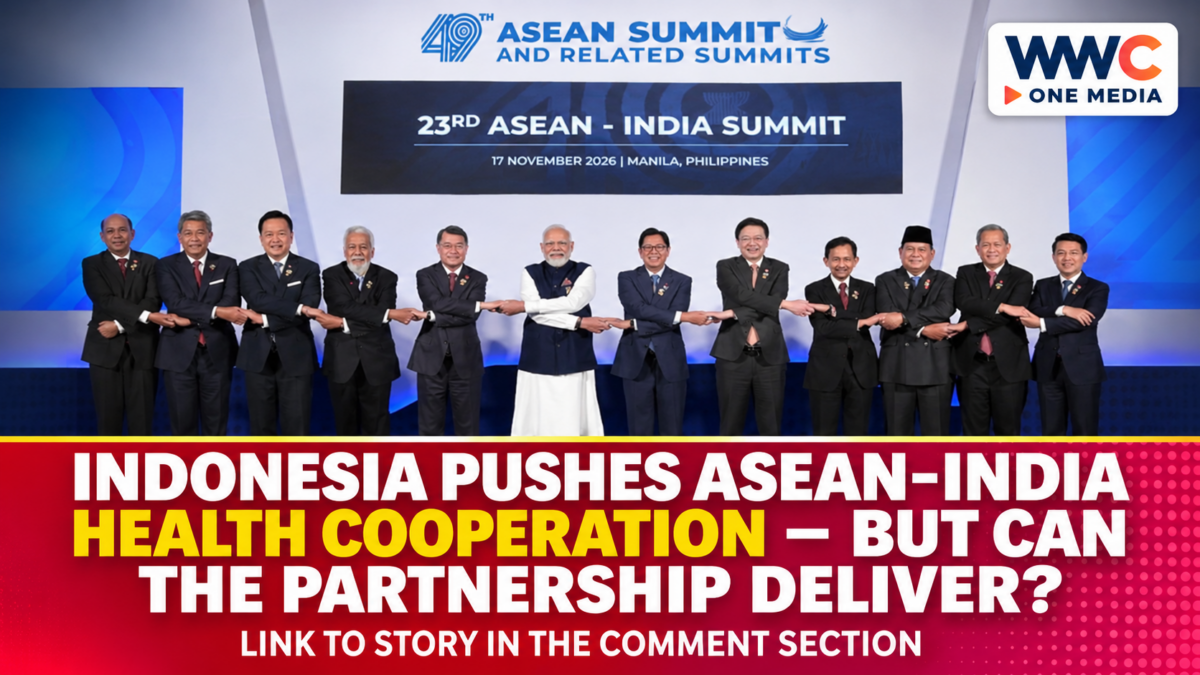
MANILA, Philippines — Indonesian President Prabowo Subianto urged closer ASEAN–India cooperation on healthcare and disaster preparedness during the 23rd ASEAN–India Summit in Manila on Nov. 17, 2026. His proposals covered access to pharmaceuticals and medical equipment, stronger domestic medicine production, early-warning systems and safer coastal infrastructure.
The appeal connects two essential public services: keeping healthcare accessible and protecting communities when disasters interrupt normal life. Yet the next test is not another statement of intent. It is whether governments identify workable projects, assign responsibilities and show how people will benefit.
ASEAN India cooperation puts medicines on the agenda
Prabowo described India’s pharmaceutical sector and medical technology as useful partners for Southeast Asian countries. He also said Indonesia already operates cooperation programmes with India involving medicines, pharmaceutical products and medical equipment that he characterised as affordable.
That distinction matters. The presidential remarks were not an announcement of a new regional procurement contract. They described existing Indonesian cooperation and a political preference for deeper engagement. The public statement did not identify participating suppliers, quantities of medicines, contract values or a new delivery timetable.
For households, the practical issue is whether cooperation can help health systems obtain dependable products at manageable cost. For health administrators, that raises further questions about product regulation, quality assurance, purchasing procedures and distribution. Those details cannot be assumed merely because leaders support closer ties.
The wider health-security challenge is also visible in WWC’s earlier coverage of Singapore’s expanded role in international infection-prevention cooperation. Regional partnerships can spread expertise, but their impact depends on how national institutions use it.
Indonesia wants greater pharmaceutical capacity at home
Prabowo linked cooperation with India to Indonesia’s ambition to strengthen its own pharmaceutical industry. This introduces a different goal from importing finished medicines: building domestic capabilities that could support health-system resilience over time.
What might that involve? As an analytical matter, domestic capacity could include skills development, manufacturing technology, quality-control systems or stronger supply networks. But the presidential announcement did not commit India to a particular factory, technology-transfer agreement or investment amount. Those possibilities should not be presented as approved projects.
There is a policy tension worth watching. Importing affordable products may address immediate needs, while building local production generally requires sustained investment and reliable demand. Governments may need to balance both aims rather than treat them as alternatives.
For businesses, any eventual programme would still need clear rules on approvals, procurement, intellectual property and commercial participation. The current announcement establishes an area of interest, not a guaranteed market opportunity or an invitation to invest.
Disaster warnings require more than technology
The Indonesian president also called for cooperation on disaster-risk reduction, identifying early warnings, resilient coastal infrastructure and coordinated response as priorities. These are complementary measures rather than interchangeable solutions.
An early-warning system can help authorities detect danger and communicate risk. Coastal infrastructure may reduce exposure or support continuity of essential services. Emergency coordination concerns the decisions and resources needed after a warning is issued or an incident occurs.
The challenge is connecting those functions. A warning that never reaches a coastal village offers limited protection; a prepared evacuation plan can also fail if access roads and communications are unusable. That is why implementation matters as much as technical capability.
WWC has separately examined how disaster-warning cooperation can reach Philippine communities and why the country needs stronger infrastructure before hazards strike. Those discussions illustrate the operational questions that any ASEAN–India initiative would have to address.
What the Manila remarks establish — and what they do not
Prabowo delivered his intervention at the Philippine International Convention Center during the summit. His remarks placed health supplies, domestic pharmaceutical development and disaster preparedness within Indonesia’s preferred direction for ASEAN–India ties.
The record supports that policy position. It does not, however, provide a costed programme covering all ASEAN members. It does not specify new funding, binding deadlines, a dedicated implementation agency or measurable targets for medicine availability and disaster-warning coverage.
The distinction is important for readers and investors alike. Diplomatic support can open the way for cooperation, but operational commitments normally require decisions on financing, technical standards, implementation and accountability.
There is already a useful regional lesson in the difference between planning and testing readiness. WWC’s coverage of a multinational ASEAN disaster-response exercise shows why coordination procedures must work in practice, not only in conference documents.
Why it matters for the Philippines and ASEAN
For the Philippines, the proposal is relevant because health-system readiness and disaster preparation are connected. A severe disruption can affect transport, communications and the movement of medical supplies at the same time that demand for treatment rises.
Stronger regional cooperation could therefore have value beyond diplomacy. Shared training, compatible warning procedures and more dependable medical supply arrangements are examples of potential benefits. They remain possibilities, not outcomes established by the Nov. 17 remarks.
A credible programme would need answers to several questions: Which national agencies would participate? What would India and individual ASEAN members contribute? How would progress be measured? Would support reach provincial hospitals and exposed coastal communities rather than remain concentrated in capital cities?
Those questions provide a practical standard for assessing any follow-up announcements. They also separate useful cooperation from broad commitments that are difficult for the public to evaluate.
What happens next
The next meaningful development would be a formally described initiative with named partners, activities and milestones. An implementation plan might clarify whether the initial emphasis will fall on medicines, training, warning systems, coastal engineering or emergency coordination.
As of Nov. 21, the Indonesian presidential statement reviewed for this article does not establish those project-level commitments. Readers should therefore treat the remarks as a policy push, not evidence that a new medicine programme or disaster infrastructure project has already begun.
The potential is clear: regional cooperation can bring capabilities together. Whether it delivers will depend on what governments commit, what institutions execute and what communities can actually use.