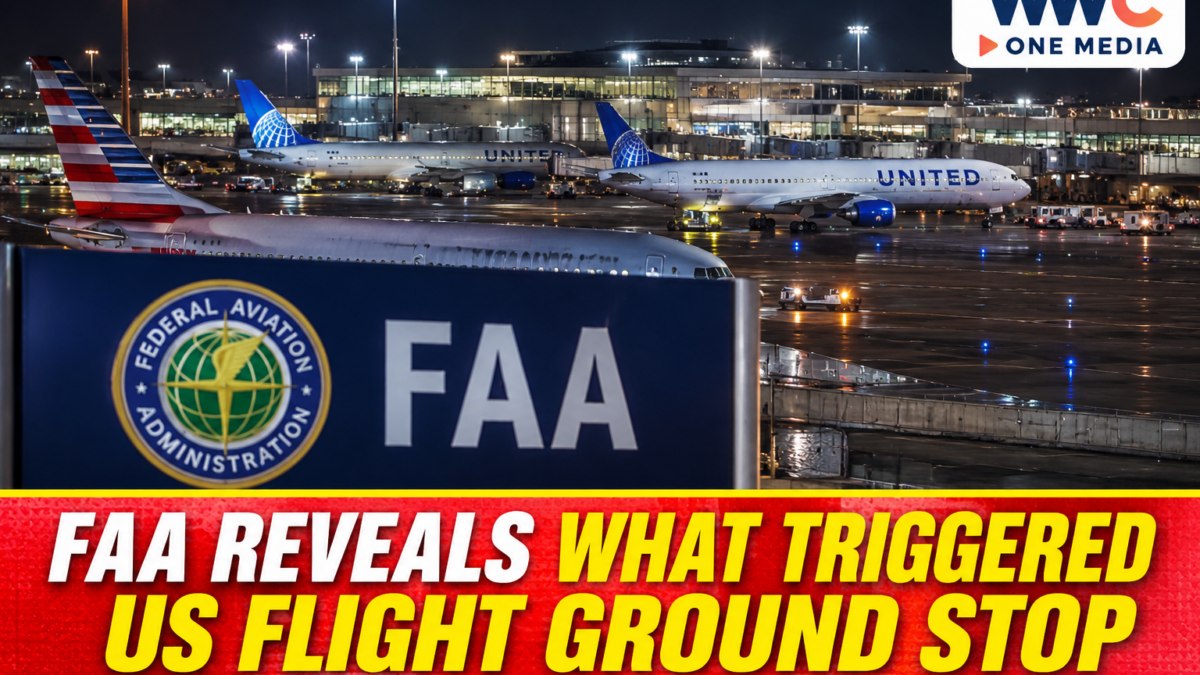
The Federal Aviation Administration (FAA) has disclosed new technical details about the telecommunications failure that forced a nationwide ground stop across the United States on Nov. 13, 2026, including abnormal network traffic that disrupted aircraft communications and radar feeds.
The agency identified two locations associated with the data surge and confirmed that a contractor had been installing a new router at one of them. However, the precise technical failure remains under investigation, leaving an important question unanswered: what caused a routine infrastructure operation to destabilise a critical part of the US aviation network?
The disruption affected 17 of the FAA’s 22 Air Route Traffic Control Centers. Although the restriction was lifted on the evening of Nov. 13, the incident exposed the operational risks of maintaining ageing telecommunications infrastructure while modernising a nationwide air traffic control system.
What the FAA found inside its telecommunications network
The FAA said its legacy equipment became unstable after its telecommunications network experienced approximately 1,000 connection attempts every four to five seconds.
The abnormal traffic disrupted systems supporting communications with aircraft and radar feeds used by air traffic controllers.
The agency identified two potential locations associated with the excessive data traffic: a radar site in Amarillo, Texas, and a radio communications site in El Dorado, Arkansas.
L3Harris, the FAA’s network service provider, had been working at the El Dorado location, including deploying a new router. The agency said the two locations were blocked and the broadcasting function on new routers was disabled as a precaution.
The FAA has not established whether the underlying problem resulted from a defective router, an installation issue or another technical failure. Its investigation with L3Harris remains ongoing.
That distinction is important. Identifying equipment and locations associated with a disruption does not automatically establish negligence or final responsibility.
Why a problem at two locations affected 17 control centres
The incident demonstrates how interconnected aviation infrastructure can turn a local technical problem into a much wider operational concern.
Air traffic controllers depend on telecommunications networks to exchange information, maintain communications with pilots and coordinate aircraft movements. Radar feeds provide another essential layer of information for tracking aircraft.
When the FAA detected instability across its network, it ordered a nationwide ground stop as a precaution.
The agency said instability appeared at 17 of its 22 Air Route Traffic Control Centers and subsequently spread into several Terminal Radar Approach Controls.
Importantly, this was not a complete loss of communications. The FAA said certain radio frequencies and radar feeds remained operational, allowing controllers to continue communicating with and tracking aircraft.
The agency reported that approximately 3,500 aircraft safely landed during the response and that every passenger arrived safely.
Critical life-saving, law-enforcement and military flights also continued, with no reported impact on those operations.
More than 12,000 cancellations — but not all were caused by the ground stop
The operational consequences extended beyond the period when departures were restricted.
The FAA reported approximately 12,462 flight cancellations on Nov. 13, including 9,082 cancellations by major airlines.
However, the agency specifically cautioned that not every cancellation was directly caused by the nationwide ground stop.
That qualification matters when assessing the disruption’s actual impact. A cancellation total recorded on the same day as an aviation emergency should not automatically be treated as the number of flights cancelled solely because of that emergency.
The restriction began at approximately 3:30 p.m. Eastern Time. The FAA said its system had stabilised and air traffic resumed at 8:15 p.m. that evening.
More than 8,000 flight operations resumed after the restriction was lifted, according to the Transportation Department’s Nov. 14 update.
Nevertheless, reopening airspace does not immediately restore normal airline schedules. Aircraft may be away from their planned departure airports, crews may have reached duty limits, and passengers may have missed connecting services.
For travellers, the distinction between a reopened airspace and a fully restored airline schedule can determine whether a journey proceeds as originally booked.
Was it a cyberattack or a failure of the modernisation programme?
The FAA said it had no indication, based on the available evidence, that the incident resulted from a cyberattack or an outside malicious actor.
It also distinguished the disruption from its broader air traffic control modernisation programme.
The agency attributed the instability to legacy telecommunications equipment and said the incident involved the transition away from ageing copper-wire infrastructure. It also said the Strategic Management of Airspace, Routes and Trajectories system, known as SMART, was not connected to the failure.
This distinction matters because the United States has been investing in replacing older aviation technology.
WWC previously examined the US air traffic control modernisation programme and its funding challenges. The latest incident adds a practical concern to that debate: modernisation must not only deliver newer equipment but also ensure that maintenance and installation work do not destabilise existing operations.
The wider issue also connects with the growing importance of digital resilience and reliable network infrastructure. Essential services can experience serious disruptions even when there is no evidence of a deliberate attack.
What happens next
The FAA said it believes it addressed the initial cause by disabling the relevant functionality on the originating Juniper routers.
As a precaution, the agency disabled the same functionality on more than 60 other Juniper routers across the network and paused further installations.
The FAA and L3Harris are continuing to investigate the technical inconsistencies. The agency has also said it will reassess when maintenance and equipment replacement work should take place following the incident.
The investigation must still establish the precise failure mechanism and whether additional safeguards are needed before similar installations resume.
For passengers, the immediate disruption has passed, but the incident has renewed questions about the reliability of the infrastructure supporting US air travel.
Travellers dealing with cancellations should distinguish refunds from additional compensation. WWC’s explanation of why the proposed US airline compensation payments never became law explains why a ticket refund does not automatically mean a passenger qualifies for a separate cash payment.
The central test for the FAA is now whether the corrective measures can prevent a repeat of the network instability. Until investigators establish the exact technical cause, the public record supports a clear account of what happened — but not a final conclusion about who or what was responsible.
Frequently asked questions
What caused the US nationwide flight ground stop on Nov. 13, 2026?
The FAA said abnormal data traffic destabilised legacy telecommunications equipment, affecting aircraft communications and radar feeds. The precise technical root cause remains under investigation.
How many air traffic control centres were affected?
The FAA reported instability at 17 of its 22 Air Route Traffic Control Centers, with the disruption spreading into several Terminal Radar Approach Controls.
Was the FAA outage caused by a cyberattack?
The FAA said it had no indication, based on available evidence, that the incident was a cyberattack or the work of an outside malicious actor.
How many flights were cancelled?
The FAA reported approximately 12,462 cancellations on Nov. 13, including 9,082 by major airlines. It cautioned that not all cancellations were directly caused by the ground stop.
Has the FAA fixed the problem?
The agency said it stabilised the network, disabled certain router functions and paused further installations. However, its investigation into the root cause remains ongoing.