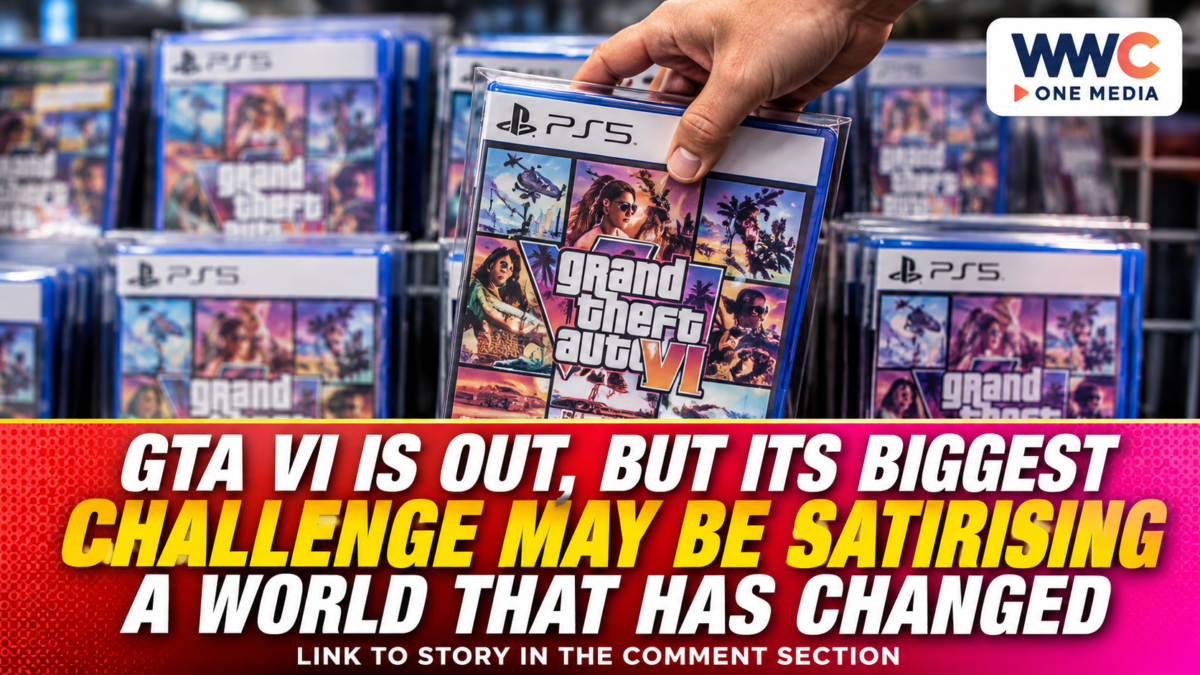
Grand Theft Auto VI arrived worldwide on Nov. 19, 2026, bringing Rockstar Games’ long-running crime franchise back into the spotlight with a new setting, two central characters and a commercial legacy few entertainment properties can match.
But the significance of the launch goes beyond another blockbuster game. The series built much of its identity around exaggerating modern society — its money, celebrity culture, media, consumerism and appetite for spectacle. With real life becoming increasingly difficult to distinguish from the absurd worlds that games once treated as parody, GTA VI faces a different creative challenge: finding something meaningful to say about the present without simply repeating jokes that worked in the past.
The commercial stakes are equally substantial. Take-Two Interactive’s latest filing shows that the Grand Theft Auto franchise remains one of its most important properties, while the arrival of a new instalment puts that established business model and the series’ cultural reputation under fresh scrutiny.
GTA VI returns to a world built for social commentary
Rockstar’s official game description places the new story in Vice City and the wider fictional state of Leonida. The narrative follows Jason and Lucia, whose lives become entangled in a criminal conspiracy after an attempted score goes wrong.
The setting is familiar in one important respect: GTA uses fictional locations to create distance from the real places and institutions it portrays. Vice City is not simply a recreation of a real American city. It is a fictional environment through which the developers can build characters, conflicts and social observations without presenting the story as a documentary account.
That approach has been central to the franchise’s identity. Its fictional cities allow it to explore wealth, crime, ambition and public image through exaggerated situations.
The new game arrives in an era shaped by online personalities, viral content and the constant circulation of public images. Those developments offer plenty of material for satire, but they also create a problem for writers: audiences are already familiar with many of the behaviours that once seemed outrageous enough to parody.
The creative test is whether the game can turn that familiarity into a distinctive point of view rather than relying only on recognisable references.
The commercial legacy behind the launch
Take-Two’s quarterly filing for the six months ended Sept. 30, 2026, provides a clear picture of the franchise’s business importance.
The company reported that the Grand Theft Auto series had sold-in more than 475 million units worldwide. Grand Theft Auto V, released in 2013, accounted for more than 230 million units sold-in.
The distinction between units sold-in and consumer purchases matters. The figure is the publisher’s reported measure of units supplied into the distribution channel; it should not automatically be described as a count of individual customers or verified retail sell-through.
The filing also identifies Rockstar Games as Take-Two’s wholly owned publisher of the Grand Theft Auto franchise and other established series.
More importantly, Grand Theft Auto products generated 12.6% of Take-Two’s net revenue for the six months ended Sept. 30, 2026. The company specifically identified its dependence on major franchises, including Grand Theft Auto, as a business risk.
That makes GTA VI more than a creative release. Its performance matters to a publisher whose financial results can be influenced by the timing and commercial reception of a small number of major titles.
Why satire has to evolve with its audience
A successful satire does more than make familiar institutions look ridiculous. It identifies contradictions in the way people live, communicate and pursue status.
That task becomes harder when the audience has already seen years of real-world events that appear to resemble fictional comedy. A joke about manufactured celebrity, online attention or extravagant displays of wealth may feel less surprising when those behaviours are already part of everyday digital culture.
For GTA VI, the opportunity is to examine how those pressures shape its fictional characters and communities. The challenge is to make the observations relevant without reducing the world to a collection of topical references.
This is where the franchise’s open-world format can matter. A fictional setting can communicate through its environments, advertisements, background characters and incidental encounters, not only through the main storyline.
However, the existence of a large game world does not automatically make its social commentary effective. The writing still has to give the details meaning, and the humour must do more than repeat what players already recognise.
The question is not whether the game can make fun of modern life. It is whether it can offer a perspective that remains interesting after the immediate novelty of its references wears off.
The audience is also part of the commercial equation
The franchise’s long life has been supported by more than the release of new mainline games.
Take-Two’s filing describes Rockstar’s strategy as developing a limited number of titles with long market lives, creating opportunities for sequels, virtual currency, additional content and in-game purchases. The company also identifies GTA+ as a membership programme offering rotating benefits to players.
That model gives the publisher several ways to maintain engagement beyond the initial purchase of a game.
It also helps explain why GTA VI carries expectations beyond its opening sales period. A successful launch can establish the foundation for years of additional activity, but sustained interest depends on the quality of the experience and the publisher’s ability to keep its audience engaged.
WWC previously examined the franchise’s commercial expectations in its report on GTA VI’s pre-loading and the challenge of following GTA V.
The business implications also extend beyond the publisher. The decision to distribute the boxed retail edition with a download code rather than a conventional game disc has created a separate challenge for physical retailers, explored in GameStop’s response to GTA VI’s disc-free launch.
The wider gaming industry is also competing for attention through live events, community programmes and creator ecosystems. Garena’s 2027 plans for Call of Duty: Mobile show how publishers are seeking to keep players involved between major releases.
A launch is not yet proof of cultural success
Rockstar confirmed that Grand Theft Auto VI became available worldwide on Nov. 19 for PlayStation 5 and Xbox Series X|S.
That establishes the release, but it does not yet establish how the game will be remembered. Its launch-day availability should not be confused with verified long-term sales, player retention, critical reception or cultural influence.
Those measures will take time to develop. The same caution applies to claims that the game has already surpassed its predecessor or become the defining entertainment release of its generation.
The commercial record of GTA V gives the new title an extraordinary benchmark. Yet a sequel cannot inherit its predecessor’s cultural impact simply because it carries the same name.
For a series known for social commentary, the more important measure may be whether its humour and observations remain relevant after the initial excitement fades.
What happens next
The next stage will be shaped by player response, continued updates and the publisher’s future financial disclosures. Take-Two’s subsequent results should provide a clearer picture of how GTA VI contributes to the company’s business, while the game’s longer-term reception will show whether its creative approach connects with audiences.
For now, the franchise has secured another major launch after years of anticipation. Its commercial foundation is supported by a long record of sales, but its cultural standing will depend on what the new game adds to that history.
GTA has spent decades turning society into a fictional playground. The harder task in 2026 is making that playground feel like a meaningful reflection of a world that has changed around it.
The game is finally here. Whether its satire will age as well as its commercial legacy remains the question worth watching.