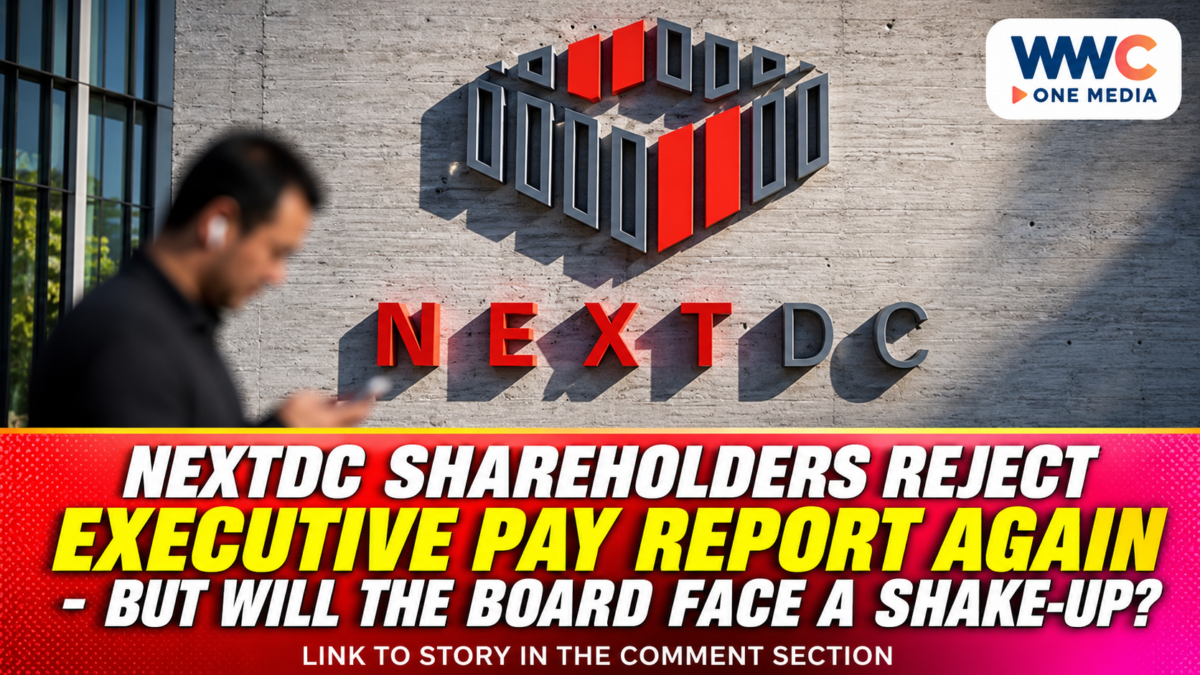
Australian data centre operator NEXTDC Limited has received a second consecutive shareholder strike against its executive remuneration report, with 72.03% of votes cast opposing the FY26 report at its annual general meeting on Nov. 20, 2026.
The result triggered a separate vote on a possible board spill, but shareholders rejected that resolution overwhelmingly, leaving the proposed board-wide shake-up off the table. The outcome puts executive pay and accountability under renewed scrutiny while the company works to address delays affecting its Melbourne M3 data centre project.
A second strike puts executive pay under pressure
The vote concerned NEXTDC’s remuneration report for the financial year ended June 30, 2026. The company’s AGM materials recorded 314,227,856 votes against adoption, representing 72.03% of votes cast, compared with 121,283,445 votes in favour, or 27.80%.
The result followed a first strike at the 2025 AGM, when 71.88% of votes were cast against the previous remuneration report.
Under Australia’s two-strikes mechanism, a remuneration report receives a strike when at least 25% of votes validly cast oppose it. When a company receives a second consecutive strike, shareholders must also consider a conditional resolution that could require a separate meeting to elect the board.
The remuneration vote itself is advisory. It does not automatically cancel executive pay arrangements or remove directors. Its significance is that repeated opposition activates another governance process and gives shareholders a formal opportunity to express dissatisfaction.
NEXTDC had acknowledged the possibility in its AGM notice, which explained that the second strike would bring Resolution 8 before shareholders.
The board spill vote failed decisively
Although the remuneration report attracted strong opposition, shareholders did not support the proposed board spill.
Resolution 8, the conditional board spill meeting resolution, received 489,218,329 votes against, equivalent to 95.75%. Only 19,377,410 votes, or 3.79%, supported it. A further 2,345,735 votes, or 0.46%, were recorded as open.
The proposed resolution would have required an extraordinary general meeting within 90 days. At that meeting, the non-executive directors covered by the resolution would have faced the end of their appointments, with replacement appointments put to shareholders.
Because the spill resolution was defeated, that process will not proceed under this vote.
The distinction is important. The second strike signals substantial shareholder opposition to the remuneration report, but it does not mean the board has been removed or that directors must automatically stand down.
The voting results therefore delivered two different messages: shareholders rejected the company’s pay report, but they also rejected the immediate mechanism that could have forced a board-wide election.
NEXTDC makes changes to its remuneration proposals
The AGM materials also recorded changes to other remuneration-related resolutions.
NEXTDC withdrew Resolution 5, which had proposed increasing the maximum aggregate annual remuneration available to non-executive directors by A$300,000, from A$2.2 million to A$2.5 million.
The company said incumbent non-executive directors had agreed to an immediate voluntary 10% reduction in their current fees. As the resolution was withdrawn, it was not put to shareholders for approval.
Resolution 7, which proposed granting 145,916 performance rights and 145,914 restricted rights to Chief Executive Officer and Managing Director Craig Scroggie under the FY27 long-term incentive plan, was also withdrawn.
The AGM materials state that Scroggie agreed to forgo his FY27 short-term and long-term incentive opportunities and would receive no cash or other award in their place.
These measures are relevant to the shareholder vote because they show that the company made adjustments to its remuneration proposals ahead of the meeting. However, the 72.03% opposition demonstrates that those changes did not secure majority support for the FY26 remuneration report.
M3 delays have added pressure to the company’s performance
The governance dispute is unfolding alongside an operational challenge involving NEXTDC’s M3 data centre in Melbourne.
In his AGM address, Scroggie said the delay in securing additional electricity supply affected the company’s ability to fully deliver some customer contracts at the facility. He also accepted responsibility for delivery, identifying power, planning approvals, construction and community support as elements of the company’s execution responsibilities.
The company explained that additional power for M3 requires new electricity infrastructure. Works by network provider Jemena were suspended after residents and community stakeholders raised concerns about the size of proposed power poles. NEXTDC’s AGM address said Jemena cited safety concerns and a lack of access to work sites resulting from community opposition.
The company said it was pursuing several possible ways to bring power supply forward, including alternative routes, underground infrastructure, different substations and upgrades to existing electricity feeders.
NEXTDC also said construction continues, while the affected customer contracts remain subject to the customer’s rights.
The delay has affected the company’s financial outlook. In its Nov. 20 FY27 guidance update, NEXTDC raised its expected net revenue range to A$485 million–A$500 million, from the revised A$475 million–A$500 million range announced in October. Its underlying EBITDA guidance increased to A$260 million–A$275 million from A$245 million–A$265 million.
Capital expenditure guidance remained at A$4.5 billion–A$5 billion. The revised outlook continues to exclude revenue and attributable EBITDA from the affected M3 customer contracts because the company said it could not yet reliably estimate their contribution.
The challenges facing NEXTDC also reflect a wider issue for Australia’s expanding data centre industry: securing customers and financing is not enough if electricity connections and project approvals cannot keep pace. WWC examined that wider constraint in its report on Australia’s projected A$260 billion AI data centre investment opportunity and the electricity grid.
Why the vote matters beyond executive compensation
The result highlights the difference between a company’s growth ambitions and shareholders’ assessment of how management should be rewarded.
Data centre operators are competing to secure capacity for cloud computing and artificial intelligence. Their investments require substantial capital, long development timelines and dependable electricity infrastructure.
NEXTDC’s experience illustrates how execution risks can become governance issues when shareholders question whether executive rewards appropriately reflect performance and outcomes.
The company’s situation is not unique to one operator. WWC’s coverage of Infratil’s expanding data centre earnings and contracted capacity examines how infrastructure developers must convert customer commitments into operating facilities. In the Philippines, MGEN and VITRO’s exploration of renewable-powered data centres also shows why electricity planning is becoming central to digital infrastructure investment.
For NEXTDC, the shareholder vote does not settle the debate over executive pay. The company will still need to demonstrate that its remuneration framework reflects measurable performance and that its major projects can be delivered within revised expectations.
What happens next
The immediate board spill threat has been rejected, but the second strike remains a clear governance warning.
NEXTDC has said it will continue engaging with shareholders and has outlined changes to director fees and the CEO’s FY27 incentive arrangements. Its next major test will be whether management can make progress on M3, deliver contracted capacity and rebuild confidence through operational results.
The company has indicated that it expects to report on M3 progress at its half-year results in February, or earlier if a material development occurs.
For shareholders, the next reporting period will offer a more concrete basis for judging whether the company’s response has translated into improved execution.
Frequently asked questions
What is a second strike at an Australian company AGM?
A second strike occurs when at least 25% of votes validly cast oppose a company’s remuneration report for two consecutive annual general meetings. It triggers a separate conditional vote on a possible board spill.
How many NEXTDC shareholders opposed the FY26 remuneration report?
The AGM voting results recorded 314,227,856 votes against the report, representing 72.03% of votes cast.
Will NEXTDC’s board be removed after the second strike?
No. Shareholders rejected the conditional board spill resolution, with 95.75% voting against it. The proposed extraordinary general meeting will therefore not proceed under that resolution.
Did NEXTDC change its executive pay proposals?
Yes. The company withdrew a proposed increase in the maximum aggregate annual fees for non-executive directors, and the incumbent directors agreed to a voluntary 10% reduction in their current fees. CEO Craig Scroggie also agreed to forgo his FY27 short-term and long-term incentive opportunities.
What is the main operational issue facing NEXTDC?
Delays in securing additional electricity supply for its M3 Melbourne data centre have affected the company’s ability to fully deliver some customer contracts and have led it to revise its FY27 financial guidance.