CHINA — Nov. 19, 2026. China’s artificial intelligence ambitions are moving beyond the development of advanced chatbots and towards industrial deployment, as Beijing expands policies supporting AI-powered businesses, communications networks and intelligent equipment.
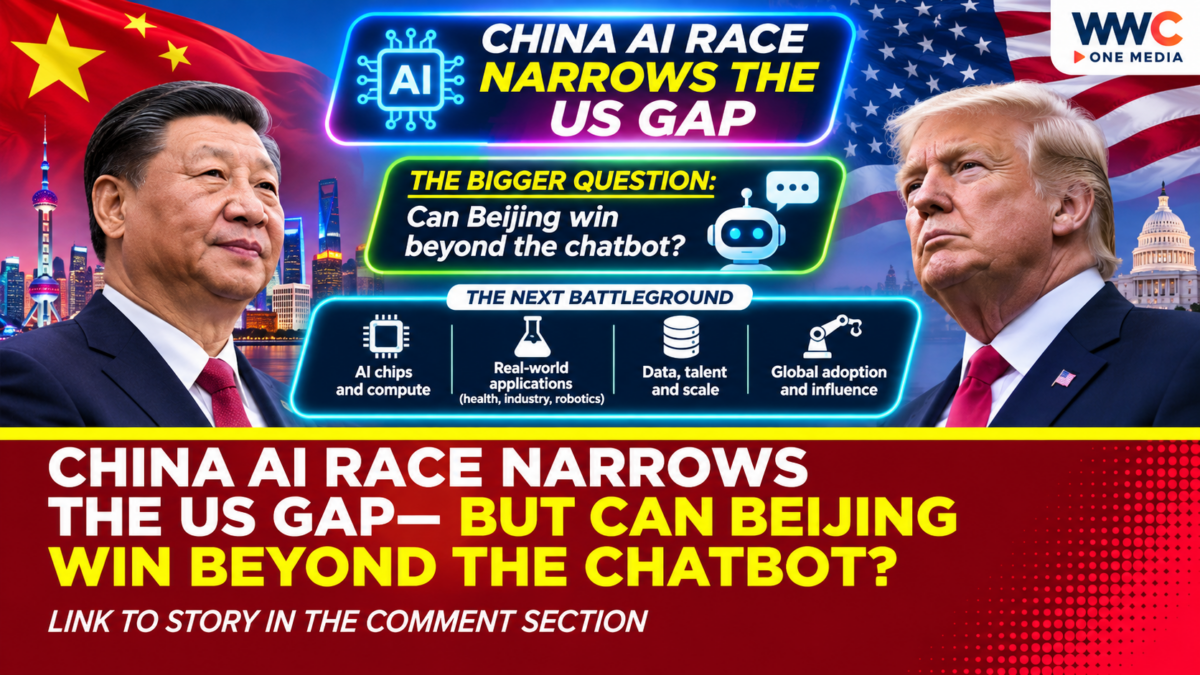
The China AI race is becoming harder to measure through model rankings alone, with new research showing a narrow US–China performance gap even as the United States maintains major advantages in private investment and computing infrastructure.
For Southeast Asian economies, including the Philippines, this competition could influence access to affordable AI technologies, cloud services and the equipment companies use to modernise their operations.
China AI Race Is No Longer Just About Powerful Models
The debate over which country leads artificial intelligence often focuses on the capabilities of major language models.
That is an important measure, but it captures only one part of the technology’s economic impact.
Stanford University’s 2026 AI Index found that the performance gap between leading American and Chinese AI models had effectively narrowed to single digits.
As of March 2026, the leading US model was ahead by approximately 2.7% on the assessment cited in the report.
The findings do not establish that China has overtaken the United States across artificial intelligence.
American developers continued to produce more notable frontier models, while China led in several research and industrial measures, including AI publication volume, patent output and industrial robot installations.
These differences matter because technological leadership can emerge in several forms.
A country may develop stronger models but face challenges turning them into commercially valuable products. Another may achieve significant industrial deployment without producing the highest-ranked general-purpose system.
The next phase of competition therefore involves not only intelligence benchmarks but also economic usefulness.
Beijing Is Pushing AI Into Everyday Economic Activity
China’s official policy direction increasingly emphasises the commercial application of artificial intelligence.
In March 2026, the government’s work programme called for expanding its AI Plus initiative and accelerating the deployment of intelligent devices, AI agents and new forms of digital economic activity.
The programme identified several areas for technological development, including multimodal AI, embodied intelligence and autonomous software agents.
These technologies address different kinds of work.
Multimodal systems can process different information formats, while embodied AI connects intelligent software with physical equipment such as robots.
AI agents, meanwhile, can perform sequences of digital tasks rather than responding only to individual questions.
The distinction is significant for companies.
A chatbot may improve an employee’s workflow, but an industrial AI system could potentially influence production scheduling, equipment monitoring, inventory management or service delivery.
Analysis: The strongest commercial returns may come from integrating AI into existing business processes rather than introducing another standalone consumer application.
However, government objectives are not proof of successful deployment. Actual productivity improvements must be demonstrated through operational results, costs and commercial demand.
Factories, Networks and Automation Become the Next Test
China has also established specific goals for integrating AI into telecommunications and information infrastructure.
A government implementation plan issued in June 2026 covers the period from 2026 to 2028 and seeks to introduce more autonomous communications networks.
The plan targets more than 30 high-value AI application scenarios and at least 75% coverage of one-millisecond-latency computing access in metropolitan areas by 2028.
These are policy targets, not verified achievements.
The programme also sets longer-term ambitions for technological development through 2030.
Reliable communications networks are important because many advanced AI applications require rapid data exchange between equipment, computing systems and users.
For manufacturers, delays or interruptions in these connections can affect the practicality of automation.
The wider industry is already debating how accessible AI models should be.
WWC ONE MEDIA previously examined the competition between American and Chinese open-weight AI models, including the distinction between downloadable model weights and fully open-source technology.
That distinction matters for manufacturers and software developers seeking greater control over their applications.
America’s Investment Advantage Remains Substantial
China’s industrial ambitions have not eliminated the financial advantages held by the United States.
Stanford’s 2026 AI Index reported that US private AI investment reached US$285.9 billion in 2025, compared with US$12.4 billion in China.
The comparison measures private investment and does not capture every form of government-backed financial support.
The United States also retains an important advantage in AI computing infrastructure.
Stanford’s assessment counted 5,427 US data centres, more than ten times the number in any other country.
Computing capacity matters because training and operating demanding AI models requires substantial investment in processors, electricity, networking and related infrastructure.
China’s technology ambitions therefore face a practical constraint: software competitiveness does not automatically remove hardware limitations.
This issue is particularly relevant for the Philippines and neighbouring economies.
WWC’s earlier examination of how US AI chip restrictions could affect Southeast Asian data centres explored the regional implications of access to advanced computing equipment.
Analysis: A country’s advantage in AI research may produce less economic value if businesses cannot obtain enough reliable, affordable computing capacity to deploy its technologies at scale.
Conversely, broader access to efficient models could help smaller businesses adopt AI without building expensive systems themselves.
Adoption Could Matter More Than Headlines
AI adoption is expanding rapidly, but usage is not the same as commercial success.
Stanford’s report found that 88% of surveyed organisations were using AI in at least one business function in 2025.
However, more advanced AI-agent deployment remained limited across most business functions.
This suggests a sizeable difference between experimenting with artificial intelligence and reorganising business operations around it.
China’s expanding consumer AI market illustrates another dimension of the challenge.
WWC previously examined how China’s growing generation of AI users is changing education and digital technology adoption.
The wider economic question is whether everyday familiarity can eventually translate into improvements in workplace productivity, technical skills and enterprise competitiveness.
There are also reasons for caution.
Businesses must manage data protection, reliability, implementation expenses and employee training.
A company adopting AI software may gain capabilities without necessarily achieving immediate cost savings.
For developing markets, the affordability and adaptability of competing AI technologies could prove more important than nationality.
What Happens Next?
China’s next major test will be the implementation of its industrial and communications programmes rather than the announcement of additional AI ambitions.
The 2028 communications targets provide measurable milestones for deployment, while the broader policy framework places AI integration within the country’s longer-term economic development plans.
Future evidence should include verified business adoption, operational improvements, infrastructure availability and the commercial performance of AI-related products.
The United States remains influential in advanced models, investment and computing infrastructure, while China has demonstrated substantial capabilities in research, industrial automation and technology deployment.
Analysis: The AI race may ultimately produce different leaders across different industries instead of one country winning every category.
For the Philippines, the practical question is which technologies can deliver dependable services, manageable costs and useful productivity improvements.
China is closing important gaps in artificial intelligence. Whether it can convert those advances into a wider economic advantage remains an open question.