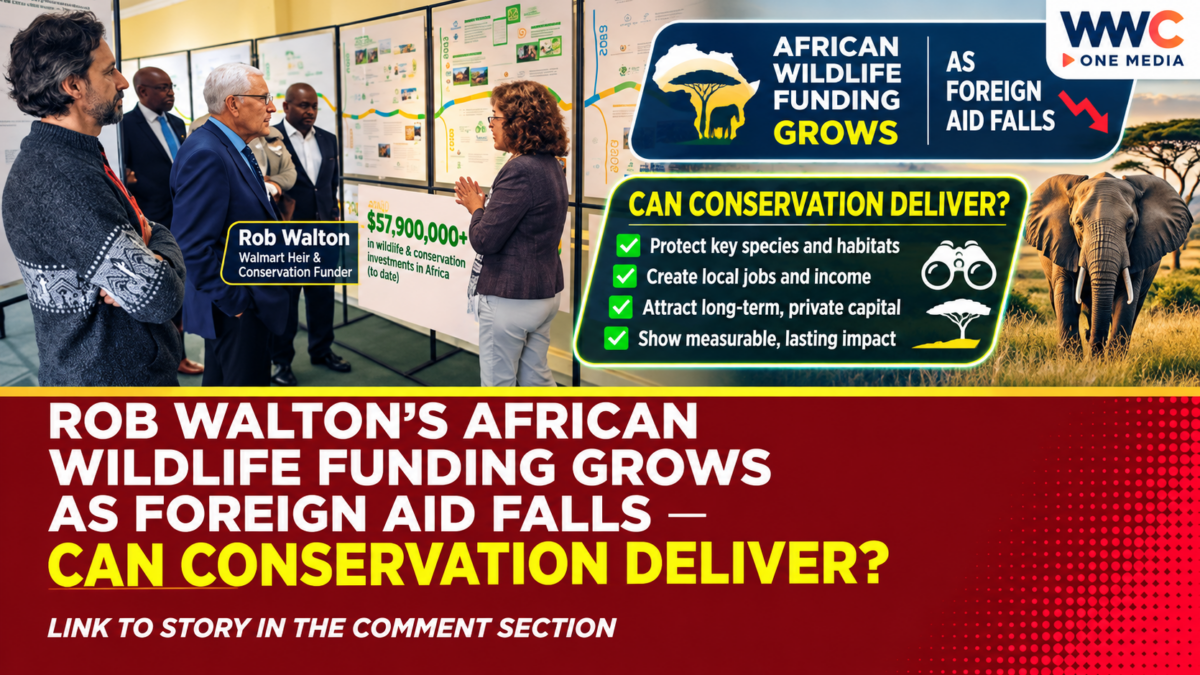
JOHANNESBURG — Nov. 19, 2026. The Rob Walton Foundation has committed US$4.6 million to results-linked conservation work across four African protected areas, adding to longer-running efforts to finance wildlife protection through partnerships with governments and local communities. African wildlife funding is drawing fresh attention as official development assistance contracts, prompting questions about how parks can sustain operations without relying on a single donor.
This is not a newly announced payment of every dollar discussed in Walton-linked conservation programmes. A previous US$100 million endowment pledge, the US$4.6 million grant and a separate potential US$50 million matching arrangement have different terms and cannot be treated as one immediately available cash balance.
African Wildlife Funding: What Rob Walton Committed
African Parks announced on Sept. 21 that the Rob Walton Foundation had committed US$4.6 million using an outcomes-based approach involving Verifiable Nature Units. The named locations are Majete Wildlife Reserve in Malawi, Odzala-Kokoua National Park in the Republic of Congo, Garamba National Park in the Democratic Republic of the Congo and Zakouma National Park in Chad.
The commitment is intended to support biodiversity monitoring, community development and park infrastructure. The original statement does not establish how much money has already been disbursed to each site, or prove that the new grant has already generated measurable wildlife gains.
Rob Walton, a former Walmart chairman and son of founders Sam and Helen Walton, has backed African Parks since its early years. The organisation previously disclosed a US$100 million endowment pledge in 2021 through the Rob and Melani Walton Foundation. An endowment commitment serves a different purpose from a project grant and should not be counted twice as new 2026 financing.
A Different Way to Pay for Conservation
The latest grant introduces Verifiable Nature Units, or VNUs, as a method of linking support to measured conservation performance. African Parks describes one unit as one square kilometre of nature whose ecological integrity has been maintained or improved over an annual period.
Such a measurement requires credible ecological information and independent verification. It is not the same as purchasing a square kilometre of land, creating a new national park or proving that every species in the area has increased.
The ambition is to give funders a clearer view of results rather than measuring success only by expenditure. WWC has examined Canada’s proposed performance-based tropical forest financing, a separate initiative built around verified conservation outcomes. The programmes have different structures and are not interchangeable.
Why Declining Aid Changes the Calculation
Official development assistance from OECD Development Assistance Committee members and associates fell 23.1% in real terms in 2025 to US$174.3 billion, preliminary figures show. A subsequent OECD projection anticipates another reduction in 2026, including a projected 11.6% fall in bilateral assistance to sub-Saharan Africa.
Those figures describe broad development aid, not a verified cut of the same percentage to African Parks or wildlife programmes specifically. Nonetheless, a more constrained aid environment can make long-term financing less predictable for organisations whose work spans government services, habitats and livelihoods.
African Parks’ 2025 annual report says the organisation closed a US$25.4 million funding gap through cost reductions and partner support, without job losses. It also reported tourism revenue of US$17.8 million. Those are the organisation’s own operational figures, not an independent audit of the return on Walton’s latest grant.
The Larger Matching-Fund Opportunity
A separate initiative links the Rob Walton Foundation with the Global Environment Facility. The foundation says eligible African governments choosing to direct GEF-9 resources towards qualifying protected-area organisations could pair them with up to US$50 million in philanthropic matching support.
This amount is a conditional ceiling, not evidence that US$50 million has been transferred. The proposed arrangement involves national priorities, eligibility decisions and project development, with Conservation International providing technical assistance.
The foundation’s strategy identifies 162 Keystone Protected Areas whose effective management it wants partners to strengthen. Walton’s August statement expresses an intention to fund up to 25% of suitable collaborative management partnerships’ effective operating budgets over time. That is a funding approach, not a blanket promise to pay one-quarter of every African park’s expenses.
Wildlife Results Need Community Safeguards
African Parks’ 2025 report records the relocation of 2,217 animals from 13 species, including 256 southern white rhinos under its Rhino Rewild initiative. It also reports livelihood programmes, community income and investment in safeguards and grievance mechanisms. These are organisation-reported activities and outcomes; they cannot all be attributed to Walton’s September grant.
A durable conservation model also needs residents to benefit from and participate in decisions affecting protected landscapes. The operator says it has established an independent panel of African legal and human-rights specialists to oversee its grievance mechanism. Reporting a new safeguard does not, by itself, demonstrate that every concern has been resolved.
The principle has parallels in WWC’s coverage of community incentives for protecting Indonesian wildlife and its report on international cooperation to protect Philippine eagles. Effective conservation depends on practical local arrangements as well as funding announcements.
What Happens Next
Analysis: The strongest test is whether multi-year funding translates into independently checked ecological outcomes, transparent spending and credible community participation. The US$4.6 million commitment offers a defined experiment in results-linked philanthropy, while the matching-fund proposal could broaden financing only if eligible governments and partners secure the necessary agreements.
Future park-level reports should clarify disbursements, verified nature-unit performance and how safeguards operate in practice. Until then, a commitment should be described as a commitment, not a fully paid grant or completed conservation success.
Frequently Asked Questions
How much has Rob Walton’s foundation committed to African Parks recently?
African Parks announced a US$4.6 million results-linked commitment on Sept. 21, 2026, across four named protected areas. It is separate from an earlier US$100 million endowment pledge.
Is the US$50 million conservation partnership already funded?
The foundation describes up to US$50 million in potential matching support for eligible projects connected with GEF-9 resources. That is a conditional funding ceiling, not confirmed full disbursement.
Has international development aid declined?
Yes. OECD preliminary figures show official development assistance declined 23.1% in real terms in 2025. This cannot be interpreted as the exact reduction in every wildlife conservation budget.
How will the success of the wildlife funding be measured?
The new grant uses Verifiable Nature Units tied to independently checked ecological integrity over defined areas and periods. Disbursement details and subsequent measured outcomes remain important evidence to monitor.