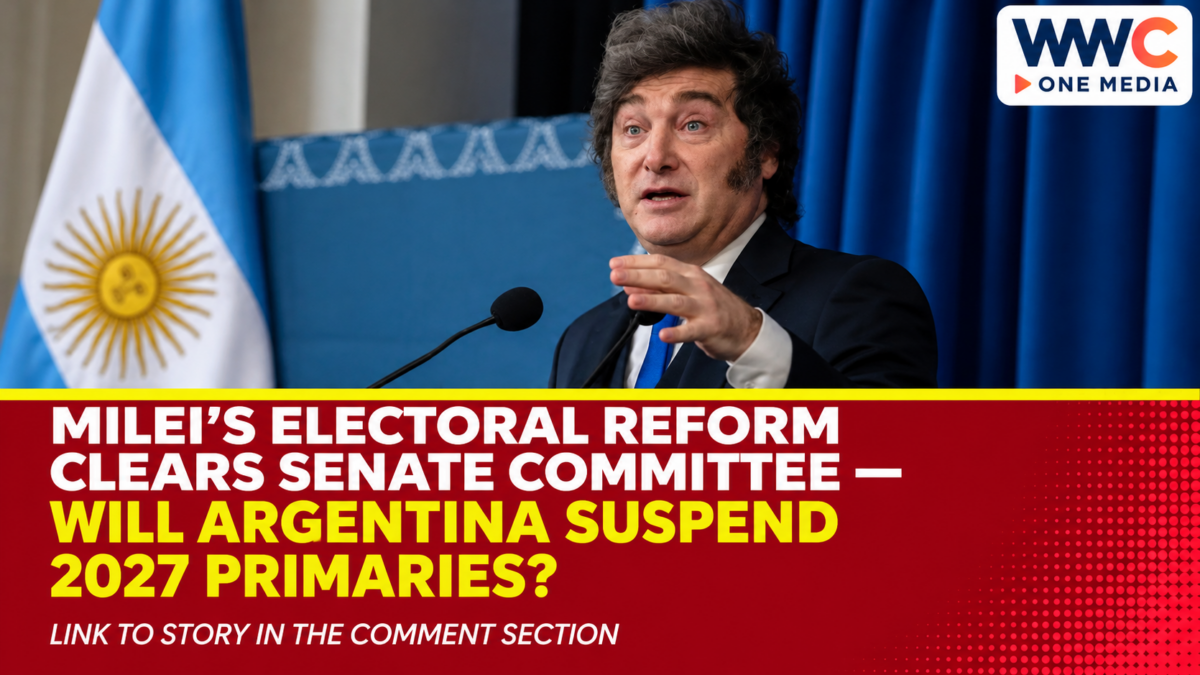
BUENOS AIRES, Argentina — President Javier Milei’s electoral reform advanced in Argentina’s Senate after the Constitutional Affairs Committee’s report entered the chamber’s legislative records on Nov. 18, 2026. The proposed changes put the future of the country’s national primary elections under scrutiny ahead of the 2027 electoral cycle, but the committee step does not amount to a law.
The Senate docket identifies the government’s proposal as file PE-102/26, tied to Presidential Message 110/26. It records disagreements among committee members, leaving legislators to settle both the rules themselves and the political support needed to enact them.
Milei Electoral Reform Reaches a Legislative Milestone
The Senate’s official tracking page records the arrival of the committee report on Nov. 18 and identifies Order of the Day 434/26. It lists senators Espínola, Fama and Vigo as dissenting on that date.
That is more substantial than an administration announcement: a committee report is a formal stage in the legislative process. But it is not an approval by the full Senate, much less final passage through Congress.
The public docket does not by itself establish the precise number of committee signatures, the latest wording of every amendment or a confirmed date for a floor vote. Those details should be checked against the actual committee report and subsequent session records before publication as settled facts.
This distinction is especially important when headlines describe an electoral overhaul as having cleared a hurdle. A legislative hurdle is not the same as the reform taking effect.
Argentina’s Earlier Primary Suspension Was Temporary
Argentina has already demonstrated that PASO elections can be suspended without permanently removing the system from national law.
Law 27,783, published in the Official Gazette on March 7, 2025, suspended the open, simultaneous and compulsory primaries for 2025 only. It also adjusted related electoral deadlines for that year’s voting process.
The time limit matters. A one-year suspension does not automatically apply to elections in 2027, nor does it repeal every provision establishing the primaries.
The underlying PASO framework appears in Law 26,571. Its purpose includes organising a national process through which political groupings select candidates before the general election.
Why it matters: Without a new legislative change, it would be misleading to treat the 2025 suspension as proof that the 2027 primaries have already been cancelled.
Why Milei Wants to Change the PASO System
The President’s Office set out its electoral reform agenda publicly on April 22, 2026, when it announced that a comprehensive proposal had been sent to Congress.
At that stage, the government sought permanent elimination of the PASO system. It described the primaries as costly and argued that candidate selection should instead be handled within political parties.
The same official announcement outlined proposals concerning party-registration thresholds, digital affiliation, campaign financing, political advertising arrangements and eligibility rules for public office.
Those were executive proposals, not automatic changes to the law. A government can explain what it hopes to enact without having secured congressional agreement on every provision.
The administration also cited an election-related cost estimate for 2023 in defending its position. Because a separate audited calculation was not independently inspected for this article, that asserted saving is not presented as an established fiscal benefit.
The Difference Between Suspension and Abolition
A temporary suspension preserves the underlying system while setting it aside for a defined election period. Permanent abolition would remove the statutory basis for that system, requiring a different arrangement for the nomination of candidates.
This difference could determine how parties prepare for the 2027 presidential and legislative contests. If national primaries do not take place, organisations would need to follow whatever valid candidate-selection procedures the final legislation and other applicable rules require.
Analysis: Parties with established internal decision-making structures might adapt differently from alliances that use open contests to settle competing candidacies. The possible effects would depend on the final enacted wording, not simply the political label attached to the reform.
The latest committee document was not available in readable form during this verification. Accordingly, this article does not assert that a one-year suspension, a permanent repeal or any particular compromise has already won final congressional approval.
What the Reform Could Mean for Voters
Changing primary rules has consequences beyond campaign costs. A nationwide primary allows eligible voters to participate in an earlier stage of choosing candidates; party-controlled nominations could involve a different electorate and different eligibility conditions.
Supporters of reform can reasonably argue that avoiding an extra national election may reduce administrative demands. Critics can reasonably question whether moving candidate selection further inside party organisations would limit public participation.
Neither conclusion should be treated as an automatic outcome. The answer depends on the procedures that actually replace or suspend PASO and on how political parties implement them.
For international investors, electoral rules can also influence expectations about candidate selection and political competition. WWC ONE MEDIA previously examined Argentina’s bond-market concerns ahead of Milei’s 2027 reelection test. That earlier market discussion is context, not proof of a direct financial-market reaction to this committee report.
Comparable procedural questions have arisen elsewhere. WWC’s coverage of the Philippine Senate’s debate over changing barangay election schedules illustrates why a proposal’s legislative status must be separated from an enacted election calendar. The countries’ legal systems are different, and neither case decides the other.
WWC has also reported on Philippine election administrators preparing for scheduled polls while legislative changes remained possible. The general lesson is procedural: officials and voters need to know which timetable is legally in force.
What Happens Next
The next decisive evidence will be the complete Senate committee text, any floor debate and recorded vote, and the subsequent action of the other legislative chamber. Any approved electoral change must follow Argentina’s constitutional lawmaking requirements before it can govern a future election.
Until those steps are documented, the verified development is narrower but important: the reform has advanced through a Senate committee stage, and disagreement remains part of the official record. Whether Argentina suspends its 2027 primaries is still a legislative question, not a completed election-calendar change.
Frequently Asked Questions
Has Argentina officially cancelled its 2027 primary elections?
No final 2027 cancellation law was established in the official records examined for this article. The Senate docket confirms committee progress, not completed enactment.
What does PASO mean in Argentina?
PASO refers to Primarias Abiertas, Simultáneas y Obligatorias—open, simultaneous and compulsory primary elections used in the national candidate-selection framework.
Did Argentina already suspend its primaries before?
Yes. Law 27,783 suspended the national PASO elections for 2025. Its stated suspension applied to that year, not automatically to 2027.
What changed on Nov. 18, 2026?
The Senate’s legislative file records receipt of the Constitutional Affairs Committee report for electoral reform and identifies dissenting senators.
Is the reform already binding on voters and political parties?
No. A committee report alone does not enact legislation. Further congressional action and the relevant legal formalities are required.