
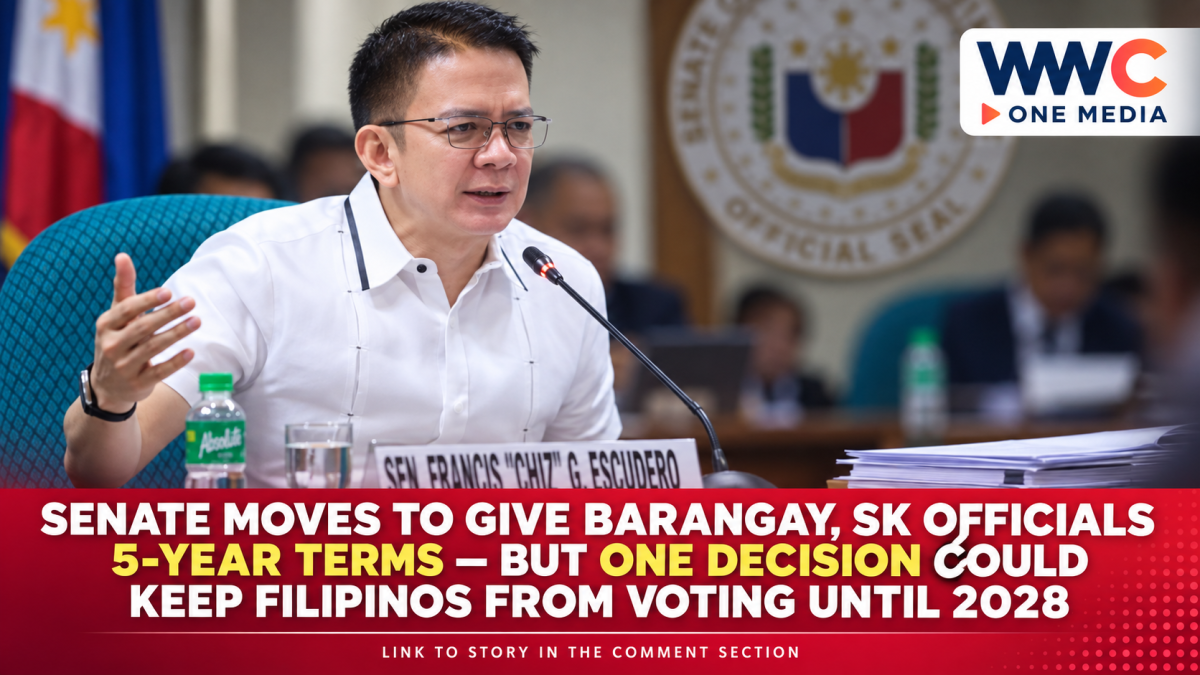
MANILA, Philippines — The Philippines is moving closer to another major change in its barangay and Sangguniang Kabataan election calendar, with lawmakers advancing a plan that would give grassroots officials five-year terms and effectively move the next elections from November 2026 to November 2028.
But what appears on the surface to be a simple change in term length has become a much larger debate over voters’ rights, political accountability and how long elected officials should be allowed to remain in office without facing another election.
The Senate approved Senate Bill No. 2387 on second reading on September 9, a day after the House of Representatives approved its counterpart, House Bill No. 10971, on third and final reading.
If the legislation ultimately becomes law, barangay and SK officials would serve fixed five-year terms instead of the four years provided under current law, while the next Barangay and Sangguniang Kabataan Elections, or BSKE, would be held in November 2028 and every five years thereafter.
That means incumbents elected in 2023 could remain in office for roughly five years before voters get another chance to replace them.
And that is where the controversy begins.
Five Senators Break With the Majority
Five senators opposed the measure during the Senate’s second-reading approval: Senate President Pro Tempore Vicente “Tito” Sotto III and Senators Joel Villanueva, Francis “Kiko” Pangilinan, Bam Aquino and Risa Hontiveros.
Their disagreement is not necessarily centered on the idea of a five-year term itself.
One of the biggest questions is whether the government needs to cancel the already scheduled November 2 election in order to introduce that five-year term.
Sotto has argued that Congress could allow the November 2026 elections to proceed and simply give the officials elected this year the new five-year tenure. He warned that postponing the vote once again risks restricting the public’s opportunity to choose its barangay leaders.
That distinction could become crucial.
Congress is debating two connected but fundamentally different questions: How long should barangay officials serve? And should today’s officials be the first to benefit from that longer cycle?
Why Supporters Want Five Years
Sen. Francis “Chiz” Escudero, sponsor of the Senate measure, has repeatedly described the proposal as an effort to “fix” the election cycle rather than merely postpone another election.
His argument is that barangay governments need enough time to implement community programs, infrastructure projects, disaster-preparedness measures and peace-and-order initiatives without being repeatedly disrupted by elections.
The proposal is also meant to stop Congress from repeatedly rewriting the BSKE calendar.
Barangay elections have been postponed numerous times over the past two decades, and Escudero has argued that establishing a predictable five-year timetable could finally end that cycle.
Supporters have also pointed to the administrative and financial burden of conducting another nationwide election.
But critics say convenience and savings should not automatically outweigh the public’s right to periodically choose its leaders.
Villanueva Raises a Simple Question: Why Five Years?
Villanueva challenged one of the basic assumptions behind the legislation: What evidence shows that four years is no longer enough?
The current four-year term was enacted only in August 2025 under Republic Act No. 12232.
During Senate deliberations, Villanueva questioned what had changed in roughly one year that would suddenly make the four-year term inadequate. Escudero acknowledged that agencies asked to provide supporting studies had not produced a clear basis explaining specifically why five years was the appropriate number.
That admission adds another dimension to the debate.
Five years may provide greater continuity, but lawmakers are now being asked to explain why it is better than four — and whether that additional year justifies delaying an election that election authorities have already spent months preparing for.
Comelec Is Already Deep Into Election Preparations
The Commission on Elections has not been waiting for Congress.
Comelec Chairman George Erwin Garcia said earlier this year that the agency was about 90 percent prepared for the November 2, 2026 BSKE, with ballots and other election materials already part of the preparation process. Around 95 million voters were expected to be eligible to participate.
Garcia has also warned that billions of pesos have already been spent or committed for the polls.
DZRH reported that Comelec estimated roughly ₱8 billion had already gone into preparations, raising the question of how much public money could effectively be stranded if Congress moves the election to 2028.
Supporters of postponement counter that fewer elections over the long term could eventually generate savings.
But the immediate financial reality is harder to ignore: preparations for November are already well underway.
House Moves Faster Than Senate
The House of Representatives has already gone a step further than the Senate.
On September 8, lawmakers approved House Bill No. 10971 on third and final reading, with 211 voting in favor, 13 against and one abstaining. Official House records confirm that the measure sets fixed five-year terms for barangay and SK officials and amends Republic Act No. 12232.
Under the House proposal, the next elections would be held on the second Monday of November 2028, followed by elections every five years.
The House version would also limit barangay officials to two consecutive terms, while SK officials would continue to be limited to one term. Barangay officials already serving their third consecutive term would not be allowed to run for the same position in 2028.
Those details could still change depending on the final Senate version and any reconciliation process between the two chambers.
Important: The November 2026 Election Is Still the Law—for Now
Despite headlines saying the BSKE has already been postponed, that is not yet legally final.
Republic Act No. 12232 remains the controlling law. It established four-year terms and scheduled the next regular barangay and SK elections for the first Monday of November 2026, with elections every four years thereafter.
The Senate measure has passed only second reading.
It must still clear third and final reading. Any differences between the House and Senate versions must then be reconciled, both chambers must approve the final text, and the measure must ultimately go through the constitutional process required for enactment.
Until that happens, November 2, 2026 remains the legally scheduled BSKE date.
That distinction matters for voters, candidates and Comelec officials preparing for an election less than two months away.
Supreme Court History Could Become the Real Story
The political fight may only be the first round.
The Supreme Court has dealt with barangay-election postponements before, and its rulings explain why lawmakers are carefully describing the current proposal as a term-setting law rather than simply a postponement measure.
In 2023, the Court struck down Republic Act No. 11935, which had postponed the 2022 BSKE, ruling that election postponements require sufficiently important government justification because regular elections are closely tied to the right of suffrage.
But the legal picture changed in 2025.
The Supreme Court later upheld Republic Act No. 12232, which established today’s four-year terms and moved the election to November 2026. The majority ruled that the measure was fundamentally a term-setting law, with the election rescheduling considered incidental to Congress’ constitutional authority to determine barangay officials’ terms.
That precedent could give supporters of the new five-year measure a significant legal argument.
But it does not guarantee that another law will automatically survive another challenge.
Election lawyer Romulo Macalintal, who has previously challenged BSKE postponement measures, has already indicated that another Supreme Court challenge could follow if the current proposal becomes law.
Why the 2028 Date Is the Real Flashpoint
The political appeal of five-year terms is easy to understand.
Barangay officials are responsible for services Filipinos encounter every day—from certificates and community disputes to disaster response, health programs and peace-and-order coordination.
More time can mean greater continuity.
But elections serve another purpose: they allow voters to judge whether that continuity deserves to continue.
The hardest question facing Congress is therefore not simply whether five years is a better term than four.
It is whether Filipinos who expected to vote in November should now be told to wait until 2028.
If the five-year system begins only after voters elect a fresh set of officials, much of that controversy disappears.
If incumbents remain until 2028, however, Congress may once again find itself defending the line between setting a term and extending political power without a fresh mandate from voters.
And that may ultimately be the issue the Supreme Court is asked to decide.



Leave a Reply