
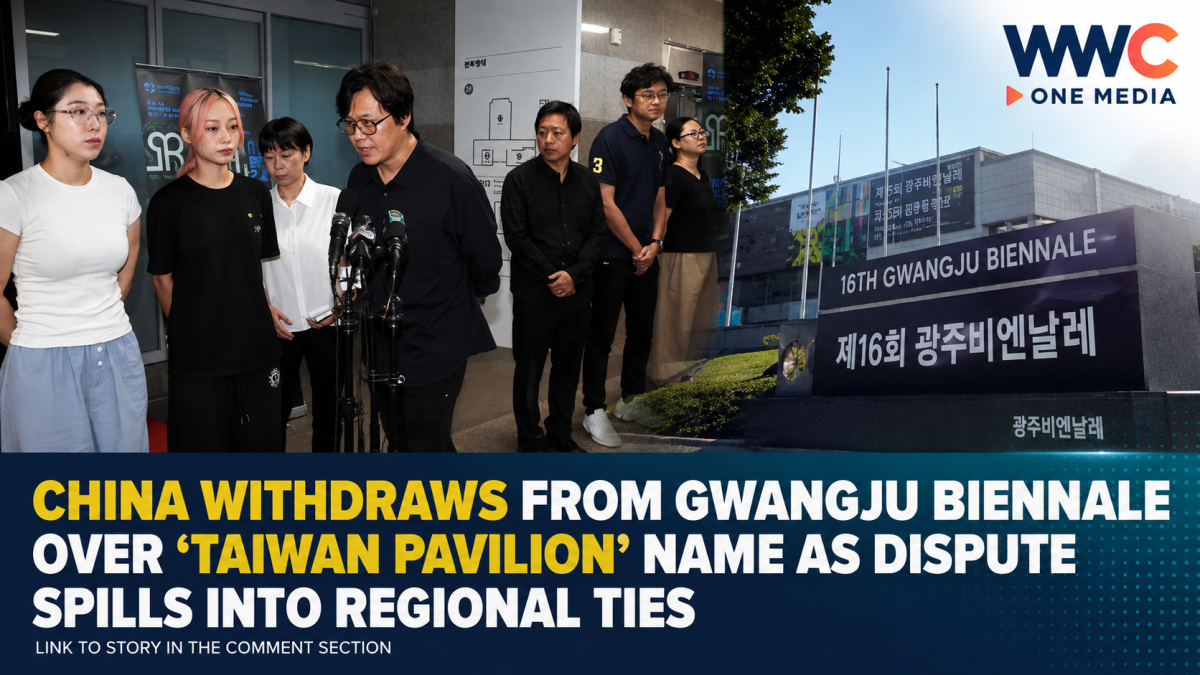
GWANGJU, South Korea — A naming dispute over Taiwan has erupted into a major diplomatic and cultural controversy just two days before the opening of South Korea’s 16th Gwangju Biennale, after Chinese artists and curators announced their withdrawal from the exhibition.
The Chinese exhibition team announced on September 3 that it had unanimously decided to pull out of the biennale, arguing that organizers’ approval of the name “Taiwan Pavilion” allowed political issues to enter the arts.
The decision follows weeks of controversy over how the Taiwanese exhibition would be identified — and has now expanded beyond the exhibition itself, with a planned Chinese delegation visit to the Gwangju area also reportedly cancelled.
The dispute started with the name “Taiwan Pavilion”
The controversy centers on Taiwan’s participation in the biennale through the National Taiwan Museum of Fine Arts (NTMoFA).
The Gwangju Biennale Foundation initially changed the exhibition’s designation from “Taiwan Pavilion” to “NTMoFA Pavilion,” saying the participating institution was an institutional rather than a national pavilion and that its administrative procedures required the use of the institution’s name.
Taiwanese artists and officials strongly objected.
Ten Taiwanese artists and curators accused the foundation of what they described as political censorship, arguing that “Taiwan” had been removed from promotional material without their agreement.
The dispute generated support from Korean and international artists and cultural organizations, increasing pressure on the foundation to reconsider its decision.
On August 25, the foundation approved the restoration of the “Taiwan Pavilion” designation. Taiwan’s Ministry of Culture subsequently confirmed that the name would be used in official documents and promotional materials.
That decision solved one problem — but created another.
China objects and halts its pavilion preparations
China strongly objected to the restored name.
Chinese officials argued that referring to the exhibition as the “Taiwan Pavilion” conflicts with Beijing’s One China principle.
Chinese Ambassador to South Korea Dai Bing reportedly raised the issue with Gwangju-area officials, expressing concern and opposition over the naming decision.
Chinese participants then stopped preparations for their own pavilion.
On September 3, curator Ruan Yuelai announced that the Chinese exhibition team had unanimously decided to withdraw, saying the naming decision represented political interference in the arts. The announcement was made at the Ha Jung-woong Museum of Art in Gwangju.
The press conference reportedly lasted only a few minutes and ended without a question-and-answer session.
Beijing says the issue goes beyond an art exhibition
China’s Embassy in Seoul has taken a firm position on the controversy.
The embassy said allowing the Taiwan exhibition to use the name “Taiwan Pavilion” violated the One China principle and argued that the decision damaged the political foundation of China-South Korea relations.
China’s position is that Taiwan is part of China and that its participation in international or multilateral activities should follow Beijing’s interpretation of the One China principle.
Taiwan, meanwhile, operates as a self-governing democracy and maintains its own government and institutions, while Beijing claims sovereignty over the island.
That longstanding political dispute has increasingly spilled into international sporting, cultural and academic events.
Gwangju Biennale apologizes — but refuses to make the dispute about politics
The Gwangju Biennale Foundation has attempted to separate the controversy from the artistic content of the exhibition.
In a September 2 statement, the foundation apologized for the confusion surrounding the pavilion project and acknowledged that differences between participating institutions had not been adequately coordinated.
The foundation maintained that its pavilion project is intended to facilitate cultural and artistic exchange and said it respects the autonomy of participating institutions and artists.
It also expressed hope that the Chinese Pavilion would continue participating.
But that appeal did not prevent the Chinese team from announcing its withdrawal the following day.
South Korean officials are caught between the two sides
The controversy places South Korean organizers and local officials in a difficult position.
China is an important economic and diplomatic partner for South Korea, while Taiwan has developed increasingly visible cultural and economic links with the country.
South Korean officials have also stressed their existing position regarding the One China policy.
At the same time, Gwangju officials have argued that the “Taiwan Pavilion” designation is an artistic presentation and does not mean that South Korea or the Gwangju authorities are recognizing Taiwan as a separate state.
That distinction has not satisfied Beijing.
The fallout is now reaching local diplomacy
The controversy is no longer confined to the biennale.
A Chinese delegation from Guangzhou had been scheduled to visit the Jeonnam-Gwangju area on September 6–7. According to Yonhap, the delegation cancelled the planned visit in what was understood to be a protest connected to the Taiwan Pavilion dispute.
The planned program reportedly included meetings with local officials, visits to industrial and cultural facilities and a visit to the Gwangju Biennale.
The cancellation is significant because Gwangju and Guangzhou have maintained local-government exchanges dating back to a friendship agreement signed in 2012.
Another Chinese city, Zhoushan in Zhejiang province, has also reportedly indicated that it would not operate a promotional pavilion at the upcoming Yeosu World Island Expo, although organizers are attempting to persuade it to participate.
The developments suggest that the Gwangju dispute could have consequences beyond the art festival itself.
Why Gwangju makes the controversy particularly sensitive
The Gwangju Biennale is not an ordinary commercial art show.
Founded in 1995, it emerged in a city internationally associated with South Korea’s pro-democracy movement and the 1980 Gwangju uprising.
The 2026 biennale is built around the theme “You Must Change Your Life,” inspired by the final line of German poet Rainer Maria Rilke’s Archaic Torso of Apollo. The official exhibition runs from September 5 through November 15, 2026.
That history makes the current dispute over identity, political pressure and artistic autonomy particularly sensitive.
The Taiwanese artists who protested the original name change argued that the issue was not simply about a label, but about whether artists and cultural institutions should be able to determine how they identify themselves.
Taiwan’s name was restored — then China walked away
The sequence of events is what makes this dispute particularly striking.
First: the Gwangju Biennale Foundation changed “Taiwan Pavilion” to “NTMoFA Pavilion.”
Then: Taiwanese officials and artists protested, accusing the organizers of suppressing Taiwan’s identity.
Next: Korean and international artists joined the criticism.
After that: the foundation restored the “Taiwan Pavilion” name on August 25.
Then: China protested, halted work on its pavilion and ultimately announced its withdrawal on September 3.
What began as an administrative dispute over exhibition labeling has therefore evolved into a confrontation involving China, Taiwan, South Korea, the international art community and local governments.
What happens when the biennale opens?
The 16th Gwangju Biennale is still scheduled to open on September 5, despite the Chinese withdrawal.
The immediate question is whether the Chinese pavilion will remain empty or whether organizers can find a way to proceed with some portion of the planned exhibition.
The larger question may be more difficult:
Can a major international cultural event keep politics outside the gallery when the very names used inside the exhibition carry geopolitical meaning?
For Gwangju, that question has arrived just days before opening.
And with Chinese cultural participants now withdrawing and local diplomatic exchanges being affected, a dispute that began with the name of one pavilion is showing signs of becoming something much larger.
WWC ONE MEDIA G.A



Leave a Reply