
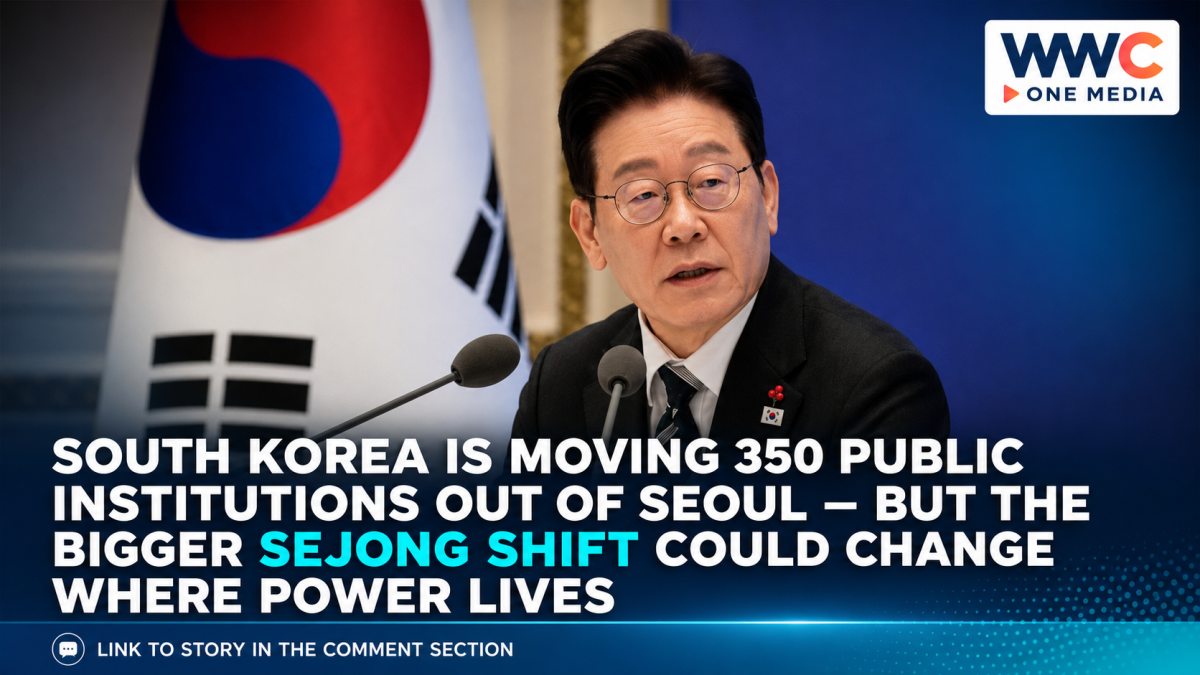
SEOUL — South Korea is preparing one of its most ambitious attempts yet to loosen Seoul’s grip on political, economic and administrative power, with hundreds of public institutions potentially heading out of the capital region and more national government functions shifting to Sejong.
The government announced Thursday, September 3, that central administrative agencies still based in the Seoul metropolitan area will begin relocating from the first half of 2027, putting fresh momentum behind a decentralization project that has been unfolding for more than a decade.
But this is no longer simply about moving government offices.
The broader plan could reshape where South Korea’s public-sector jobs, investment and political influence are concentrated — at a time when many communities outside Greater Seoul are struggling with shrinking populations, ageing residents and weakening local economies.
Justice Ministry Among Agencies Heading to Sejong
Among the most immediate moves, South Korea’s Ministry of Justice and Ministry of Gender Equality and Family are expected to relocate to Sejong beginning in the first half of 2027.
Other major bodies requiring purpose-built headquarters — including the prosecution organization and the National Police Agency — are expected to follow after new facilities are completed.
The government is also considering the future relocation of other ministries, including the foreign affairs and unification portfolios, as Sejong’s role expands.
The move builds on a process that began in 2012, when the prime minister’s office relocated to Sejong, roughly 120 kilometres south of Seoul.
Since then, 44 central government organizations have completed moves to the city, according to Yonhap, turning Sejong into South Korea’s de facto administrative hub even as the presidency and National Assembly remain primarily based in Seoul.
350 Public Institutions Could Be Next
The scale of the next phase is considerably larger.
The government plans to announce detailed relocation arrangements in the fourth quarter of 2026 for roughly 350 public institutions currently based in the Seoul metropolitan area, with relocations beginning in 2027.
Rather than simply distributing agencies evenly across the country, officials want related institutions clustered around regional innovation centers, potentially giving individual cities stronger specialized economic ecosystems.
That represents an evolution from South Korea’s first major public-institution relocation program.
The Korea Times reported that the earlier round, completed in 2019, involved 153 institutions. President Lee Jae Myung has argued that the previous approach did not create enough concentration between organizations in related industries, limiting its ability to generate powerful regional growth centers.
This time, the strategy appears to be less about simply moving addresses and more about building economic clusters capable of attracting companies, workers, researchers and investment around relocated government institutions.
Sejong Presidential Office Targeted for 2029
The symbolic centerpiece of the plan is the expansion of Sejong itself.
Prime Minister Han Seong-sook said the government intends to complete a presidential office in Sejong by August 2029, strengthening the city’s status as the center of national administration.
A second National Assembly complex is also planned.
There is a notable discrepancy in same-day reporting over its completion date. An English-language Yonhap report cited 2030, while South Korea’s official August 26 national development strategy states that the Sejong National Assembly complex is planned for completion in the second half of 2033. Reuters-carried and KBS reports published September 3 also cite 2033. Based on the official government document and corroborating coverage, 2033 is the stronger current date.
That distinction is important because the plan does not formally erase Seoul’s position as South Korea’s capital. Instead, it moves more of the machinery of government into Sejong, potentially creating a much more powerful dual-center system.
Why Seoul’s Dominance Has Become a National Problem
Behind the relocation campaign is a problem South Korean governments have struggled to solve for decades: an extraordinary concentration of people, jobs, universities, corporate headquarters and wealth around Seoul.
About half of South Korea’s roughly 51 million residents live in the Seoul metropolitan area.
The capital region occupies only around 12 percent of the country’s land, yet generates about 53 percent of national GDP and accounts for more than three-fifths of research and development investment, according to figures cited by CNA from OECD data.
The divide becomes even more serious when viewed alongside South Korea’s demographic crisis.
Government data cited by CNA showed that, as of 2024, 130 of the country’s 228 cities, counties and districts — roughly 57 percent — were considered at risk of disappearing because of population decline.
Smaller cities and rural communities have increasingly faced school closures, fewer medical services and difficulty attracting young families as employment and education opportunities remain heavily concentrated around the capital.
That is why decentralization has shifted from a regional-development slogan into what policymakers increasingly describe as a question of national sustainability.
Government Is Also Preparing a Major Institutional Shake-Up
The relocation program is arriving alongside another major reform: South Korea intends to reduce the number of public institutions by 109, or roughly one-fifth of the total covered by the restructuring plan.
Officials say organizations with duplicate or overlapping responsibilities could be merged, while smaller bodies may be consolidated.
Among the proposals reported by SBS and Reuters-carried coverage are plans to consolidate five state power-generation companies and restructure four port authorities.
That means the 2027 relocation drive will not merely determine where institutions operate. In some cases, it may determine which institutions continue to exist independently at all.
The Bigger Test Comes After the Moving Trucks Leave
South Korea has tried decentralization before.
The harder question is whether physically relocating ministries and public institutions will be enough to persuade businesses, universities, skilled workers and young families to follow them.
The Lee Jae Myung administration appears to believe that government relocation must be combined with industrial investment and regional specialization.
That strategy is already being reflected in broader development policies, including efforts to establish regional economic growth engines rather than allowing the Seoul metropolitan area to remain the country’s overwhelming center of opportunity. South Korea’s government has described Sejong’s expanded administrative role as one piece of a wider transformation toward locally driven growth.
If the strategy works, Sejong could evolve from a government-office city into a genuine second center of national power while other regions gain stronger economic identities of their own.
If it does not, South Korea may discover that relocating institutions is much easier than relocating opportunity.
And with hundreds of agencies now potentially preparing to move, the country is about to test that proposition on a scale it has never attempted before.
WWC ONE MEDIA MJE



Leave a Reply