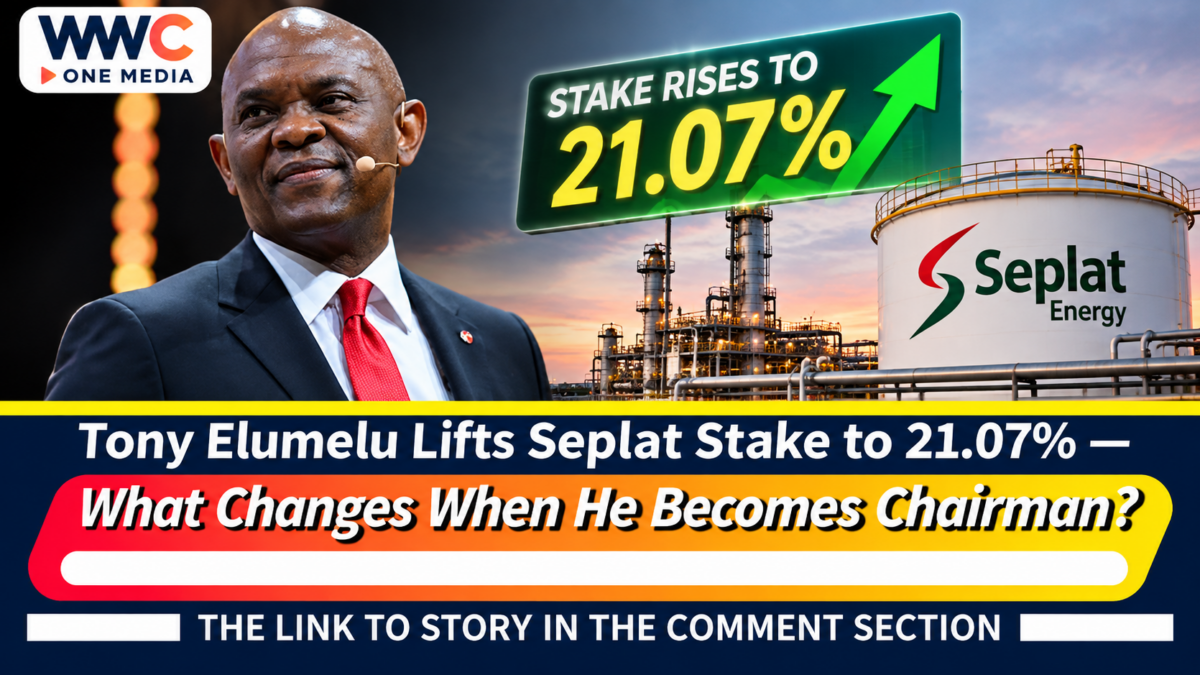
LAGOS, Nigeria — Seplat Energy’s exchange filing records a purchase of six million shares by Heirs Energies on Sept. 30, 2026, increasing the combined voting interest of companies controlled by Tony Elumelu to 21.07%. The Tony Elumelu Seplat investment also overlaps with a planned governance transition: Seplat’s board has elected him chairman with effect from Jan. 1, 2027.
The transaction was not newly executed on Nov. 17. It was disclosed in September and reaffirmed in Seplat’s financial results published on Oct. 29. The significance lies in the relationship between a substantial shareholder, the company’s leadership structure and its operating performance, rather than in an unverified new purchase.
Tony Elumelu Seplat stake: What the exchange filing says
Seplat’s notification identifies Heirs Energies Limited as the buyer of 6,000,000 ordinary shares, acquired in London at £8.87 each on Sept. 30. Multiplying the disclosed price by the number of shares gives £53.22 million in transaction consideration, before any fees or other costs not described in the notice.
The purchase left Heirs Energies with 27,943,867 shares. Together with Heirs Holdings Limited, the two entities controlled by Elumelu held 126,400,000 shares, representing 21.07% of the company’s 599,944,561 issued shares.
That is an indirect holding through identified companies. It should not be described as 126.4 million shares registered in Elumelu’s individual name, or as outright ownership of the whole business.
Seplat’s earlier half-year financial report recorded the combined interest at 20.07%. The September purchase raised that position by approximately one percentage point. Both the previous holding and the increase are supported by corporate documents.
Why the timing matters for the chairman transition
The board’s June 9 announcement elected Elumelu as the next chairman, effective Jan. 1, 2027. The announcement said incumbent chairman Udoma Udo Udoma intended to retire on Dec. 31, 2026. Those dates remain prospective as of Nov. 17.
Elumelu joined Seplat’s board as a non-executive director in January 2026. The June announcement also named Effiong Okon chief executive officer from Aug. 1, succeeding Roger Brown, who was due to retire at the end of July.
Analysis: A chairman helps lead board oversight, while the chief executive runs operations. A significant voting interest can strengthen a shareholder’s influence, but a 21.07% position is not automatically majority control. Other shareholders, board responsibilities and governance rules remain relevant.
The distinction between investment ownership and operating management matters in other energy companies too. WWC previously examined PXP Energy’s production, financing and exploration challenges, where financial returns also depend on operating assets rather than the size of any single investment stake.
What Seplat’s nine-month results show
Seplat’s unaudited results for the nine months ended Sept. 30, 2026, reported US$2.764 billion in revenue, up 27% from a year earlier. Adjusted earnings before interest, taxes, depreciation and amortisation were approximately US$1.530 billion, up 38%.
The company reported US$260.2 million in net income and US$749 million of free cash flow for the period. Its average working-interest production was 144,999 barrels of oil equivalent per day, an increase of 7% from the comparable period in 2025.
These figures describe the company’s reported performance through September, not what the new share purchase independently caused. An ownership transaction between shareholders does not itself put the purchase consideration into Seplat’s operating accounts.
Analysis: Earnings and cash generation provide context for why an investor might value the company, but they do not guarantee future returns. Commodity prices, production reliability, costs and capital spending can all alter the eventual financial result.
Related-party disclosures deserve careful attention
Seplat’s nine-month accounts identify business relationships involving other entities associated with Elumelu. United Bank for Africa, where he is a director and shareholder, provides the group with banking and financing services.
The accounts disclose US$90.1 million in balances with UBA at the reporting date. They also disclose US$2.3 million in gas sales to Transcorp Power Limited, an entity controlled by Elumelu, and US$6.2 million due from Transcorp Power at period-end.
The company describes the related-party transactions as conducted on arm’s-length terms. Their inclusion in the financial statements does not, without further evidence, establish impropriety or a conflict that has been mishandled.
Analysis: As board and ownership relationships become more concentrated, transparent reporting of transactions between associated businesses is especially useful to minority shareholders. Such disclosures allow readers to distinguish operating activity from dealings involving connected parties.
Why Nigerian energy investment matters beyond one shareholder
Seplat operates in an industry where oil production, domestic gas supply and capital investment influence Nigeria’s wider economy. Its corporate materials describe both upstream production and gas-processing operations.
WWC’s report on the competition between conventional energy and China’s green-technology investment in Africa offers wider context. Seplat’s corporate results, however, must be judged on its own performance rather than as proof of any continent-wide investment trend.
Energy investors also face questions about how governments tax and regulate profitable producers. WWC has separately covered proposed changes to taxation of US oil-company profits. That US policy debate is not a rule governing Seplat; it illustrates why country-specific regulation matters when comparing producers.
Analysis: Greater Nigerian ownership of a listed energy producer may be commercially significant, but the transaction alone does not demonstrate higher national output, lower energy prices or improved public revenue. Each outcome requires separate operating and government data.
What happens next
The most immediate governance milestone is the planned Jan. 1, 2027 chairman transition. Future exchange notifications will show whether the Heirs entities change their holdings again, while new company reports can clarify production, cash generation and related-party balances.
A separate disclosure would be necessary to establish any fresh purchase after Sept. 30. As of the records reviewed, the verified incremental acquisition is the September six-million-share trade, priced in sterling. The approximate US$70 million valuation cited elsewhere is not an independently disclosed dollar settlement amount.
FAQ
How many Seplat shares did Heirs Energies buy?
Seplat disclosed a purchase of six million ordinary shares on Sept. 30, 2026, at £8.87 per share.
What percentage of Seplat do Tony Elumelu-controlled companies hold?
After the transaction, Heirs Energies and Heirs Holdings together held 21.07% of Seplat’s issued shares, based on the Sept. 30 disclosure.
Was this a new share purchase on Nov. 17?
No new Nov. 17 transaction was independently confirmed. The documented six-million-share purchase occurred on Sept. 30 and appeared in Seplat’s October results.
When will Tony Elumelu become Seplat chairman?
The board elected him to take the chairmanship on Jan. 1, 2027, succeeding Udoma Udo Udoma under the announced succession plan.
Does a 21.07% stake mean Elumelu controls Seplat completely?
No. It is a substantial voting interest held through controlled entities, not ownership of all outstanding shares or proof of an absolute voting majority.