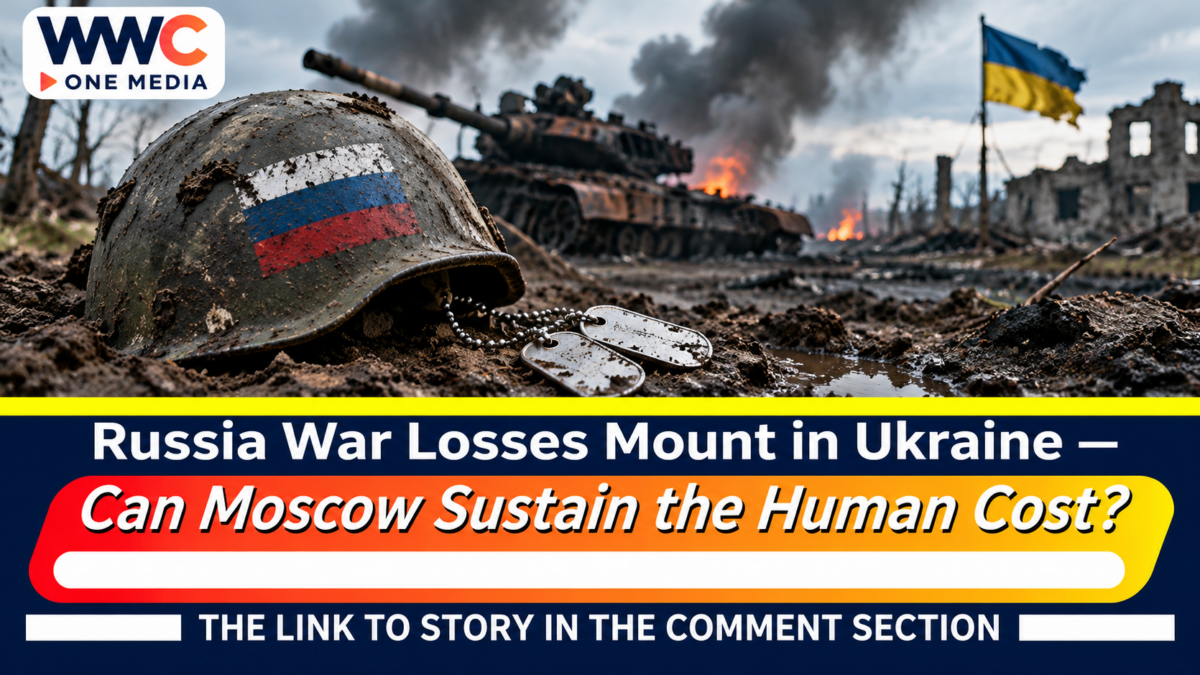
LONDON/MOSCOW — British officials told the United Nations on Nov. 9, 2026, that Russian forces suffered an estimated 54,000 casualties in October as fighting in Ukraine continued. The estimate adds urgency to a wider question about Russia war losses: what can official military and population records actually reveal about the pressure on Russian men and the country’s longer-term workforce?
The figures do not establish how many Russians have died. Military casualties can include people killed or wounded, while population statistics count many changes unrelated to the conflict. Separating those measures is essential to assessing the war’s lasting effects without turning estimates into confirmed death certificates.
Russia War Losses: What Officials Have Actually Reported
At the Nov. 9 UN Security Council meeting, the United Kingdom’s ambassador said Russia had sustained 54,000 military casualties in October. The number was presented as a British government assessment, not a count verified through Russian death registrations or a jointly audited battlefield database.
Another UK government statement to the Organization for Security and Co-operation in Europe in October said Russian casualties had reached approximately 1.5 million over the course of the war. That is an assessment of total casualties, not a claim that 1.5 million Russian soldiers have been killed.
The difference between deaths, injuries and missing personnel changes the meaning of any headline. Some wounded soldiers may return to service; others may experience long-term disability. Neither outcome can be calculated from a headline casualty total alone.
WWC has previously reported on Russia’s previously reported monthly battlefield losses. That earlier coverage also identified the limits of wartime estimates, rather than presenting one party’s figures as independently established totals.
Russia’s Population Data Show a Pre-Existing Imbalance
Russia’s federal statistics service published a population table covering Jan. 1, 2024, showing 146,150,789 residents: 67,917,353 males and 78,233,436 females. The difference exceeds 10 million people, but it would be wrong to attribute that difference to the war.
The table describes the entire age structure, including older adults, and the imbalance predates the full-scale invasion. It cannot isolate military deaths, wartime migration or the number of men unable to work because of injuries.
The same official publication identifies 43,612,145 men in its defined working-age population, alongside 41,099,378 women. Its working-age definitions differ by sex, so those figures should not be treated as a like-for-like measure of every potential worker or service member.
Analysis: Losses among working-age adults can have an outsized effect on households and certain occupations, but the national population totals alone do not establish the scale of that effect. An age-specific mortality series, verified migration flows and labour-force data would be needed to assess it properly.
What Military Pressure Means for Russia’s Labour Market
Replacing military personnel requires recruitment, training and equipment. Replacing civilian expertise can be equally difficult when a worker leaves an occupation for military service, emigrates or cannot return to work after injury.
The pressure is not uniform. A mechanic, engineer or transport operator may have skills that cannot immediately be replaced by a new hire. The economic cost also depends on whether employers can improve productivity, raise wages or recruit workers from elsewhere.
Analysis: A prolonged mobilisation of people and resources may constrain civilian businesses even before its full demographic consequences become measurable. Yet it is not possible to calculate a definitive national labour shortage directly from British casualty estimates.
Likewise, the fact that a military force continues fighting does not prove its replacements are adequate or inadequate. Measures of operational capacity require evidence on training, equipment and deployment, none of which can be inferred from the Rosstat population table.
Ukraine’s Civilian Toll Must Remain Visible
The war’s consequences extend beyond Russian military personnel. UN human-rights monitors verified at least 328 civilians killed and 2,105 injured in Ukraine during September 2026. Their report puts January-to-September civilian casualties at 2,570 killed and 15,211 injured, 59% higher than during the corresponding period in 2025.
These are verified civilian casualties in Ukraine, not Russian military fatalities. They belong to a different dataset and should never be added to, or directly compared with, a combatant estimate as if both were measured identically.
WWC has also examined the documented risks to Ukrainian civilians. The broader context is important: focusing on the pressures borne by Russian families does not diminish the deaths, displacement and destruction experienced by Ukrainians.
Why a Casualty Number Cannot Predict the War’s End
High losses can create difficult decisions about recruitment, public spending and the use of equipment. But wars do not end according to a fixed numerical casualty threshold. Political choices, outside assistance, defence production and negotiations all shape what happens next.
Analysis: The evidence supports the conclusion that Russia faces substantial military attrition; it does not support a precise countdown to military collapse. It also cannot determine from public figures alone how losses are distributed among Russia’s regions or age groups.
Diplomacy offers a different measure of progress. WWC’s coverage of the November prisoner-exchange negotiations illustrates how limited humanitarian agreements can be discussed even while wider disputes remain unsettled.
What Happens Next
The next reliable demographic evidence would be fuller official age-by-sex mortality statistics, transparent military loss reporting and labour-market series that distinguish deaths from migration and disability. Such data have not been established by the public records reviewed for this article.
For the war itself, watch for verifiable changes in recruitment policies, official peace arrangements and independently documented civilian protection outcomes. Until then, the human cost is evident, but a precise account of Russian military deaths remains unconfirmed.
Frequently Asked Questions
How many Russian soldiers have died in Ukraine?
The primary records reviewed do not establish a verified total of Russian military deaths. British government casualty assessments include more than deaths and must not be reported as death counts.
Did Russia lose 54,000 soldiers in October 2026?
The UK government reported an estimate of 54,000 Russian casualties during October, not 54,000 confirmed fatalities. The number is a government assessment and has not been independently audited here.
Are there more women than men in Russia?
Yes. Russia’s published Jan. 1, 2024, population table lists 78,233,436 females and 67,917,353 males. It does not show that the entire difference was caused by the war.
How has the war affected Ukrainian civilians?
UN monitors verified 2,570 civilian deaths and 15,211 injuries in Ukraine from January through September 2026. These figures concern civilians, not military casualties.
Can Russia’s losses determine when the war ends?
No. Military attrition is one factor, alongside recruitment, equipment, political decisions, external support and diplomacy. No verified public record establishes a specific end date.