
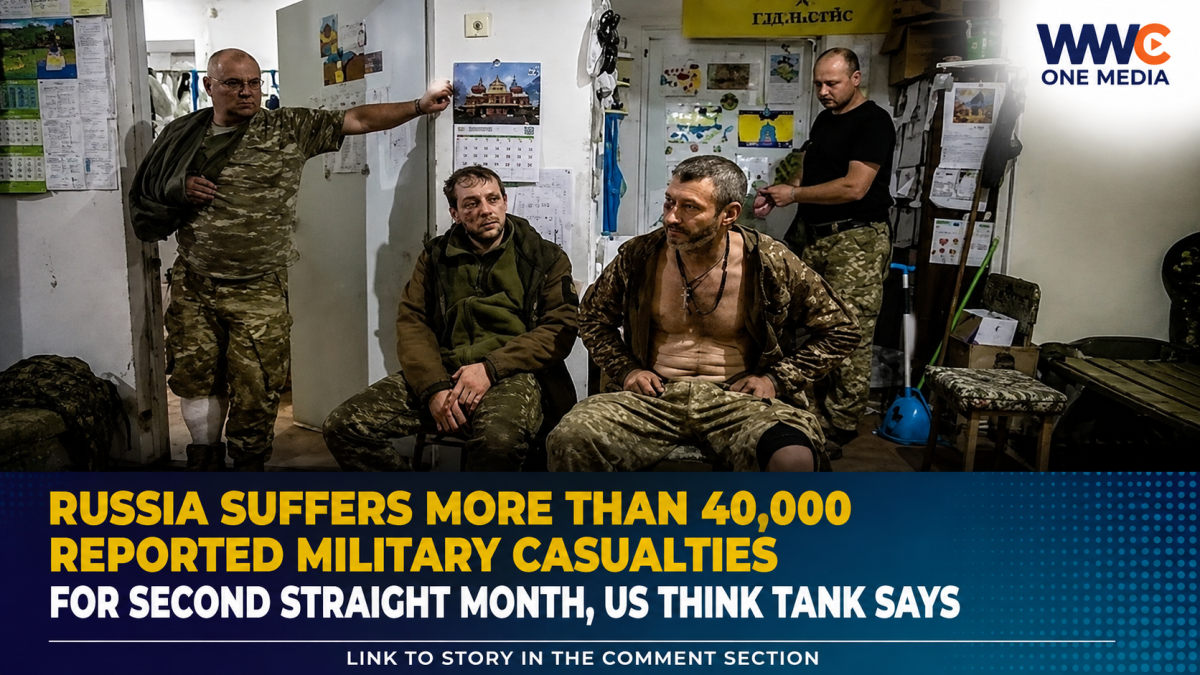
Russia’s military is reportedly continuing to pay a heavy price for limited battlefield gains in Ukraine, with Ukrainian authorities estimating more than 42,000 Russian military casualties in August alone.
The figure, cited by the US-based Institute for the Study of War (ISW), would mark the second consecutive month in which reported Russian casualties exceeded 40,000. Ukraine’s General Staff estimated 42,020 Russian casualties for August, following an estimated 42,860 in July.
That would put the Ukrainian-reported total for the two months at nearly 85,000 casualties.
However, an important distinction is needed: these figures refer to military personnel casualties, meaning killed and wounded, and the August number is a Ukrainian estimate. It has not been independently verified, and Russia does not publicly confirm figures on this scale.
Heavy losses for limited gains
ISW said Russian forces were paying an increasingly high price for what it described as limited territorial gains.
The think tank calculated that Russian forces suffered an average of about 340 casualties for every square kilometre of territory seized or infiltrated in August. It also said Russia’s current volunteer-based recruitment system appears to be struggling to replace battlefield losses at the same rate.
The assessment raises a critical question for Moscow: how long can Russia maintain its current offensive tempo without another major mobilisation effort?
ISW said it remains unclear whether Russia can sustain its present rate of offensive operations if losses remain at these levels.
July was also a record-breaking month
The August estimate follows an exceptionally costly July.
Ukraine’s General Staff reported 42,860 Russian casualties for July, which ISW described as the highest monthly Russian casualty figure reported by Ukraine up to that point in 2026.
The pattern suggests that Russia’s military campaign is continuing to generate substantial personnel losses even as its territorial advances remain relatively limited.
That does not mean Russia is losing the war or that its forces are incapable of continuing operations. Rather, it highlights the growing manpower requirements associated with maintaining a large-scale offensive.
Is another mobilisation coming?
That question has become increasingly prominent in Russia.
Ukrainian officials have warned that Moscow could seek hundreds of thousands of additional personnel, while reports of increased recruitment activity and preparations involving military reservists have fueled speculation about another mobilisation.
There has also been a notable increase in Russians crossing into Georgia. Politico reported that more than 113,000 Russians crossed through the Upper Lars checkpoint toward Georgia in one week, amid fears of another mobilisation. The surge was interpreted as evidence of growing public concern, although the border figure itself does not establish that those travellers were leaving specifically to avoid military service.
Putin rejects mobilisation rumours
Russian President Vladimir Putin has pushed back strongly against reports that a new mobilisation could be announced after Russia’s September elections.
Putin dismissed the reports as “complete nonsense” and described them as an information attack against Russia.
Russian officials have repeatedly rejected claims that a new nationwide mobilisation is imminent.
The Kremlin has instead continued relying heavily on recruitment through financial incentives and volunteers to replenish its forces.
Russia says it is still advancing
Despite the casualty estimates, Moscow has continued to portray the battlefield situation differently.
Putin recently claimed that Russian forces were maintaining the initiative and making advances in the Donetsk region. He also said Russia remained confident of achieving its objectives.
This creates two sharply contrasting narratives.
Ukraine and Western analysts point to high Russian losses and relatively slow territorial gains.
Moscow argues that its military is continuing to advance and that its current recruitment system is sufficient.
What the numbers really mean
The reported 40,000-plus monthly figures should therefore be treated carefully.
They are not confirmed independent counts of Russian soldiers killed. They are estimates of total military casualties, including wounded personnel, reported by Ukraine and cited by ISW.
Actual losses could be higher or lower.
Still, the consecutive monthly estimates are significant because they point to the scale of personnel Russia may need to replace if its current rate of combat continues.
And that brings the war to another potentially consequential crossroads.
Russia has so far avoided announcing a new nationwide mobilisation.
But if battlefield losses remain exceptionally high while recruitment struggles to keep pace, Moscow could eventually face a difficult choice:
Continue the offensive with its existing manpower — or find another way to bring more soldiers into the war.
For now, Putin says reports of a new mobilisation are nonsense.
The battlefield numbers, however, are keeping the question alive.
WWC ONE MEDIA J.M.D



Leave a Reply