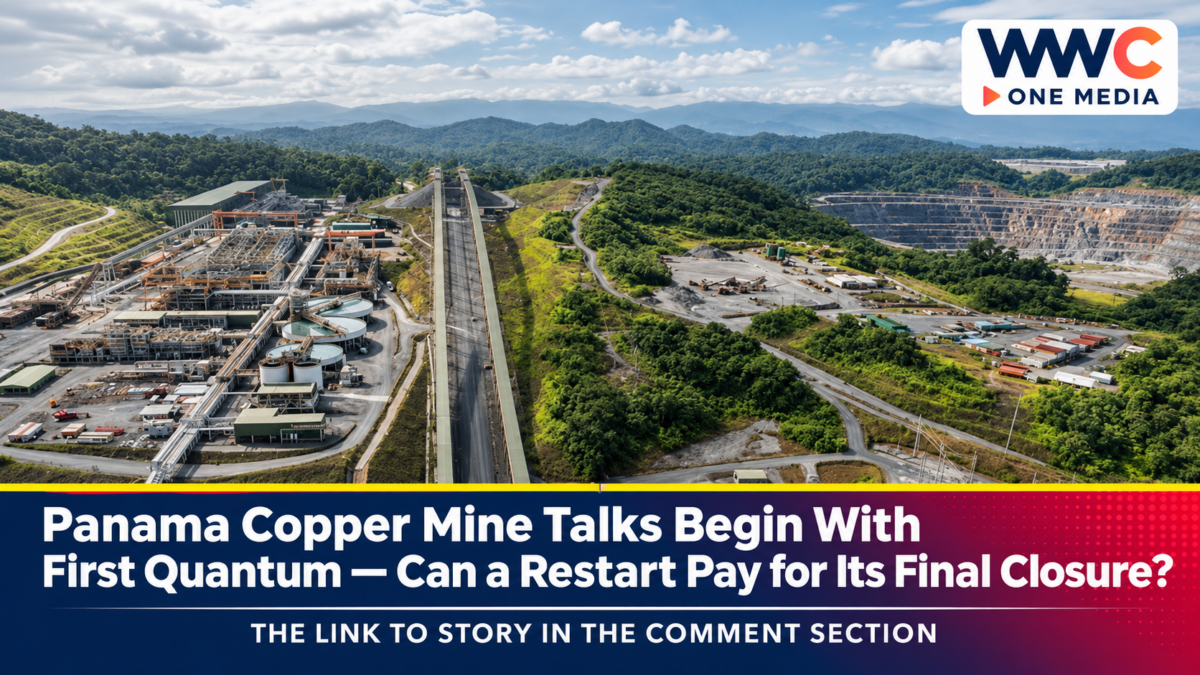
PANAMA CITY — Panama’s President José Raúl Mulino announced on Nov. 16, 2026, that his government would begin formal negotiations with Minera Panamá over the future of the Cobre Panamá mining complex. The Panama copper mine talks will examine whether limited renewed operations could fund an eventual closure while meeting constitutional, environmental and economic conditions set by the government.
The announcement starts a negotiation, not a reopening order. Panama has not disclosed a signed agreement, a timetable for renewed extraction or a legal structure authorising the project to resume mining.
Panama copper mine talks: Five conditions before any agreement
Mulino assigned an interministerial team led by Commerce and Industries Minister Julio Moltó to conduct the discussions. The presidential announcement identifies five principles: public ownership of underground minerals, maximum economic benefit for Panama, national sovereignty, environmental protection and compliance with the constitution and national laws.
It also demands transparent accounting for extracted materials, responsible water management, independent environmental oversight and public information. Communities near the mine are to be involved under the principles of the Escazú Agreement.
Crucially, the government insists that any arrangement include a company-funded, verifiable and definitive mine-closure plan without an extension. The president said a future agreement would not be a conventional concession, but the legal instrument has not been identified.
Analysis: These requirements put financial returns and accountability on the same negotiating table. A declaration of principles is not proof that the company has accepted each term or that regulators have approved a restart.
The court ruling still shapes the legal choices
Panama’s Supreme Court declared Law 406 of 2023 unconstitutional in a judgment issued on Nov. 27, 2023. That law had approved the mining-concession contract between the state and Minera Panamá. The judicial decision explains why negotiators cannot simply treat the previous contract as an operating permit.
A government commission delivered 17 recommendations and six guiding criteria on Sept. 30, 2026. Its first recommendation was to consider formal talks to determine whether a new arrangement could permit operations that would finance an orderly closure without drawing on Panama’s general budget.
That report was advice to the president, not an approval to resume extraction. Panama’s Nov. 16 announcement is the subsequent decision to enter talks, while any eventual agreement still requires a lawful framework.
Other copper-producing countries face different ownership and investment choices. WWC’s report on Chile’s copper project partnerships explains why a proposed arrangement should not be confused with completed financing or an operational authorisation.
Existing stockpiles are already being processed
First Quantum’s April 7 announcement confirmed government approval to process and export ore extracted before the 2023 suspension. It explicitly distinguished that work from new drilling, blasting or extraction, describing the programme as a means of managing environmental and operational risks.
The company’s Oct. 28 quarterly results reported that the stockpile programme produced 13,229 tonnes of copper in the third quarter and 13,463 tonnes of copper sales. First Quantum estimated the remaining stockpiled material could sustain authorised processing into mid-2027.
Analysis: This distinction prevents a misleading conclusion. Concentrate production from previously mined stockpiles does not mean the mine has legally reopened for fresh extraction. Negotiations now concern a separate, broader decision about the site’s future.
The company also reported US$203 million in Cobre Panamá sales revenue for the third quarter. That figure reflects the authorised stockpile programme; it is neither the amount Panama would receive under a proposed new agreement nor evidence of a completed restart.
Arbitration and environmental costs are central obstacles
The president wants all outstanding arbitration proceedings against Panama brought to an end as part of an eventual settlement. A Panamanian government gazette records an investment arbitration involving First Quantum, registered as ICSID Case No. ARB/25/18 on April 11, 2025.
The existence of arbitration does not establish that Panama or First Quantum has won. It identifies a legal dispute that negotiators must resolve if the government’s stated conditions are to be met.
The September commission report also examined the cost and complexity of caring for the site over the long term. It documented environmental compliance findings alongside matters requiring corrective action. These records support the need for ongoing monitoring; they do not independently establish that every environmental concern has been resolved.
For Philippine readers, the parallel is the importance of transparent permits and community participation. WWC’s reporting on consultation questions surrounding a Bataan mining project concerns a separate dispute, but illustrates why legal approval and community confidence must be examined independently.
Why copper markets will watch the outcome
First Quantum describes Cobre Panamá as a major copper deposit that entered preservation and safe management after mining stopped in November 2023. Its published third-quarter update demonstrates that the site can generate metal from stored ore, while the legal question of future extraction remains unsettled.
Analysis: Renewed mining, if ultimately authorised, could alter future copper supply and company investment decisions. But there is no verified restart date or production forecast for newly extracted ore under a future agreement.
Copper markets also respond to conditions elsewhere. WWC’s coverage of pressure on Chinese copper smelters provides a separate example of how processing economics differ from the legal status of a mine.
What happens next
The next substantive evidence will be a government negotiating framework, an agreement that identifies the legal mechanism, an arbitration settlement and documented environmental and closure obligations. Public consultation and any required regulatory decisions will also matter.
The clearest conclusion on Nov. 17 is that formal talks are authorised, not that Cobre Panamá has been approved to reopen. Whether a temporary return to mining can finance permanent closure remains an unresolved question for the parties and Panama’s institutions.
FAQ
Has Panama approved the reopening of Cobre Panamá?
No. The president authorised negotiations. The existing authorisation covers processing previously extracted stockpiled ore, not new mining.
Who is leading the Panama copper mine negotiations?
An interministerial team headed by Commerce and Industries Minister Julio Moltó.
What must First Quantum agree to?
Panama says any agreement must safeguard sovereignty, maximise public benefits, provide enforceable environmental oversight, settle arbitrations and fund definitive closure.
Why was Cobre Panamá suspended in 2023?
Panama’s Supreme Court ruled the law approving its concession contract unconstitutional, and the mine entered preservation and safe management.
Is there a date for a full mining restart?
No new-extraction start date or signed agreement was established by the official records reviewed.