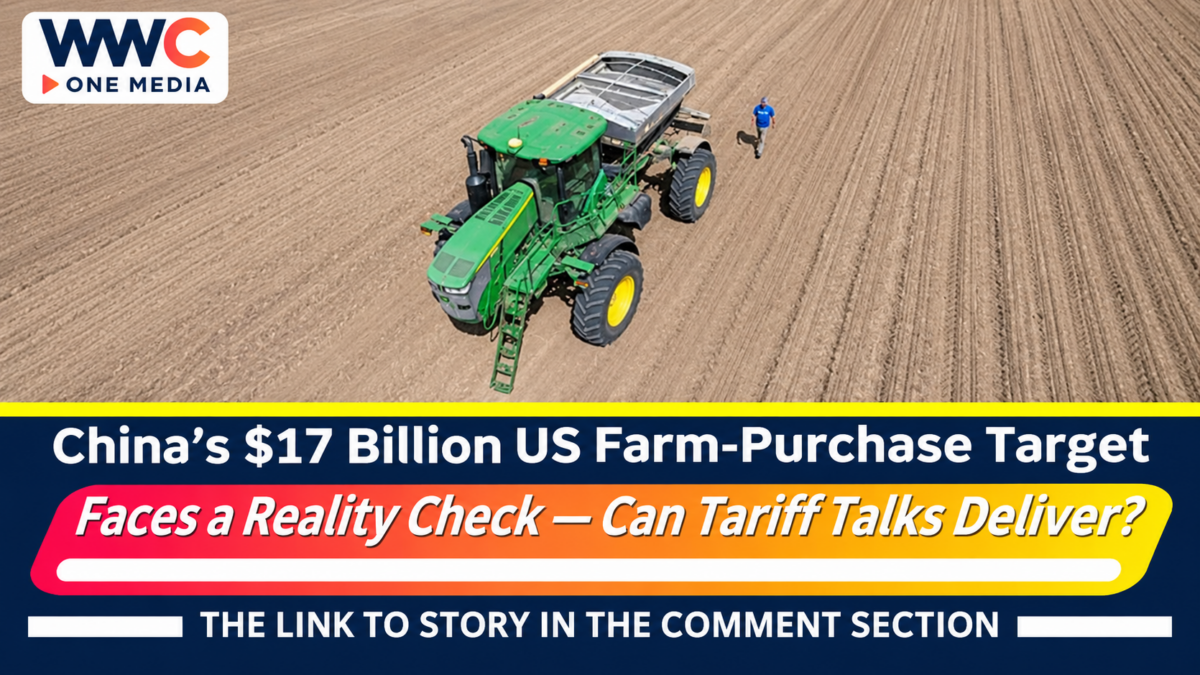
WASHINGTON/BEIJING — A US-announced commitment for China to buy at least $17 billion a year in additional American agricultural products is facing a crucial implementation test ahead of further US-China talks. The White House announced the target in May, while official trade statements this month show the two governments are still working through tariffs and farm-market access.
The issue is not simply whether China buys more soybeans. Washington has described one soybean commitment and a separate dollar-based farm-purchase target, while Beijing has publicly framed agricultural expansion as a guiding goal shaped by business demand.
China’s $17 Billion Crop Target: What Was Actually Announced?
On May 17, the White House said China would purchase at least $17 billion per year of US agricultural products in 2026, with that year’s amount prorated, and in 2027 and 2028. It described those purchases as additional to soybean commitments announced under an earlier trade arrangement.
The earlier White House statement, dated Nov. 1, 2025, specified purchases of at least 25 million metric tons of US soybeans in each of 2026, 2027 and 2028.
There is an important limit to what these announcements establish. The May document does not spell out, in the published passage, how the 2026 proration is calculated or present an item-by-item buying schedule. Without that, a precise full-year compliance calculation would require more information than the headline dollar figure alone.
Beijing Describes a Guiding Goal, Not Automatic Orders
The dollar target is distinct from the 25-million-tonne soybean pledge. China’s Ministry of Commerce addressed the $17 billion issue at a July press conference. Its public reply described a guiding target for expanding agricultural trade in both directions, and said businesses would trade independently on the basis of market demand and commercial conditions.
As WWC previously examined in its coverage of China’s proposed farm-tariff reductions and the omission of whole soybeans, the design of a tariff list can matter as much as the political announcement surrounding it.
Soybean Sales Offer Evidence, but Not the Whole Answer
The US Department of Agriculture has published actual soybean sales announcements during the autumn marketing season. Its Nov. 6 announcement reported 136,000 metric tons of soybeans sold for delivery to China in the 2026/27 marketing year. Its Nov. 2 notice reported another 136,000 metric tons destined for China.
A September USDA agricultural assessment said Chinese state-owned enterprises continued buying US soybeans, but it also observed that an additional tariff on US beans was affecting purchasing decisions by commercial buyers. The report identified 5.7 million metric tons of US new-crop soybeans purchased by China as of Aug. 13, plus 3.8 million metric tons sold to unspecified destinations, which could not safely be counted as confirmed Chinese purchases.
For that reason, evidence of soybean sales cannot, by itself, demonstrate that the separately announced $17 billion agricultural-purchase objective has been achieved.
The $30 Billion Tariff Framework Is a Different Deal
In September, the governments outlined a reciprocal tariff framework commonly described as “30-for-30.” Each side identified import products whose historical trade values totalled approximately $30 billion, using 2024 bilateral trade as the reference.
China’s Ministry of Commerce said its prospective import list included agricultural products, medical devices, personal care goods and coal. China’s statement also said the reductions would be implemented simultaneously after both governments completed their respective domestic legal procedures.
On Nov. 13, the two sides held the first meeting of their bilateral Board of Trade by video link. China’s Nov. 14 announcement confirmed discussion of tariffs, the reciprocal reduction framework and agricultural trade, but reported no final implementation date or new purchase total.
WWC’s earlier examination of the US-China trade council and its proposed tariff package explained why an agreed framework should not be confused with changes already in force.
What the Public Data Can — and Cannot — Show
USDA’s Global Agricultural Trade System said September 2026 US export data had been released on Nov. 4, while October data were scheduled for Dec. 8. That publication timetable is an important limitation for anyone seeking to assess the full 2026 position in mid-November.
The public data portal supplies underlying trade statistics, but the material reviewed for this article did not establish an authoritative, like-for-like dollar tally measuring the exact products and proration contemplated by the May announcement. It would be misleading to infer a precise shortfall from general export figures without matching the agreement’s scope and timeframe.
Meanwhile, the US Trade Representative’s Nov. 6 statement said Washington wanted concrete action on earlier commitments, including farm purchases. That is a documented negotiating position, not proof that any specific target has already been formally breached.
WWC has also covered Washington’s demand for implementation of farm and critical-mineral commitments. The renewed emphasis on implementation shows why officials are looking beyond announcements toward measurable results.
What Happens Next
Analysis: The most useful next signals are published tariff measures, verifiable sales and shipment data, and any jointly clarified timetable for the dollar target. Lower duties may improve the commercial case for American farm products, but cheaper access does not guarantee that buyers will order particular quantities.
A lower tariff is not a purchase order. The two sides have also agreed to establish an agricultural working group, with its first meeting planned before the end of 2026. That offers a forum for addressing market-access and regulatory questions, though the public records reviewed do not guarantee a settlement or a surge in orders.
Frequently Asked Questions
Did China promise to buy $17 billion of US farm products?
The White House announced at least $17 billion annually in additional agricultural purchases for 2026, prorated, and for 2027–2028. China’s commerce ministry described a guiding trade-expansion target and said commercial purchases depend on demand and market conditions.
Is the $17 billion target the same as the soybean agreement?
No. The White House separately described a commitment to buy at least 25 million metric tons of US soybeans annually in 2026–2028.
Have the $30 billion reciprocal tariff reductions taken effect?
The official announcements reviewed establish a framework and product lists, with implementation subject to domestic procedures. The Nov. 14 Chinese announcement did not confirm a completed rollout.
Does the latest USDA soybean sales data prove compliance?
No. Individual soybean sales notices are evidence of sales, not a complete audit of a separate dollar-based farm-purchase target.
When will the next meaningful trade data become available?
USDA’s trade portal scheduled October 2026 trade-data publication for Dec. 8, 2026. Additional official purchase and tariff announcements could arrive separately.