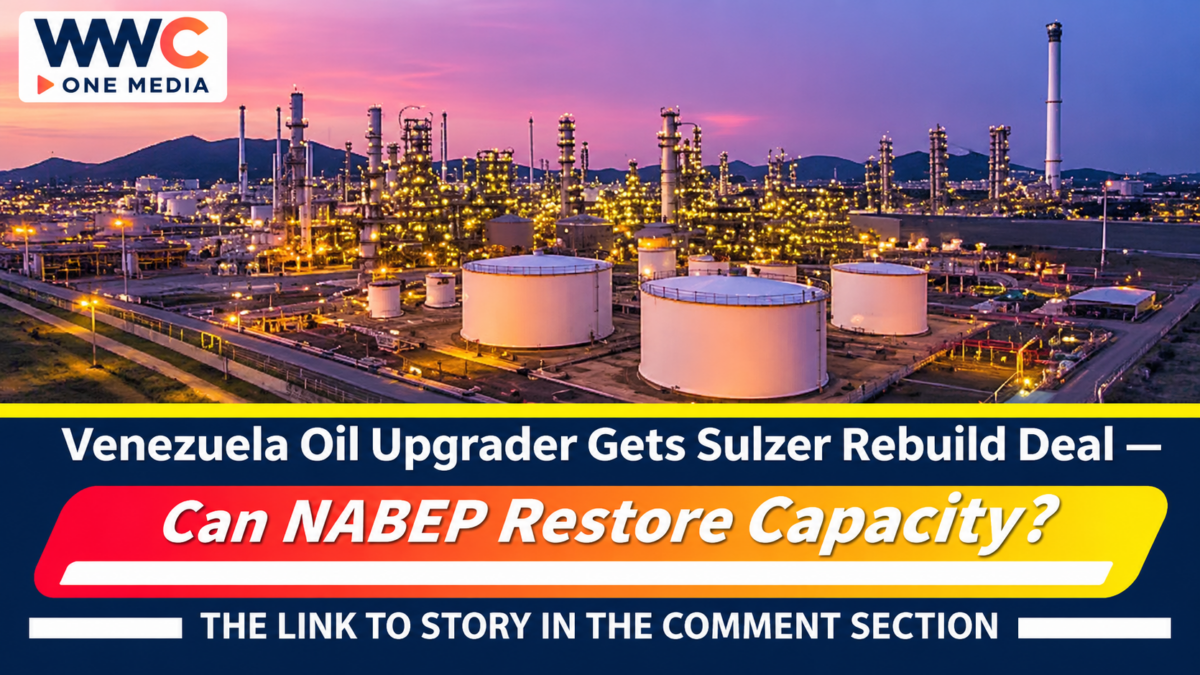
CARACAS, Venezuela — North American Blue Energy Partners (NABEP) and Swiss engineering company Sulzer announced an agreement on Nov. 16, 2026, to replace damaged equipment at the Petrocedeño oil upgrader. The work includes a new atmospheric distillation column and improvements to existing processing towers.
The agreement gives Venezuela’s extra-heavy crude processing system a defined repair project, but it does not establish that the plant is fully restored. The important distinction is between equipment being contracted, machinery being installed and a facility actually producing usable output at a sustained rate.
Venezuela Oil Upgrader: What the Agreement Covers
Petrocedeño sits in the Jose industrial complex near Barcelona, in Venezuela’s Orinoco Belt. The facility handles extra-heavy crude, which needs treatment before it can be transported and refined more readily.
Sulzer’s announced work includes supplying a replacement atmospheric distillation column, new internal components for existing distillation towers, and maintenance services. NABEP separately identified work on the preflash and vacuum towers, which form part of the facility’s processing arrangement.
The companies say the existing crude column was severely damaged in an explosion and fire in November 2025. Their announcements describe a replacement project, not a completed installation. Neither announcement gives a firm commissioning date or a disclosed contract price.
That is the central business question: a signed engineering arrangement addresses a clearly identified bottleneck, while the operational and financial benefits will depend on installation, testing and reliable service afterward.
Why Rebuilding a Distillation Tower Matters
An oil upgrader is more than a storage site. Its machinery changes the characteristics of difficult crude so that the resulting product is easier to move and can undergo further refining.
Atmospheric distillation is one part of that industrial chain. A damaged major column can constrain the processing route even if wells continue producing oil elsewhere. Consequently, repairing a tower and bringing more oil out of the ground are related but different achievements.
Sulzer describes its role as a technology partner in bringing idle capacity back into service. The company’s scope also includes work on equipment already present at Petrocedeño, not simply delivery of one standalone replacement unit.
The practical measure of success will not be a photograph of new equipment. It will be whether the complete processing system can run safely and consistently after the necessary work has been completed.
Earlier Furnace Restart Shows Both Progress and Limits
Petrocedeño’s restoration is not beginning from zero. On Nov. 2, NABEP announced that it had restarted a furnace at its Zuata 2 facility, also identified as Petrocedeño, following repairs, inspections and mechanical testing completed before its Oct. 31 restart.
NABEP said the furnace had been idle for five years. It estimated the restart could contribute another 8,000 to 10,000 barrels of oil per day within weeks; that was a company expectation, not independently verified additional production already delivered.
The furnace heats oil mixed with water, helping separate the two before subsequent processing. NABEP identified a maximum water-content requirement of 2% for the crude to meet its saleable specification.
This is why the new Sulzer agreement deserves careful reading. A functioning furnace can improve one stage of production, but a damaged distillation column can still limit broader operations. Restoring separate components is not the same as certifying the entire upgrader at full capacity.
WWC has previously examined the distinction between Venezuela’s oil reserves and the commercial commitments needed to develop them. The latest repair announcements put that distinction into an industrial setting.
NABEP’s Bigger Production Plan Faces an Infrastructure Test
NABEP said its production reached 223,509 barrels of oil equivalent per day on Oct. 19, compared with about 200,000 in August. These are company-reported figures covering its operations, not a disclosed output figure for the restored Petrocedeño column.
The company says its ambition is to exceed one million barrels of oil per day and has identified 500,000 barrels per day by the end of 2028 as an intermediate target. Those objectives should be treated as plans rather than assured results.
Its wider restoration programme extends beyond Petrocedeño. A Nov. 12 announcement described 32 units of gas compression and power equipment being refurbished through facilities in the United States, United Kingdom and United Arab Emirates. It said 24 had shipped, with eight more intended to follow in December.
That programme illustrates the logistical side of restarting mature oil infrastructure: components must be removed, transported, serviced, tested and returned to the field. Each step carries execution risk even when the engineering work has a clear purpose.
In a separate Venezuelan energy project, WWC has explored the gap between offshore resource rights and actual production. The same analytical discipline applies here: an announcement of planned work must not be presented as oil already reaching customers.
What This Could Mean for Energy Markets
Analysis: The Petrocedeño project could make a meaningful contribution if it removes a processing constraint and the remaining infrastructure performs as intended. But the company announcements do not quantify the additional sustained output attributable specifically to the new column.
It would therefore be premature to calculate a precise effect on world crude supply, export volumes or consumer fuel prices. Those outcomes depend on production, operating uptime, transportation and market demand as well as completion of the work itself.
There is also a longer-term tension between restoring oil supply and the growth of competing energy technologies. WWC’s coverage of how electric vehicles and renewables are changing fossil-fuel demand provides that wider context without implying that demand has already disappeared.
For Philippine readers, the relevant lesson is that prospective overseas oil supply is not an immediate pump-price forecast. A new tower, even once installed, is only one link in the chain between an oilfield and a retail fuel station.
What Happens Next
The next test is whether the companies announce manufacturing and installation milestones, followed by commissioning and operating performance. An updated project timetable and a verified statement of processing throughput would make the potential benefit easier to assess.
Until then, the public record supports a significant repair commitment and previously disclosed progress elsewhere at the facility. It does not support declaring the full Petrocedeño upgrader restored or assigning it a new production rate.
Frequently Asked Questions
What is the Petrocedeño oil upgrader?
It is a processing facility in Venezuela’s Orinoco Belt that converts extra-heavy crude into a lighter product suitable for transport and further refining.
What will Sulzer supply to Petrocedeño?
Sulzer has agreed to provide a new atmospheric distillation column, internal components for existing towers and maintenance services.
Has the Venezuelan oil upgrader returned to full capacity?
The Nov. 16 announcements do not confirm that. They identify planned replacement and restoration work rather than completed full-capacity operations.
How much oil does NABEP currently produce?
NABEP reported 223,509 barrels of oil equivalent per day across its operations as of Oct. 19, 2026. That is a company-reported total, not a Petrocedeño-only figure.
Will the repair immediately lower fuel prices?
No immediate effect can be established from the announcements. Equipment installation and sustained processing performance must come before any credible assessment of incremental supply.