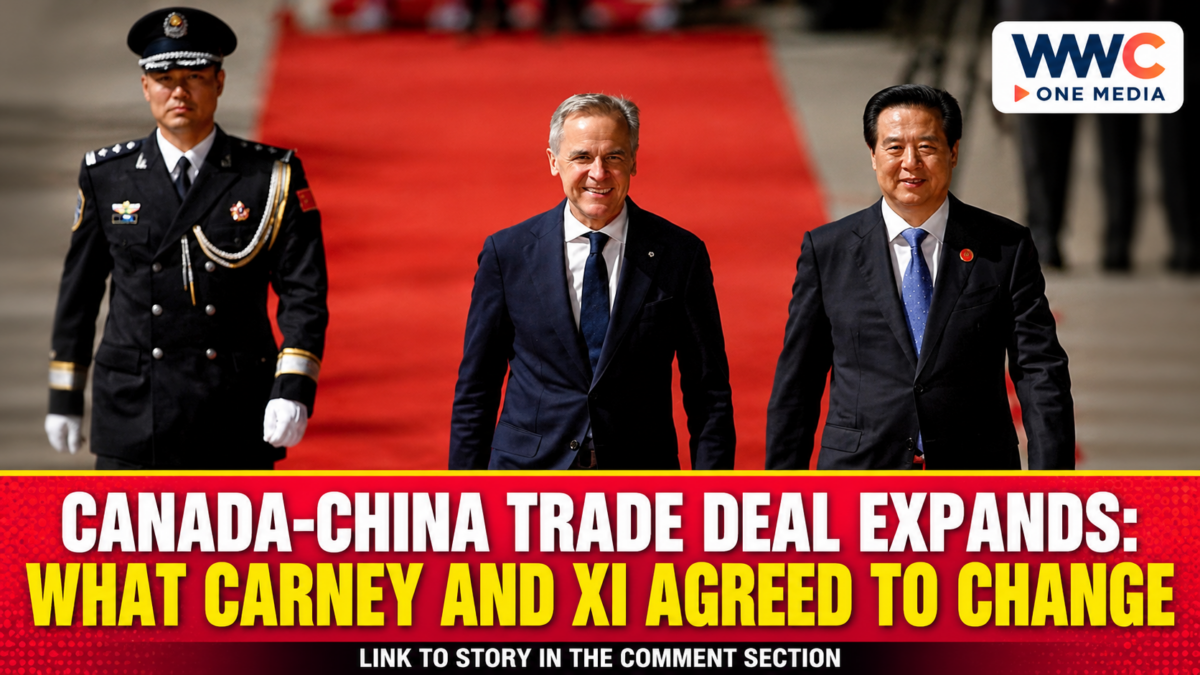
Canadian Prime Minister Mark Carney and Chinese President Xi Jinping agreed on Nov. 17 to expand their countries’ economic cooperation after meeting in Shenzhen, with new arrangements covering agricultural and seafood exports, industrial tariffs, e-commerce and investment. The agreement extends their preliminary bilateral trade arrangement through December 2028 and provides additional tariff relief for approximately C$400 million in Canadian exports.
The announcement adds a significant commercial dimension to the leaders’ engagement ahead of the Asia-Pacific Economic Cooperation (APEC) Economic Leaders’ Meeting. It also shows how both governments are attempting to manage trade disputes while keeping business, investment and diplomatic channels open.
For Canada, the immediate gains centre on market access for farmers and seafood exporters. China, meanwhile, receives an extension of Canadian tariff-remission measures covering selected steel and aluminium products. The arrangement is not a comprehensive free trade agreement, but it gives businesses a clearer framework for several important trade categories. Prime Minister of Canada+1
Canada-China trade deal extends key arrangements to 2028
The expanded Preliminary Joint Arrangement on Addressing Bilateral Economic and Trade Issues between Canada and China will run through December 2028.
Under the arrangement, China agreed to suspend the application of its anti-discrimination tariffs on specified Canadian products from Jan. 1, 2027, to Dec. 31, 2028. The measure is intended to improve access for Canadian agricultural producers and seafood exporters.
The Canadian government estimates that the additional relief will cover approximately C$400 million in exports. The listed products include most frozen pork cuts, certain frozen cold-water shrimp and prawns, selected molluscs such as geoduck, sea cucumber and Greenland halibut.
The expansion builds on earlier tariff-relief arrangements covering canola meal, peas, lobster and crab.
The practical significance is straightforward: exporters that previously faced additional trade barriers may have a better opportunity to sell specified products in the Chinese market. However, the actual benefit will depend on the products covered, customs implementation and whether businesses can meet the relevant import requirements. Prime Minister of Canada+1
The agreement also gives China concessions on steel and aluminium
The arrangement is not a one-way concession.
Canada agreed to extend existing remission measures for selected Chinese steel and aluminium products through Dec. 31, 2028. It will also expand coverage to 32 additional tariff items: 23 steel items and nine aluminium items.
The Canadian government says the additional coverage applies to products for which domestic Canadian supply is insufficient or unavailable.
In practical terms, tariff remission means qualifying imports can receive relief from specified duties under the applicable conditions. It does not mean every Chinese steel or aluminium product entering Canada is automatically exempt from tariffs.
The balance between these measures is important. Canada is seeking better access for its agricultural and seafood exports while allowing selected Chinese industrial products to continue entering the Canadian market under defined conditions.
The arrangement therefore combines export opportunities with targeted import relief rather than removing all trade restrictions between the two economies. Prime Minister of Canada+1
New trade mission and e-commerce programme planned for 2027
Beyond tariffs, Carney announced a new major trade mission to China in 2027. Its stated purpose is to connect Canadian businesses with Chinese decision-makers, industry representatives and potential customers.
The two countries also agreed to designate 2027 as the Canada-China Year of e-Commerce.
The initiative is intended to help Canadian small and medium-sized enterprises reach customers through Chinese e-commerce platforms. For smaller exporters, online channels may provide an additional route into overseas markets, although access alone does not guarantee sales.
The governments also endorsed outcomes from the second Canada-China Economic and Financial Strategic Dialogue. The discussions covered cooperation among financial, macroeconomic, regulatory and monetary authorities.
These initiatives suggest that the relationship is moving beyond individual tariff disputes into a broader programme of commercial and institutional engagement. Their success will depend on whether businesses can turn government-level commitments into actual transactions. Prime Minister of Canada+1
Investment, education and business agreements broaden the relationship
The announcement also included commitments involving education, environmental cooperation and private-sector partnerships.
Canada will contribute C$850,000 over three years to scholarships under the Canada Learning Initiative in China, supporting 850 additional Canadian students studying at Chinese universities.
It will also contribute C$8 million over five years to the China Council for International Cooperation on Environment and Development. The programme is intended to mobilise international expertise, including Canadian researchers, on environmental and sustainable-development policy.
On the commercial side, Carney and Xi welcomed new air services between the countries. Air Canada plans to launch flights from Vancouver to Guangzhou in May 2027, while Chinese airlines are also expected to increase flights.
Five Canadian companies from the arts and culture sector signed commercial agreements worth more than C$15 million. The leaders also welcomed a memorandum of understanding to establish a Canada-China CEO Roundtable, co-chaired by the Canada-China Business Council and the Bank of China.
A separate memorandum between the University of Ottawa and Shanghai International Studies University will support development of an undergraduate dual-degree programme. Prime Minister of Canada+1
Why the trade relationship matters beyond agriculture
The economic relationship is already substantial.
Canada’s government reported that bilateral merchandise trade with China reached C$125.6 billion in 2025, an increase of 5.6% from 2024. China accounted for C$35.1 billion of Canada’s merchandise exports that year.
The Canadian government also reported that China’s foreign direct investment stock in Canada stood at C$43.4 billion in 2025, while Canada’s direct investment stock in China stood at C$15 billion. These are investment-stock figures, not the value of new investments announced during the Nov. 17 meeting. Prime Minister of Canada
The figures help explain why both governments have an economic incentive to maintain communication despite differences over trade policy and market access.
The relationship also matters to the wider Asia-Pacific region. The Philippines, for example, is pursuing its own trade diversification efforts. WWC has examined the completion of negotiations on the Philippines-Canada free trade agreement, a separate initiative that still requires further steps before it can enter into force.
The broader regional picture is also relevant. Asia’s growing role in Philippine trade illustrates why changes in major economies’ commercial relationships can matter to businesses across the region.
The leaders’ meeting also took place as Shenzhen prepares to host the APEC Economic Leaders’ Meeting on Nov. 18–19. The gathering provides a wider setting for discussions on regional economic cooperation. WWC’s coverage of the wider diplomatic agenda surrounding the Shenzhen summit explains why the APEC programme should be distinguished from separate bilateral agreements. fmprc.gov.cn+1
What happens next
The immediate implementation period begins with the new tariff arrangements scheduled for Jan. 1, 2027, and runs through Dec. 31, 2028.
Businesses will need to monitor the detailed customs and tariff rules to determine which products qualify. Exporters should not assume that every shipment in a broad product category will automatically receive preferential treatment.
The 2027 trade mission and e-commerce initiative will provide further opportunities for business engagement, while the planned air routes and educational partnerships will add other forms of cooperation.
The central test will be implementation. The Nov. 17 announcement sets out a wider framework for trade and investment, but its long-term value will depend on whether exporters, manufacturers and smaller businesses can use the arrangements in practice.
Frequently Asked Questions
1. What did Canada and China agree on Nov. 17, 2026?
They agreed to extend and expand their preliminary trade arrangement through December 2028, including additional tariff relief for specified Canadian exports and extended Canadian tariff-remission measures for selected Chinese steel and aluminium products.
2. How much Canadian trade could receive additional tariff relief?
The Canadian government estimates that the additional relief will cover approximately C$400 million in Canadian exports.
3. Which Canadian products are included?
The announced categories include frozen pork cuts, certain cold-water shrimp and prawns, selected molluscs including geoduck, sea cucumber and Greenland halibut.
4. What does China receive in return?
Canada agreed to extend tariff-remission measures for certain Chinese steel and aluminium products through December 2028 and add 32 tariff items to the coverage.
5. When will the new tariff arrangements apply?
China’s suspension of the specified anti-discrimination tariffs is scheduled to run from Jan. 1, 2027, to Dec. 31, 2028. The detailed rules governing eligible products and imports remain important for implementation.