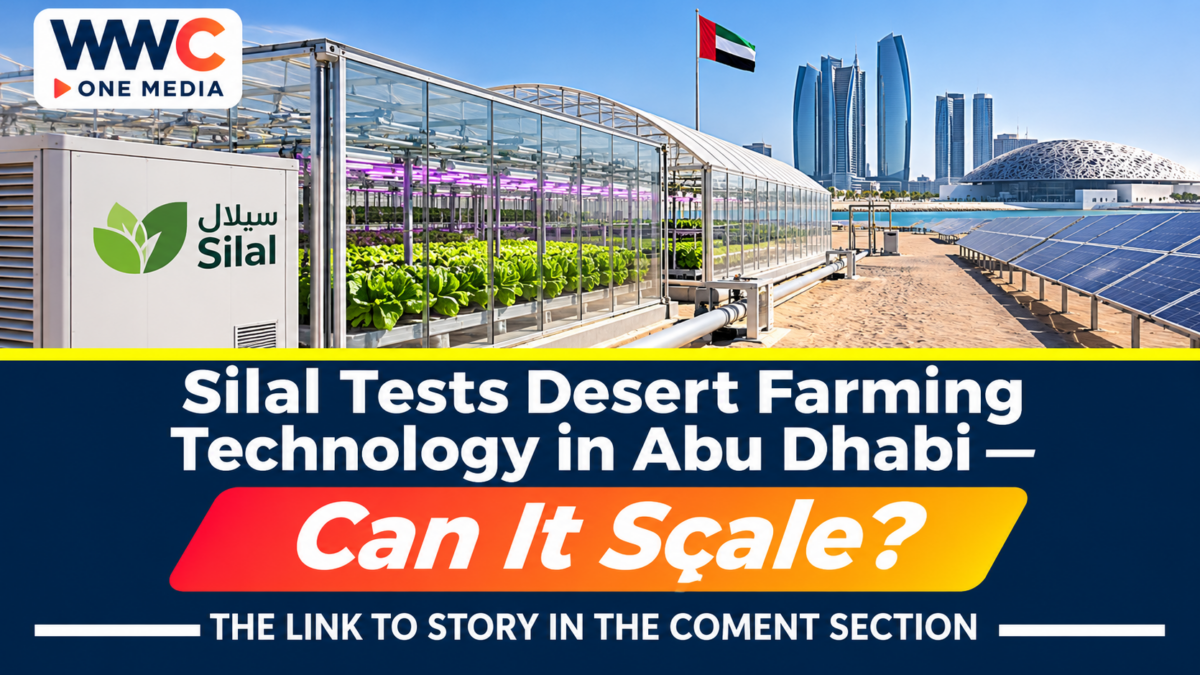
ABU DHABI, Nov. 17, 2026 — Abu Dhabi food company Silal is building a pipeline of desert-farming trials centred on its Innovation Oasis research hub in Al Ain. Official announcements show a combination of protected growing facilities, crop-testing partnerships and farmer-funded pilot projects intended to identify technologies that can withstand heat and limited freshwater supplies.
The difficult question is no longer whether advanced farms can be built in the desert. It is whether their water use, energy costs, yields and maintenance requirements can support production beyond research sites and demonstrations.
Silal Desert Farming Moves From Laboratory to Field
Silal’s Innovation Oasis was inaugurated in April 2025, alongside the Advance AgriTech Academy, as part of the United Arab Emirates’ food-security efforts. The company’s description of the site places the research centre at Al Foah farms in Al Ain, covering 34 hectares.
Its facilities combine laboratories and growth chambers with greenhouses, net-houses, outdoor crop plots and a specialised plant-measurement glasshouse. Sensors record growing conditions; automated equipment regulates irrigation and fertiliser delivery.
Those details matter because technology that performs well indoors may prove expensive or unreliable when exposed to desert heat, dust or variations in water quality. A controlled test site can compare methods before farmers are asked to make large investments.
What the Partnerships Actually Promise
In December 2025, Silal announced an agreement with Square Roots to establish a cloud-connected, artificial-intelligence-supported research facility at Innovation Oasis. The proposed work includes controlled-climate cultivation, crops adapted to desert conditions and low-light plant genetics.
The partners identified a goal of indoor farming with up to 40% lower energy consumption through low-light genetics. That is a stated research ambition, not evidence that a UAE commercial farm has already achieved that saving. No site-wide audited electricity or production results accompanied the announcement.
Silal also describes work with iyris on greenhouse cooling using saline water in Al Ain. Its project page displays prospective reductions in freshwater use, energy use and overhead costs. Without a disclosed baseline, method and reporting period, such figures should not be treated as independently established outcomes across the UAE farming sector.
Separately, a 2024 agreement with KEZAD outlined two agritech initiatives in Al Ain Industrial City, including a proposed 50,000-square-metre berry-growing project associated with iyris. A signed land arrangement indicates an intended development; it does not alone establish completed capacity or commercial harvests.
The Economics of Heat, Water and Electricity
Water is only one part of the equation. Cooling a greenhouse, moving water, running sensors and providing artificial light can raise operating expenses even when a system produces consistent crops. Similarly, desalination can expand the usable water supply but requires investment, energy and careful management.
Silal’s research programme explicitly identifies high temperatures, freshwater scarcity, poor soil and energy consumption as linked constraints. Evaluating them together is more useful than advertising one impressive percentage in isolation.
In January 2026, the Abu Dhabi Department of Energy and Silal signed an agreement to explore more sustainable energy and water management in agriculture. The agreement establishes collaboration, not a published performance guarantee for participating farms.
What this could mean: the decisive measure for commercial deployment is likely to be the cost and reliability of producing marketable crops, not whether a greenhouse uses cutting-edge artificial intelligence. That is an editorial assessment based on the project’s stated objectives, rather than a company forecast.
Small Farmers Get a Route Into Testing
Silal’s Farm Innovation Fund offers selected UAE farmers pilot support worth up to AED 200,000 per project. The programme calls for five farmers to receive access to trial land, technical support and implementation funding, with the 2026 application window closing on May 30.
Its published timetable sets implementation from October 2026 through June 2027. Areas eligible for testing include crop quality, water or energy savings, soil improvement, heat resilience and post-harvest handling.
Pilot funding helps test ideas but does not necessarily finance permanent equipment. Results still need to be assessed before wider adoption.
Silal and the Statistics Centre – Abu Dhabi also signed an October 2026 agreement to improve agricultural data exchange and analytical capabilities. More consistent statistics could eventually help compare farm productivity and resource use, although the agreement itself does not publish new national crop-output results.
Why the Philippine Comparison Matters
The UAE’s trials have particular relevance to countries exposed to seasonal drought and expensive farm inputs. They do not offer a ready-made solution for the Philippines: local crops, energy tariffs, rainfall patterns, farming scales and infrastructure vary considerably.
There is nevertheless a shared policy question. WWC has previously examined urban farming technology in Quezon City, where demonstration sites can help growers assess methods suited to limited land. Demonstrations are valuable when results can be translated into affordable practices.
Water stress is another point of comparison. WWC’s coverage of water shortages threatening Central Visayas farms illustrates why irrigation reliability matters independently of the sophistication of a crop-growing system.
And the emphasis on practical skills resembles training for vegetable growers in Capiz. Farmers need technical guidance and evidence of economic value, not simply access to equipment. These are comparisons, not evidence of partnerships with Silal.
What Happens Next
The most useful evidence will come from completed 2026–27 farmer trials and from operating results at the research and commercial demonstration facilities. Relevant measures include crop yields, quality, energy per kilogram of produce, freshwater consumed, maintenance costs and the cost of delivering food to buyers.
Silal’s partnerships demonstrate significant organisational commitment to testing desert agriculture. They do not yet establish that any one method can replace food imports, eliminate water scarcity or become profitable at every farm size.
For investors, governments and growers, the next step is to distinguish technologies that survive rigorous field testing from those that remain promising prototypes. A successful desert-farming strategy will have to prove not just that crops can grow, but that farmers can afford to keep growing them.
FAQ
What is Silal’s Innovation Oasis?
It is a 34-hectare agricultural research and development centre at Al Foah farms in Al Ain. It supports greenhouse, outdoor and laboratory trials intended to improve farming under difficult environmental conditions.
Is Silal producing food commercially with all these technologies?
Silal is involved in food supply activities, but the cited research partnerships do not establish that every proposed farming technology has reached commercial production. Individual projects require separate evidence of output and operating performance.
How much funding is available to UAE farmers?
The published Farm Innovation Fund offers pilot support worth up to AED 200,000 for selected farmers. Its 2026 applications have closed, and funding is tied to testing proposals rather than unrestricted grants.
Can desert farming technology reduce freshwater use?
Some systems are designed to use water more efficiently, including controlled irrigation and saline-water cooling. Actual savings depend on how a specific system performs against a measured baseline.
Could these technologies help Filipino farmers?
Certain practices may be relevant, especially moisture monitoring and controlled irrigation. They would still require local testing for affordability, crop suitability and energy requirements before large-scale adoption.