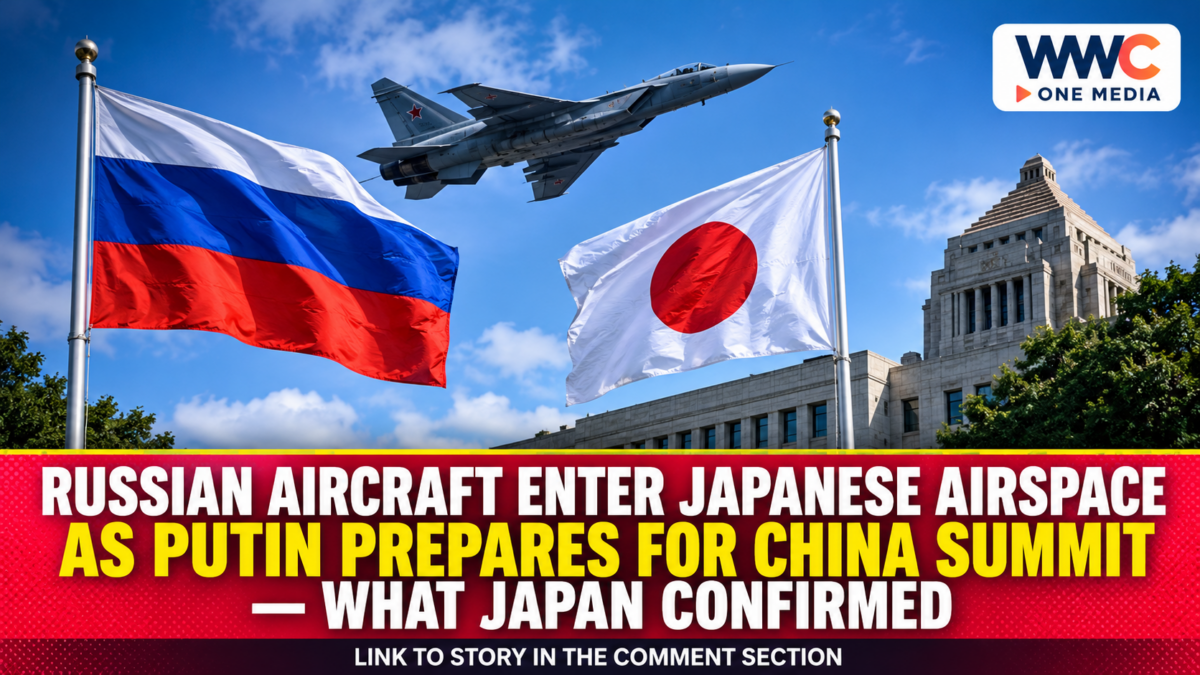
Two aircraft believed to be Russian entered Japanese territorial airspace off the coast of Fukuoka Prefecture early on November 17, prompting Japan to scramble fighter jets and issue warnings. The incident comes two days before Russian President Vladimir Putin is scheduled to join Chinese President Xi Jinping and US President Donald Trump at a summit in Shenzhen.
Japan’s government has described the airspace violation as a serious infringement of its sovereignty and said it lodged a strong protest with Moscow. The timing places the incident against a busy diplomatic and security backdrop in East Asia, although no official statement has established a connection between the aircraft movements and the upcoming summit. Ministry of Defense Japan+2
Japan confirms two Russian aircraft entered its airspace
Japan’s Ministry of Defense said two aircraft believed to be Russian separately entered the country’s territorial airspace northwest of Okinoshima, an island off Fukuoka Prefecture.
The first aircraft was recorded between approximately 4:07 a.m. and 4:10 a.m. on November 17. A second aircraft entered between approximately 4:09 a.m. and 4:12 a.m., according to the ministry’s official notice.
Japan’s Air Self-Defense Force scrambled fighter aircraft in response. The ministry said the fighters issued notifications and warnings as part of the response to the incident. Ministry of Defense Japan+1
The Japanese government identified the aircraft as presumed Russian. That qualification matters: the public notice does not provide aircraft models, individual identification numbers or other technical details that would allow readers to independently identify the aircraft.
The ministry also published an overview of the aircraft movements. It said the suspected Russian aircraft subsequently passed through the Tsushima Strait, travelled between Yonaguni Island and Taiwan, and continued towards the Pacific Ocean. Ministry of Defense Japan
Tokyo says it protested to Moscow
Japan’s Defence Minister addressed the incident during a November 17 press conference.
The minister said the government considered the violation a serious infringement of Japanese sovereignty and a threat to safety. Japan had lodged a strong protest with Russia through diplomatic channels and called for measures to prevent another occurrence.
The minister also said Japan would continue monitoring Russian military movements and maintain its airspace surveillance and response measures. Ministry of Defense Japan
The diplomatic protest is an important part of the incident because it moves the matter beyond an air-defence response. Tokyo has formally raised its objection with Moscow, making the issue one for bilateral diplomatic engagement as well as military monitoring.
However, the public Japanese statement does not disclose Russia’s response to the protest. It also does not establish whether the aircraft deliberately entered the airspace or explain their operational purpose.
Those questions should remain open until the governments involved provide further information.
The flight route brought the aircraft close to Taiwan
The route described by Japan is significant geographically.
After passing through the Tsushima Strait, the suspected Russian aircraft travelled between Yonaguni Island and Taiwan before reaching the Pacific. Yonaguni is Japan’s westernmost inhabited island and lies close to Taiwan.
The route places the incident within a sensitive part of the western Pacific, where Japan, Taiwan and China monitor military activity and maritime movements.
Taiwan’s Ministry of National Defense separately published its November 17 daily report on Chinese military activity around the island. It recorded five sorties of Chinese military aircraft, six Chinese naval vessels and two official vessels during the reporting period from 6 a.m. on November 16 to 6 a.m. on November 17.
Taiwan said all five aircraft sorties crossed the median line of the Taiwan Strait and entered its southwestern and eastern air defence identification zone. Its armed forces monitored the activity and responded with aircraft, naval vessels and coastal missile systems. AIR FORCE COMMAND HEADQUARTERS, MND
That report concerns Chinese military activity. It does not independently confirm the separate claim that Taiwan detected the Russian aircraft off its eastern coast. The two developments should not be combined into a single military operation without supporting evidence.
For readers following the wider regional picture, WWC has also examined Taiwan’s latest official reports on Chinese military activity, including what the daily figures establish and what they do not.
Putin’s scheduled China summit adds diplomatic significance
The incident occurred shortly before a high-level meeting involving the leaders of China, Russia and the United States.
China’s Foreign Ministry announced on November 16 that Xi would host Putin and Trump at a China-Russia-U.S. summit in Shenzhen on November 19. The ministry described the meeting as an opportunity for the three leaders to exchange views on major international issues. China Foreign Affairs+1
The meeting is taking place alongside the wider APEC Economic Leaders’ Meeting in Shenzhen, scheduled for November 18 and 19. China has announced that Xi will chair the APEC meeting and hold related engagements with participating leaders. China Foreign Affairs
The diplomatic calendar makes the Japanese airspace incident particularly noteworthy. Russia is preparing for direct engagement with China and the United States while Japan has publicly protested the actions of aircraft it believes were Russian.
But timing is not proof of coordination.
Neither Japan’s defence ministry nor China’s Foreign Ministry has publicly linked the aircraft incident to the Shenzhen summit. There is also no official evidence in the records reviewed that the flight was intended as a signal to any of the participating governments.
The distinction is important. A security incident can occur during a major diplomatic event without necessarily being part of that event’s agenda or strategy.
Why the incident matters to the wider Indo-Pacific
Japan’s response highlights the importance of airspace monitoring in a region where military aircraft operate near national borders and strategically important waterways.
An airspace violation can prompt fighter deployments, diplomatic protests and additional surveillance. Even without an armed confrontation, such incidents can increase tension and create opportunities for miscalculation.
For the Philippines, developments around Taiwan and Japan are relevant because the country sits along important routes connecting the South China Sea, the Philippine Sea and the wider Pacific.
The northern Philippine province of Batanes lies near the Bashi Channel, a major passage between Taiwan and Luzon. Regional military developments can therefore have implications for shipping, aviation, defence planning and crisis preparedness.
The Philippines has also continued strengthening its defence relationship with Japan. WWC previously examined the Philippines-Japan defence logistics agreement, which provides a framework for reciprocal logistical support between the two countries’ armed forces.
Japan’s wider security assistance to Manila, including surveillance drones and coastal radar, also reflects the growing importance of maritime and regional security cooperation.
For Manila, the immediate concern is not to assume that every military movement signals an impending conflict. It is to understand how repeated activity, diplomatic disputes and close encounters can affect regional stability.
What happens next
The next developments to watch include any further explanation from Japan about the aircraft, a response from Moscow to Tokyo’s diplomatic protest, and updates from the governments participating in the November 19 Shenzhen summit.
Japan’s defence authorities may provide additional information about the incident, although the current public notice does not disclose the aircraft types or their stated mission.
The summit may also produce statements on international security and relations among the three participating countries. Until those statements are released, the aircraft incident and the diplomatic meeting should be treated as separate developments.
For now, Japan has confirmed the airspace violation, its fighter response and its diplomatic protest. The reason for the aircraft movements remains publicly unexplained.
Frequently asked questions
Did Russian aircraft enter Japanese airspace on November 17, 2026?
Japan’s Ministry of Defense said two aircraft believed to be Russian entered Japanese territorial airspace northwest of Okinoshima early on November 17.
Did Japan scramble fighter jets?
Yes. Japan said its Air Self-Defense Force scrambled fighter aircraft and issued notifications and warnings in response.
Did the Russian aircraft fly near Taiwan?
Japan’s Ministry of Defense said the aircraft passed between Yonaguni Island and Taiwan before continuing towards the Pacific Ocean.
Is Putin meeting Xi Jinping in China?
China’s Foreign Ministry announced that Xi would host Russian President Vladimir Putin and US President Donald Trump at a summit in Shenzhen on November 19, 2026.
Is the Russian aircraft incident connected to the China summit?
No official record reviewed establishes a connection. The timing is notable, but there is no verified evidence that the aircraft movements were coordinated with or intended to influence the summit.