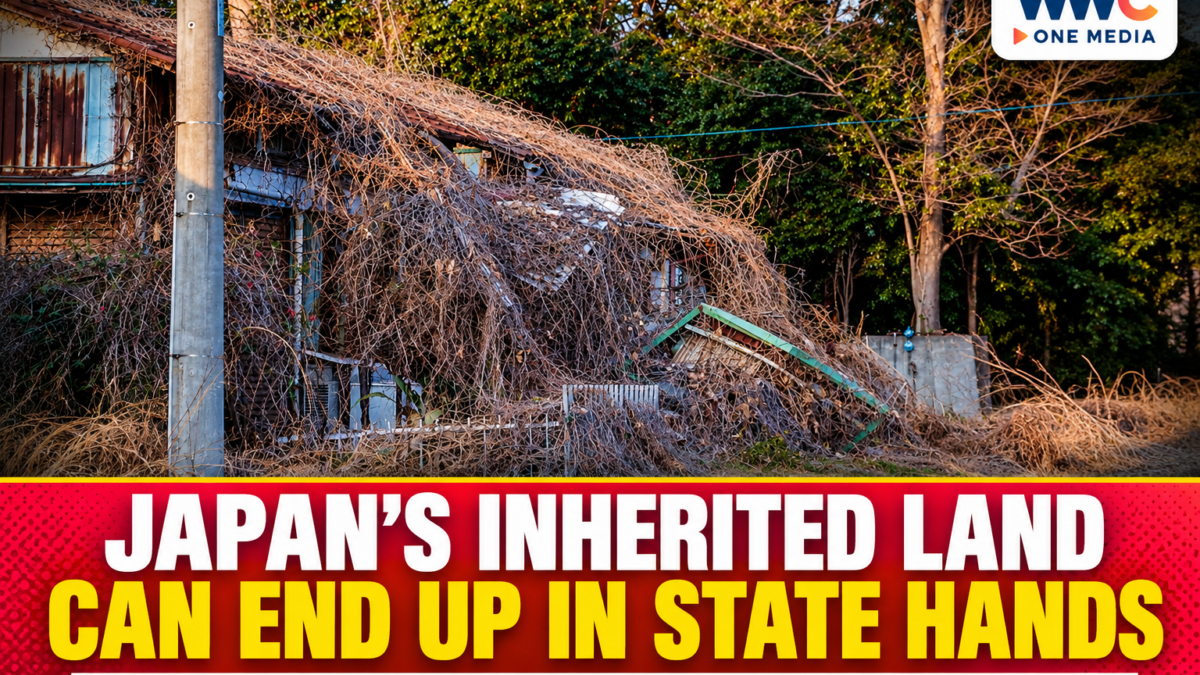
Japan has introduced legal measures to deal with a growing problem: land and buildings that become difficult to manage when ownership is unclear, relatives cannot agree on inheritance, or nobody comes forward to claim an estate.
Under Japanese law, certain inherited property can ultimately pass to the national government when no heir claims it. Separately, a system launched in April 2023 allows eligible people who inherited land to apply to transfer ownership to the state, subject to strict conditions and payment of a management contribution.
These are two different legal processes, but both address the same underlying challenge: what happens when inherited property becomes a burden rather than an asset?
The issue has implications beyond Japan. As populations age and families become smaller, governments face growing questions about who should maintain land when the original owner dies and the next generation has little interest in keeping it.
Japan’s inheritance law provides for property to pass to the state
Japan’s Civil Code establishes a process for estates where the existence of an heir is uncertain.
Under Article 952, a family court can appoint an administrator to manage the estate when it is unclear whether an heir exists. The administrator handles the estate while the required procedures take place, including arrangements for creditors and people entitled to receive property.
The law also provides an opportunity for an heir to come forward. Under Article 958, the family court must issue a public notice inviting anyone with inheritance rights to assert those rights within a specified period of at least six months.
But the process does not automatically transfer everything to the government as soon as someone dies without an immediately identifiable relative.
Article 958-3 allows a person with a special connection to the deceased to ask the family court for part or all of the remaining estate after liquidation. This may include someone who shared living expenses with the deceased or contributed to medical treatment and care.
Only property that remains undistributed after these procedures falls under Article 959, which provides for the residual estate to pass to the national treasury. Japanese Law Translation+1
This distinction matters because the law does not simply declare every unclaimed house or parcel of land government property. It establishes a legal process intended to identify heirs, address claims and consider eligible people with close connections to the deceased.
The land-return system gives some heirs another option
Japan created a separate route for people who inherit land but do not want to continue owning it.
The Act on the National Government’s Acquisition of Land through Inheritance, commonly associated with the Land Return System, took effect on April 27, 2023.
It allows eligible individuals who acquired land through inheritance or a qualifying bequest to apply to the Minister of Justice for approval to transfer ownership to the national treasury.
The system is not an automatic handover. The Ministry of Justice examines each application and may conduct investigations, including on-site inspections, before deciding whether the land meets the legal requirements.
If approval is granted, the applicant must pay a contribution towards the government’s future management expenses. Ownership transfers to the state only after that payment is made. moj.go.jp+2
The system is intended to prevent inherited land from becoming neglected simply because the person who received it has no practical use for it.
It also recognises that accepting land can bring continuing responsibilities, including maintenance and the need to address problems affecting neighbouring properties.
Not every inherited property qualifies
The government does not accept every parcel of land offered through the programme.
The Ministry of Justice identifies several conditions that can prevent approval. These include land with buildings or other structures, contaminated soil, buried objects, dangerous slopes, unclear boundaries, mortgages or other security rights, and land used or expected to be used by other people, such as certain access routes.
The underlying principle is that the government should not be required to accept property that would demand excessive expense or effort to manage or dispose of.
Applications are therefore subject to documentary checks and, where necessary, physical inspections. The process is designed to prevent owners from transferring serious maintenance or legal problems to the public without scrutiny. moj.go.jp+2
This means the system is not a simple escape route for owners who no longer want their property. Applicants must demonstrate that the land meets the legal standards, and the government retains the authority to reject applications that fail them.
Transferring land to the state comes with a cost
Applicants must pay a screening fee of ¥14,000 for each parcel of land submitted.
If the application is approved, they must also pay a contribution based on the estimated standard cost of managing the land for 10 years. The Ministry of Justice says the contribution is generally ¥200,000, although the amount can be higher depending on the type and location of the property.
For example, certain residential and agricultural land in designated urban areas and forests are assessed using area-based calculations.
The payment is not an annual charge. It is a one-time contribution calculated with reference to 10 years of standard management costs.
Once the applicant receives the payment notice, the contribution must generally be paid within 30 days. Failure to pay within the required period causes the approval to lapse. Ownership transfers only after the contribution is paid. moj.go.jp+2
The financial requirements reveal an important feature of the programme: Japan is willing to take responsibility for qualifying inherited land, but it does not intend to absorb all the management costs without contribution from the previous owner.
Japan is also tightening inheritance registration rules
The land-return programme is only one part of Japan’s wider effort to prevent properties from becoming difficult to trace.
Since April 1, 2024, people who inherit real estate have been required to apply for inheritance registration within three years of learning that they acquired the property.
Failure to comply without a justifiable reason can result in a civil fine of up to ¥100,000.
The obligation also covers qualifying inheritances that occurred before the rule took effect. For those earlier cases, the government set March 31, 2027, as the general deadline where the inheritance was already known before April 2024.
A separate obligation took effect on April 1, 2026. Registered property owners must now apply to update their registered name or address within two years of a change. Failure to do so without a justifiable reason can result in a civil fine of up to ¥50,000. moj.go.jp+2
These measures address a practical problem: land records become less useful when the registered owner has died, moved or changed their name and the information is never updated.
Japan’s Ministry of Justice has also introduced an ownership-property record certificate system, effective Feb. 2, 2026, allowing people to request a list of real estate registered under a particular deceased person’s name. This can help heirs identify properties that might otherwise be overlooked. moj.go.jp+1
What the changes could mean for Japan
Japan’s approach combines three different measures: identifying heirs, requiring timely registration and allowing eligible inherited land to be returned to the state.
Each addresses a different stage of the problem. Inheritance procedures establish who has rights to an estate. Registration requirements keep ownership records current. The land-return system provides a possible solution when an heir does not want to retain qualifying land.
The approach also places limits on what the government is prepared to accept. Requiring inspections, eligibility checks and a financial contribution helps protect public resources, although these requirements may make the process difficult for people who inherit land with little financial value.
The larger challenge is balancing private ownership with the public consequences of neglected property. Unclear ownership can delay development, complicate public works and leave land without adequate maintenance.
Japan’s measures do not eliminate those problems, but they create clearer legal routes for dealing with them.
What happens next
Japan’s inheritance registration requirements remain in force, with March 31, 2027, approaching as the general deadline for certain older unregistered inheritances.
Property owners and heirs also need to comply with the separate two-year deadline for registering changes to names and addresses.
Meanwhile, the land-return system continues to operate through applications reviewed by the Ministry of Justice. Approval is not guaranteed, and applicants must meet the legal conditions and pay the required contribution before ownership can pass to the government.
The outcome will depend partly on whether these procedures make it easier to identify owners, settle estates and prevent land from being left unmanaged.
Frequently asked questions
1. Does Japan automatically take land when someone dies without children?
No. The absence of children does not automatically mean an estate belongs to the state. Other heirs may exist, and the legal process includes estate administration and a search for anyone entitled to inherit.
2. Can someone voluntarily give inherited land to the Japanese government?
Yes. Eligible people who acquired land through inheritance or a qualifying bequest can apply under the Land Return System. Approval depends on the land meeting the legal requirements.
3. Does Japan accept houses through the land-return programme?
Land with buildings is generally excluded. The programme is intended for qualifying land that does not require excessive management or disposal costs.
4. How much does it cost to return inherited land?
The screening fee is ¥14,000 per parcel. Approved applicants must also pay a contribution towards 10 years of standard management expenses, generally starting at ¥200,000, with higher amounts possible depending on the land.
5. When must inherited property be registered in Japan?
The general rule requires registration within three years of learning that the property was inherited. Certain older unregistered inheritances are subject to the March 31, 2027, deadline.