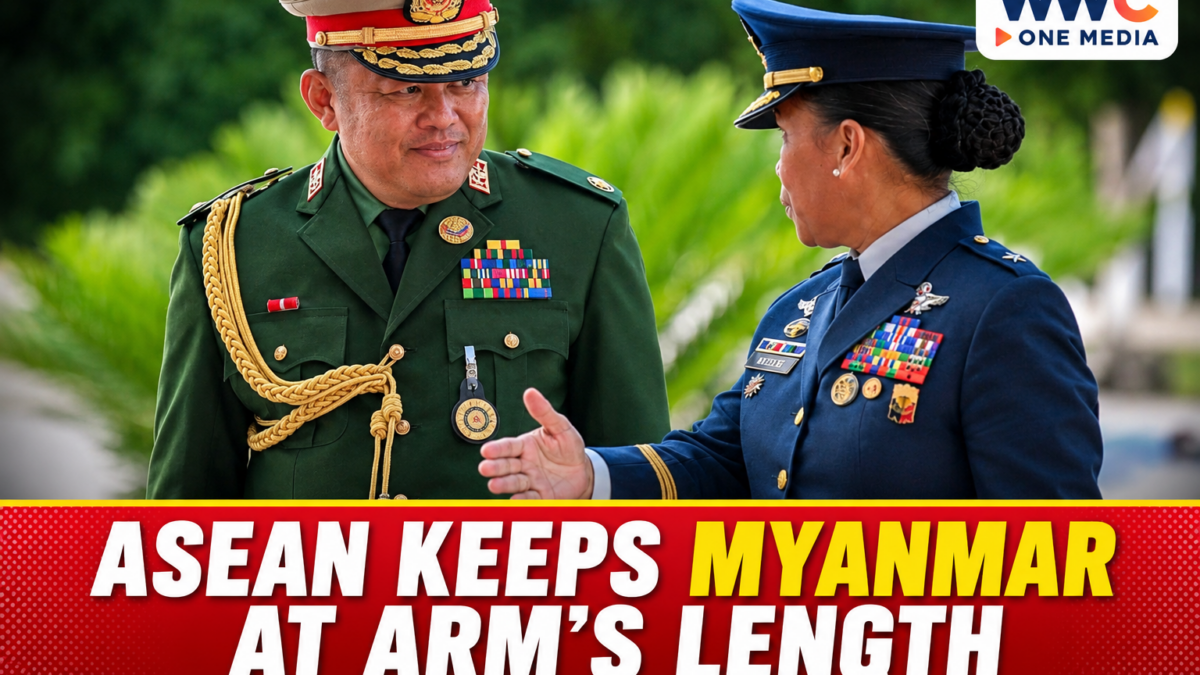
ASEAN leaders have maintained restrictions on Myanmar’s political representation while acknowledging that humanitarian assistance has reached more communities. The distinction matters: the regional bloc has recorded some progress in delivering aid, but it has not concluded that Myanmar has made sufficient progress towards resolving its political crisis.
The Nov. 15, 2026, decision adopted at the 49th ASEAN Summit in Manila makes that position clear. Leaders reaffirmed the Five-Point Consensus (5PC) as the bloc’s principal framework for addressing Myanmar’s crisis and called for its full implementation. They also expressed deep concern over the continuing conflict and humanitarian situation. ASEAN Main Portal+1
Humanitarian assistance has advanced, but the political crisis remains unresolved
One of the more concrete developments recorded in the decision concerns humanitarian operations.
ASEAN acknowledged that a month-long humanitarian support distribution had begun, reaching more than 11,000 households. The operation included four additional priority townships that had not previously been reached by the ASEAN Coordinating Centre for Humanitarian Assistance on disaster management, known as the AHA Centre.
The decision also recorded an ASEAN Monitoring Team mission to Myanmar on Oct. 28, led by the ASEAN Chair’s Special Envoy. It noted that Myanmar had indicated openness to further expanding humanitarian access.
These developments offer evidence of movement in humanitarian cooperation. They do not, however, establish that the wider conflict has eased or that aid can now reach every community in need.
The leaders’ overall assessment remained cautious: progress in implementing the Five-Point Consensus was insufficient, while progress in humanitarian assistance through the AHA Centre was limited. ASEAN
The Philippines’ diplomatic role continues beyond the summit
The Philippines has been directly involved in ASEAN’s engagement with Myanmar through Foreign Affairs Secretary Ma. Theresa P. Lazaro, who serves as the ASEAN Chair’s Special Envoy on Myanmar.
The leaders’ decision recorded her visits to Nay Pyi Taw on Jan. 6 and Oct. 29, 2026. It also recognised diplomatic efforts to bring different Myanmar stakeholders into discussions.
These included a Myanmar Stakeholders’ Meeting in Tagaytay on Jan. 19–20 and informal meetings with Myanmar ethnic armed organisations and representatives of the National Solidarity and Peacemaking Negotiation Committee in Pattaya, Thailand, on July 13.
The significance of these engagements lies in ASEAN’s attempt to maintain communication with parties beyond the authorities in Myanmar. The decision specifically called for inclusive engagement with relevant stakeholders as part of efforts to build trust and create conditions for national political dialogue.
That approach does not guarantee negotiations or an agreement. It does, however, keep diplomatic channels open while ASEAN continues to press for a reduction in violence. ASEAN
ASEAN maintains restrictions on Myanmar’s political representation
The summit did not restore Myanmar’s full political representation at ASEAN’s highest-level meetings.
Leaders agreed to maintain the policy of non-political representation at ASEAN Summits and ASEAN Foreign Ministers’ Meetings until meaningful progress is made in implementing the Five-Point Consensus.
The decision also makes an important distinction: Myanmar’s participation in other ASEAN sectoral ministerial bodies and mechanisms should remain unrestricted at all levels.
This means the bloc is not cutting off Myanmar from every form of regional cooperation. Instead, it is maintaining a specific restriction on political representation while leaving other channels of participation open.
ASEAN also left room for a gradual change in policy. Its leaders said the bloc may consider restoring full political representation through a phased and progress-based approach, but only if Myanmar demonstrates sustained and concrete progress in implementing the 5PC.
There is no fixed date for that restoration, and the decision does not promise that it will happen automatically. ASEAN
Violence and civilian protection remain central concerns
The decision places responsibility on all parties involved in the conflict to reduce violence and protect civilians.
ASEAN urged the armed forces, security forces and armed groups to de-escalate hostilities and stop targeted attacks against civilians and civilian infrastructure. It also stressed the importance of a sustained nationwide ceasefire.
Humanitarian assistance was another major concern. Leaders called for aid to be delivered safely, effectively and transparently, based on the Joint Needs Assessment, with particular attention to internally displaced persons and communities in townships that remain underserved.
The statement also called for international funding and for Myanmar to facilitate humanitarian access.
These priorities show why ASEAN has not treated the delivery of relief supplies as sufficient evidence that the political crisis is moving towards resolution. Humanitarian operations can help people survive the consequences of conflict, but a durable settlement requires broader political progress. ASEAN
What happens next
ASEAN Foreign Ministers are expected to continue monitoring implementation of the Five-Point Consensus and report developments to the next ASEAN Summit.
The leaders also called for coordination among previous, current and incoming ASEAN chairs to preserve continuity in the bloc’s approach. This is important because Myanmar’s crisis extends beyond a single summit or chairmanship.
The decision further encourages cooperation with the United Nations, neighbouring countries and external partners. It recognises that the crisis is connected to wider regional concerns, including human trafficking, drug trafficking, displacement, cyber threats and online scams.
For the Philippines, the outcome leaves a continuing diplomatic responsibility: sustain engagement, support humanitarian access and help maintain pressure for meaningful progress without suggesting that the crisis has been resolved.
ASEAN has kept the door open to Myanmar’s wider participation, but the conditions remain demanding. The next test will be whether the limited humanitarian gains recorded in 2026 can be accompanied by measurable progress towards ending violence and enabling inclusive political dialogue. ASEAN