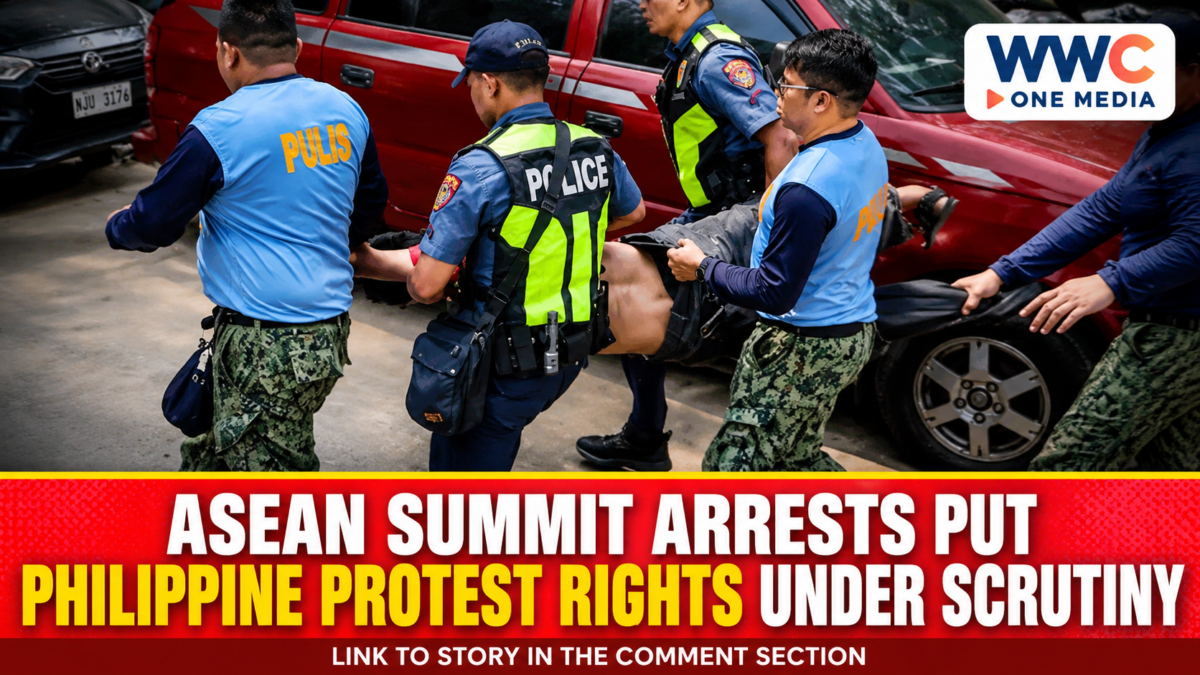
The arrest of protesters during the opening of the 49th ASEAN Summit has placed police operations, freedom of assembly and the government’s handling of public demonstrations under renewed scrutiny, following confrontations in Metro Manila on Nov. 15, 2026.
The Philippine National Police (PNP) defended its security response, while civil society groups, religious leaders and lawmakers raised concerns over the arrests and the treatment of demonstrators.
The issue goes beyond the security arrangements for an international gathering. It concerns how the government balances public safety with constitutional protections, particularly when citizens use demonstrations to express opposition to government policies and foreign relations.
What triggered the police operations during the ASEAN Summit?
The demonstrations took place as the Philippines hosted the 49th ASEAN Summit and Related Summits, which brought foreign leaders and delegations to Metro Manila.
The PNP said it monitored protest activities in Manila, Muntinlupa and Quezon City. Its Nov. 16 statement identified incidents involving arrests and injuries to police personnel.
PNP chief Gen. Jose Melencio C. Nartatez Jr. said security personnel would remain deployed at summit venues, with additional officers positioned for possible emergencies.
The police leadership maintained that officers had been instructed to remain professional while enforcing security measures.
The PNP also described the summit’s opening day as generally peaceful despite isolated confrontations.
This distinction is important. The government’s overall assessment of summit security does not mean that every police operation was free from controversy or that questions surrounding individual arrests have been resolved.
Freedom of assembly is protected by the Constitution
The central legal issue involves Article III, Section 4 of the 1987 Philippine Constitution.
It protects freedom of speech, expression and the press, as well as the right of people to assemble peacefully and petition the government for redress of grievances.
This protection is fundamental to democratic participation.
It allows citizens to express disagreement with public policies, organise demonstrations and bring concerns to the attention of government officials.
However, the right to assemble also operates within a legal framework.
Batas Pambansa Blg. 880, or the Public Assembly Act of 1985, establishes rules governing public demonstrations, including permit requirements, police responsibilities and procedures for dispersal.
The law defines maximum tolerance as the highest degree of restraint that police and other law enforcement authorities must observe during public assemblies and their dispersal.
It also recognises designated freedom parks where demonstrations may take place without securing a prior permit.
These provisions are particularly relevant when evaluating police operations during large public gatherings.
The existence of security restrictions does not automatically eliminate constitutional protections. Likewise, the right to demonstrate does not exempt participants from applicable laws.
The circumstances surrounding each incident therefore matter.
What the Public Assembly Act says about arrests
Batas Pambansa Blg. 880 provides specific rules for managing demonstrations.
Section 11 establishes procedures for dispersing assemblies with permits when violence occurs.
It requires police officers to warn participants and give them a reasonable opportunity to stop the disturbance before ordering dispersal.
The law also states that participants should not be arrested during an assembly unless they violate a law, statute, ordinance or provision of the Act.
Section 12 addresses assemblies conducted without a permit where a permit is legally required. Such assemblies may be peacefully dispersed.
Importantly, Section 13 provides that participation in an otherwise peaceful assembly, by itself, cannot make a person criminally liable under the provision concerning an organiser’s failure to secure a required permit.
These distinctions matter because the legality of an arrest depends on the specific circumstances and applicable legal grounds, not simply on whether a person attended a protest.
The Supreme Court’s decision in Bayan et al. v. Ermita also provides important guidance on freedom of assembly and the government’s obligation to establish freedom parks.
The ruling reinforces the principle that regulations must not be applied in a way that effectively removes the public’s ability to exercise constitutional rights.
Police accountability remains part of the security discussion
The PNP has a responsibility to protect summit participants, maintain public order and prevent disruptions that could endanger people.
But police accountability remains equally important.
The PNP leadership’s Nov. 16 statement specifically instructed personnel to remain professional in handling subsequent demonstrations.
Nartatez also directed police units to maintain security measures throughout the remaining summit activities.
The challenge is ensuring that these instructions are reflected in actual operations.
When arrests occur during demonstrations, the public has a legitimate interest in understanding the grounds for detention, the procedures followed and whether the rights of those apprehended were respected.
This includes access to legal assistance and the proper handling of detainees.
The Constitution’s Bill of Rights provides protections against unreasonable arrests and deprivation of liberty without due process.
It also recognises the right of individuals under investigation to competent and independent legal counsel.
These safeguards apply even during major international events.
Security operations must therefore be assessed not only by whether they prevent disruptions but also by whether authorities observe established legal procedures.
Why the issue matters beyond the ASEAN Summit
The controversy raises questions that extend beyond the country’s hosting responsibilities.
The Philippines regularly conducts international conferences, diplomatic meetings and other major public events. Each requires security arrangements that protect visitors while allowing ordinary citizens to continue exercising their rights.
A government that can maintain public order while respecting peaceful dissent demonstrates that security and democratic freedoms can operate together.
For international visitors, the handling of demonstrations also forms part of how the country’s institutions are perceived.
However, the more important consideration is the protection of Filipinos themselves.
Freedom of assembly is not limited to groups supporting government policies. It also covers peaceful expressions of disagreement, criticism and demands for accountability.
That principle is particularly important during periods when major government decisions attract public attention.
The appropriate response to demonstrations should therefore be grounded in law, proportionality and respect for individual rights.
Police officers must be able to perform their duties, but their authority must remain subject to constitutional and statutory limitations.
What happens next
The remaining ASEAN Summit activities require continued coordination among police units and other government agencies.
The PNP has committed to maintaining security deployments while directing personnel to observe professionalism in dealing with demonstrations.
The other important matter is the treatment of people arrested during the Nov. 15 operations.
Their individual circumstances, the legal grounds for their detention and any charges filed must be established through appropriate official records and legal proceedings.
Claims of excessive force or violations of detainees’ rights should also be examined through proper investigative procedures rather than treated as established facts without supporting evidence.
Ultimately, the incident presents a broader test of how Philippine institutions balance public safety with constitutional freedoms.
The success of an international summit should not be measured solely by the smooth movement of delegates or the absence of major disruptions.
It should also reflect the country’s ability to protect the rights of its own citizens while carrying out its responsibilities as host.
Frequently asked questions
1. Why were protesters arrested during the 2026 ASEAN Summit?
The PNP reported arrests following demonstrations in Metro Manila on Nov. 15, 2026. The specific grounds must be assessed through the official records relating to each arrest.
2. Does the Philippine Constitution protect the right to protest?
Yes. Article III, Section 4 of the 1987 Constitution protects freedom of speech, expression and peaceful assembly, including the right to petition the government.
3. Can police disperse a protest without a permit?
Under Section 12 of Batas Pambansa Blg. 880, an assembly held without a permit where one is required may be peacefully dispersed. However, the law also recognises exceptions, including demonstrations in designated freedom parks.
4. What does maximum tolerance mean?
Under Batas Pambansa Blg. 880, maximum tolerance means the highest degree of restraint that police and other law enforcement authorities must observe during a public assembly or its dispersal.
5. Can protesters be arrested simply for participating in a peaceful demonstration?
The Public Assembly Act states that participation in an otherwise peaceful assembly cannot, by itself, make someone criminally liable under its provision concerning an organiser’s failure to obtain a required permit. Other specific violations must be assessed separately.