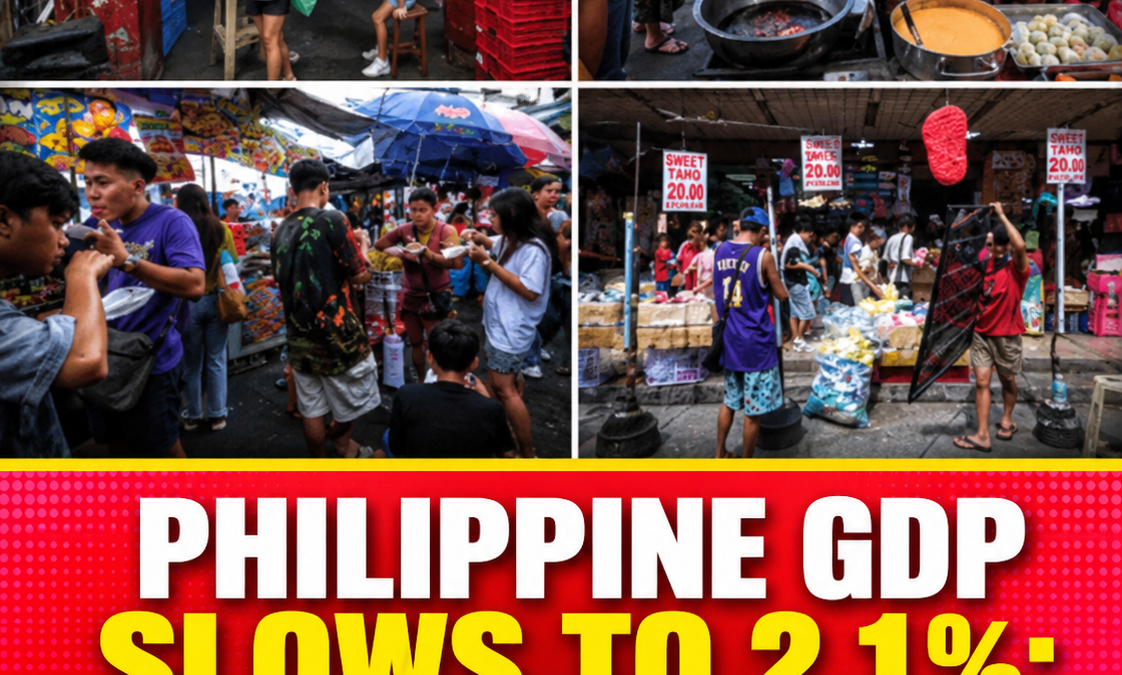
The Philippine economy expanded by just 2.1% in the third quarter of 2026, extending concerns about the country’s weakening economic momentum as household spending, agricultural production and investment struggled to provide stronger support for growth.
Data released by the Philippine Statistics Authority (PSA) on Nov. 9 showed that gross domestic product (GDP) grew by 2.1% year on year from July to September, following a revised 2.4% expansion in the second quarter.
The latest figures put the government’s economic growth ambitions under greater pressure. The Development Budget Coordination Committee (DBCC) is targeting growth of 3.5% to 4.5% for 2026, meaning the economy needs a considerably stronger performance in the remaining months to approach the lower end of that range.
The slowdown matters beyond economic forecasts. GDP growth influences business expansion, employment opportunities, government revenue and the ability of households to improve their financial conditions.
For Filipino consumers and businesses, the concern is that economic activity is losing momentum while the cost of living continues to rise.
Philippine GDP slowdown reveals uneven economic performance
The third-quarter figures show that the slowdown is not affecting every sector equally.
The services sector remained the largest source of expansion among the major sectors, growing by 3.7% year on year.
Agriculture, forestry and fishing, however, contracted by 4.8%. Industry also registered a slight decline of 0.003%.
The performance of agriculture deserves particular attention because the sector supports rural employment, food production and industries that depend on agricultural inputs.
A prolonged decline in agricultural output can affect farm incomes and contribute to supply pressures in food-related markets.
The industry result also highlights the difficulty of generating stronger economic activity through manufacturing, construction and other productive sectors.
Meanwhile, wholesale and retail trade; repair of motor vehicles and motorcycles contributed 3.54% growth, while public administration and defense; compulsory social security expanded by 9.9%.
Financial and insurance activities grew by 3.47%.
These results demonstrate that certain parts of the economy continued expanding, even as other sectors experienced contraction or weaker performance.
The challenge is achieving broader growth rather than relying on a limited number of industries to sustain overall economic expansion. Philippine Statistics Authority
Household spending faces pressure from rising prices
Consumer spending remains an important consideration in the country’s economic outlook.
The PSA reported that household final consumption expenditure increased by 2.4% in the third quarter.
Although spending continued to grow, the result highlights the importance of monitoring household purchasing power as inflation accelerates.
When families allocate more money to essential expenses, they have less flexibility to purchase nonessential products, dine out, travel or spend on other services.
This can affect businesses that depend heavily on domestic consumers.
Retailers, restaurants, transportation providers and small enterprises may experience weaker demand when households become more cautious about spending.
The inflation figures provide another indication of the pressure facing consumers.
The PSA reported that headline inflation accelerated to 7.8% in October 2026 from 7.2% in September. Average inflation from January to October reached 5.6%.
Transportation costs were among the major contributors to the acceleration, with the transport index recording annual inflation of 20.1% in October.
Housing, water, electricity, gas and other fuels also recorded faster annual price increases.
These figures help explain why economic growth and household financial conditions must be considered together.
Even when the economy continues expanding, rising prices can reduce the purchasing power of ordinary Filipinos. Philippine Statistics Authority+1
Investment weakness creates another obstacle
Another important indicator in the third-quarter national accounts was gross capital formation.
The PSA reported that gross capital formation declined by 0.2% year on year during the period.
This measure broadly captures investment in productive assets, including buildings, machinery and equipment, as well as changes in inventories.
Investment matters because businesses need capital to expand operations, improve productivity, introduce technology and increase production capacity.
When companies postpone expansion or reduce spending on equipment and facilities, the effects can extend beyond the immediate quarter.
Fewer investment activities can mean slower construction demand, reduced orders for equipment suppliers and fewer opportunities for businesses connected to new projects.
For the Philippines, strengthening investment will be important in supporting growth beyond household consumption and government spending.
The government must also ensure that public infrastructure programmes translate into actual economic activity and productive assets.
WWC ONE MEDIA previously examined the relationship between public spending and economic performance in its coverage of the Philippines’ proposed infrastructure budget and spending priorities.
Government growth targets face a difficult test
The government’s updated economic assumptions provide a benchmark for assessing the country’s performance.
In its July 8, 2026 statement, the DBCC set the Philippines’ GDP growth target at 3.5% to 4.5% for 2026.
For 2027 through 2030, the government established a target range of 5% to 6%.
The DBCC also identified domestic and international uncertainties that could influence economic performance, including elevated inflation, geopolitical developments and potential weakness in remittances and visitor arrivals.
These assumptions show that the government had already recognised several risks to the country’s economic outlook.
However, the latest quarterly performance adds another challenge: the economy must regain momentum to move closer to its full-year objective.
The government cannot rely solely on projected improvements. Actual growth will depend on whether businesses invest, households maintain spending and productive industries recover.
The contrast between the official growth target and the latest GDP performance is also relevant to the country’s fiscal planning.
Slower economic activity can affect revenue generation and complicate the government’s efforts to finance public services and infrastructure while maintaining fiscal discipline. Department of Budget and Management
What another economic slowdown could mean for businesses
For businesses, slower GDP growth can influence decisions involving hiring, expansion and capital spending.
Companies generally consider consumer demand, operating costs, financing conditions and the broader economic outlook before committing resources to new projects.
If households remain cautious about spending and production sectors struggle to recover, businesses may take a more conservative approach.
Small and medium enterprises could be particularly exposed because they often have fewer financial resources to absorb higher operating costs or prolonged periods of weaker demand.
The effects could also extend to employment.
Businesses facing weaker sales may reconsider expansion plans, while companies experiencing higher input costs could have less room to increase staffing or wages.
However, slower GDP growth does not automatically mean widespread layoffs or an economic recession.
The country recorded positive economic growth in the third quarter. The concern is the pace of expansion and whether the slowdown will persist.
WWC has also examined the broader implications of weaker economic projections in its report on ADB and S&P growth forecast reductions for the Philippines.
What happens next
The next major indicator will be the country’s fourth-quarter economic performance.
The results will help establish whether the Philippine economy can regain momentum before the end of 2026.
Agricultural production, household consumption, private investment, exports and government expenditure will remain important factors to monitor.
Inflation will also require close attention because persistent increases in essential expenses can limit consumer spending and affect business confidence.
Meanwhile, economic forecasts from international institutions should be evaluated alongside the government’s official targets and the latest national accounts.
The central question is no longer simply whether the Philippines can continue growing. It is whether that growth can become stronger, broader and more beneficial to households and businesses.
The country still has opportunities to improve its economic performance, but the latest figures underline the importance of translating policy commitments into measurable results.
Frequently asked questions
1. How much did the Philippine economy grow in the third quarter of 2026?
The Philippine economy grew by 2.1% year on year in the third quarter of 2026, based on the Philippine Statistics Authority’s national accounts.
2. What is the Philippines’ GDP growth target for 2026?
The Development Budget Coordination Committee set a growth target of 3.5% to 4.5% for 2026.
3. Which Philippine economic sector contracted in the third quarter?
Agriculture, forestry and fishing contracted by 4.8%, while industry recorded a slight decline of 0.003%.
4. How fast did Philippine inflation rise in October 2026?
Headline inflation accelerated to 7.8% in October from 7.2% in September 2026.
5. Why is investment important to Philippine economic growth?
Investment supports business expansion, infrastructure development, productive capacity and employment opportunities. A prolonged decline can weaken the economy’s ability to generate stronger growth over time.