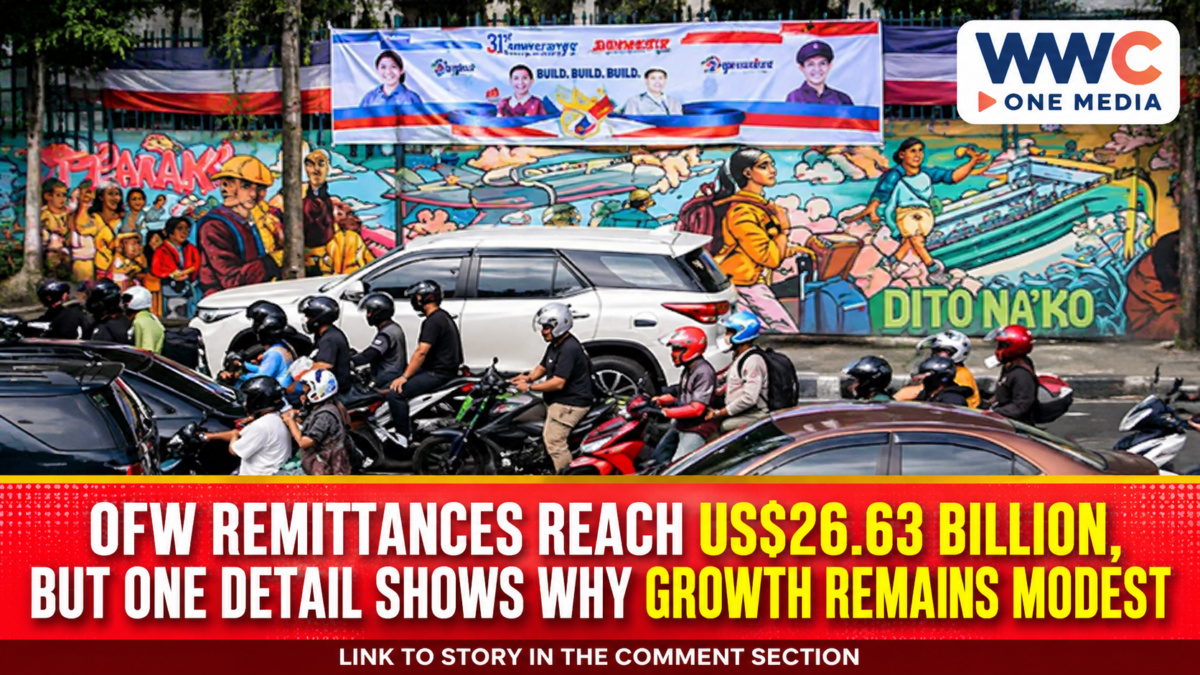
Money sent home by overseas Filipino workers continued to increase in 2026, with cash remittances coursed through Philippine banks reaching US$26.63 billion from January to September, up 2.3% from the same period last year.
The September total alone reached US$3.20 billion, while the latest Bangko Sentral ng Pilipinas figures show that the bulk of the money continued to come from land-based Filipino workers. The numbers point to a steady flow of foreign currency into the country, but the relatively limited year-to-date increase raises a bigger question: how much more can the Philippines rely on remittances to support household spending and the wider economy?
The nine-month total tells a more important story
The BSP’s September 2026 figures put cash remittances at US$26.626 billion for the first nine months of the year. That compares with US$26.030 billion recorded over the same period in 2025.
The difference amounts to approximately US$595.4 million, representing growth of about 2.3%.
The increase is positive, but it is not a dramatic acceleration. It indicates that money sent through the banking system continued to expand, although the pace of growth remained measured.
September’s US$3.202 billion contribution was part of that cumulative total. August recorded US$3.035 billion, while July reached US$3.240 billion.
These monthly movements show why a single month’s figure should not be treated as a complete picture of the remittance economy. The nine-month comparison gives a broader view of how much money entered through formal banking channels over time.
The BSP’s figures are reported in US dollars. The peso value received by families can differ depending on the exchange rate applied when the money is converted.
Land-based workers remain the largest source
The composition of remittances provides another important detail.
Land-based overseas Filipino workers accounted for US$21.307 billion of cash remittances during the first nine months of 2026. Sea-based workers contributed US$5.319 billion.
Together, the two categories made up the US$26.626-billion total.
Land-based workers therefore accounted for roughly four-fifths of reported cash inflows, while sea-based workers supplied the remaining share.
The distinction matters because the overseas Filipino workforce is not a single, uniform group. Workers in different occupations, industries and locations face different employment conditions and income arrangements.
The figures also show that seafarers remain a substantial contributor to the country’s remittance flows. Their contribution is particularly relevant to an economy with a large overseas maritime workforce.
For families receiving money from abroad, however, the practical importance of remittances goes beyond the national totals. These transfers can help cover food, housing, education, healthcare and other household expenses.
The national data do not identify how individual families spend the money, so the aggregate figures should not be interpreted as a direct measure of household welfare.
Where the money is coming from
The BSP’s country-level table offers a closer look at the geographic sources of reported cash remittances.
Singapore accounted for approximately US$1.894 billion in the January-to-September period. Saudi Arabia contributed about US$1.705 billion, while the United Arab Emirates recorded approximately US$1.197 billion.
The Middle East region as a whole generated US$4.785 billion during the same period.
Asia accounted for US$10.813 billion, while ASEAN contributed approximately US$2.496 billion.
These figures show that remittance flows are spread across several important overseas employment destinations. They also demonstrate why developments in overseas labour markets can matter to the Philippine economy.
A change in employment conditions, worker deployment or income in a major destination could influence the amount of money Filipino households receive. However, the BSP’s remittance table does not establish that any particular overseas economic development caused the changes recorded in 2026.
It is also important to distinguish the country where a remittance is recorded from the precise location where the worker earned the money. Banking channels and transfer arrangements can affect how transactions are classified.
Why moderate OFW remittance growth matters
Remittances are important not only because they provide money directly to Filipino households, but also because they bring foreign currency into the country.
When recipients spend these funds locally, the money can support demand for goods and services. Some households may also use remittances to pay debts, finance education, build savings or support small businesses.
The steady inflow is one reason banks and financial technology companies continue to compete for overseas Filipino customers.
As explored in WWC ONE MEDIA’s report on GoTyme’s push to capture a larger share of the OFW remittance market, financial institutions increasingly want to manage more than the transfer itself. They also want to become the account where customers receive, save and use their money.
The same broader opportunity is visible in the expansion of established financial services networks. WWC’s coverage of Palawan Group’s financial inclusion and remittance-related services examines how physical outlets and digital platforms can serve households with different levels of access to formal financial services.
For the Philippine economy, however, steady remittance growth should not be confused with a complete solution to domestic economic challenges.
Remittances can support household purchasing power and foreign-exchange inflows, but they do not automatically create enough local jobs, raise wages or improve productivity. Those outcomes also depend on domestic investment, business activity, infrastructure and the quality of employment available in the country.
The limits of relying on money sent from abroad
The latest figures are encouraging in one respect: the country continued to receive more cash remittances than it did during the comparable period in 2025.
But the 2.3% increase also illustrates the limits of expecting remittances alone to drive stronger economic performance.
A growing total does not necessarily mean every recipient family is better off. The actual purchasing power of a remittance depends on the amount received, the exchange rate and the prices households face when they spend the money.
A family receiving the same dollar amount may find that it covers fewer expenses if local prices rise faster than its income.
The national figures also do not reveal how many households depend on remittances, how frequently they receive transfers or whether recipients have other sources of income.
This is why remittance growth should be assessed alongside other economic indicators, including inflation, employment, household consumption and the country’s external accounts.
The government’s broader support for overseas Filipino workers also matters. As discussed in WWC’s report on the Philippines’ ADB-backed emergency financing and assistance for vulnerable sectors, including OFWs, the economic contribution of overseas workers must be considered alongside the challenges they and their families face.
The remittance figures measure money entering the country. They do not, by themselves, measure the full economic and social costs of working overseas.
What happens next
The next BSP monthly release will show whether the September performance carries into the final quarter of 2026.
The remaining months are important because household transfers can change throughout the year. However, any expectation of stronger holiday-related remittances should be treated as a possibility rather than a guaranteed outcome.
For now, the clearest benchmark is the nine-month comparison: US$26.63 billion in cash remittances, up 2.3% from the same period in 2025.
The figures confirm that overseas Filipino workers remain an important source of foreign currency and household support. They also underline the need for the Philippines to strengthen domestic employment and income opportunities so families are not forced to depend on overseas work as their primary path to financial stability.
Frequently asked questions
How much did OFW cash remittances reach in September 2026?
Cash remittances coursed through Philippine banks reached approximately US$3.20 billion in September 2026.
How much did the Philippines receive in cash remittances from January to September 2026?
The total reached approximately US$26.63 billion, compared with US$26.03 billion during the same period in 2025.
How fast did cash remittances grow in the first nine months of 2026?
The year-to-date total increased by approximately 2.3% compared with January to September 2025.
Do land-based or sea-based workers contribute more to remittances?
Land-based workers contributed the larger share. Their cash remittances reached approximately US$21.31 billion in the first nine months of 2026, compared with US$5.32 billion from sea-based workers.
Why are OFW remittances important to the Philippine economy?
They provide foreign currency and help recipient households pay for everyday expenses, education, housing and other needs. Their impact on the wider economy depends partly on how households use the money and on broader domestic economic conditions.