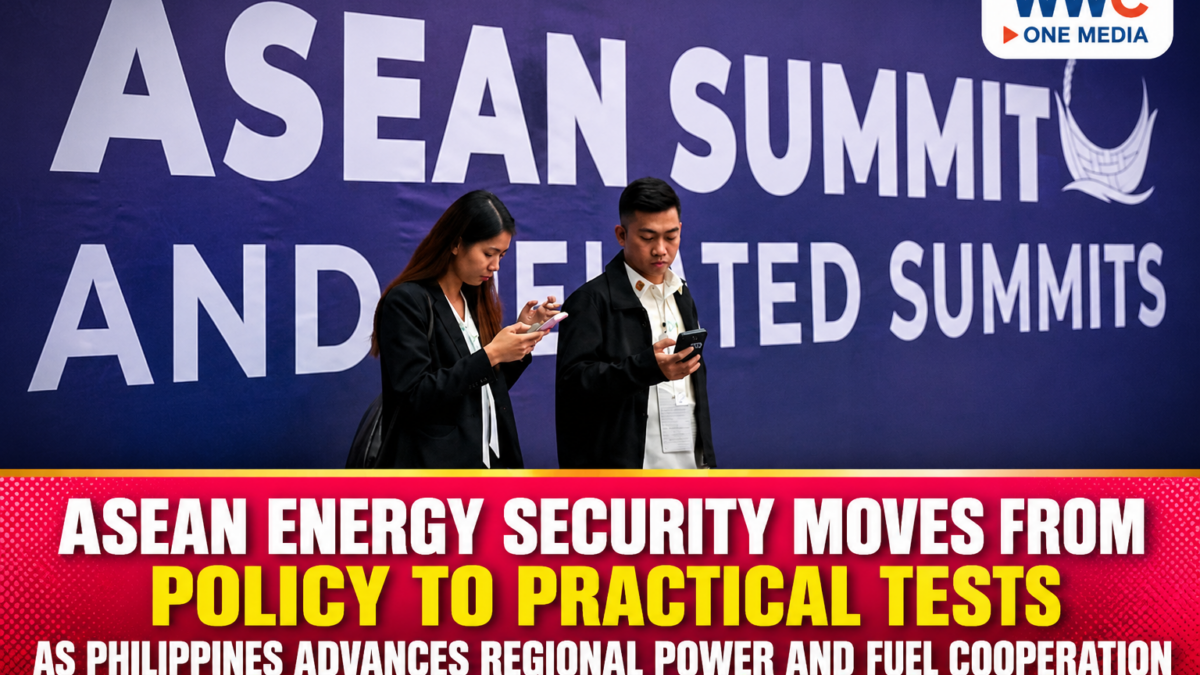
The Philippines is advancing regional energy cooperation through new technical partnerships and proposed emergency petroleum arrangements as ASEAN works to strengthen its electricity connections and protect member economies against fuel-supply disruptions.
The developments include a two-year energy cooperation agreement signed by the Philippine Department of Energy (DOE) and the Economic Research Institute for ASEAN and East Asia (ERIA) on November 15, alongside exploratory oil-access arrangements involving companies in Indonesia and Thailand.
These initiatives build on ASEAN’s May 2026 regional commitments on petroleum security, electricity connectivity and energy diversification. Their importance lies in whether governments can turn those commitments into functioning systems rather than leave them as diplomatic objectives.
For Filipino households and businesses, the distinction matters. Energy security involves not only having sufficient fuel available but also maintaining reliable electricity, developing alternative energy sources and ensuring that supply disruptions do not unnecessarily interrupt economic activity.
ASEAN energy security has two major priorities
ASEAN’s May 8, 2026 Leaders’ Statement on the Response to the Middle East Crisis established a regional framework for strengthening energy resilience.
The document identified petroleum security and electricity connectivity as priorities requiring coordinated action.
For petroleum, leaders called for the completion of national processes toward ratification of the ASEAN Framework Agreement on Petroleum Security (APSA). They also called for measures to operationalise the agreement on a voluntary and commercial basis.
The proposed arrangements include better information-sharing, contingency planning and coordinated emergency responses.
For electricity, the statement called for stronger cross-border power trading and further development of the ASEAN Power Grid (APG), alongside the Trans-ASEAN Gas Pipeline.
These are separate but complementary priorities. Petroleum cooperation addresses the availability of fuel during emergencies, while electricity interconnection aims to improve the movement of power between participating countries.
The regional statement also identified renewable energy deployment, biofuel blending and supply diversification as important components of energy resilience. ASEAN Main Portal
The Philippines expands its energy partnership with ERIA
One of the latest developments came on November 15, when Energy Secretary Sharon S. Garin and ERIA President Tetsuya Watanabe signed a memorandum of understanding.
The agreement establishes a two-year framework for research, technical cooperation and policy support aligned with the Philippine Energy Plan and the Asia Zero Emission Community initiative.
The partnership is intended to strengthen the technical basis of Philippine energy planning.
Its priority areas include studies supporting the country’s participation in the ASEAN Power Grid, sustainable energy systems for islands, distributed off-grid solutions and emerging technologies.
The DOE also identified hydrogen development, waste-to-energy systems and small-scale liquefied natural gas-to-power applications for diesel-dependent islands as areas for technical assessment.
These initiatives are particularly relevant to an archipelago where electricity access and reliability can differ substantially between interconnected urban centres and remote island communities.
However, the memorandum is a cooperation framework, not a construction contract. Its signing does not establish that new power facilities or interconnection projects have already been financed or completed. Department of Energy Philippines
Fuel security moves beyond domestic storage
Petroleum remains another major concern for the Philippines.
The country depends heavily on imported crude oil, making its energy supply vulnerable to international disruptions, shipping difficulties and changes in global petroleum markets.
On November 14, PNOC Exploration Corporation entered into two letters of intent exploring possible access to oil stored in Indonesia and Thailand.
The proposed arrangements involve PT Interport Mandiri Utama and The Shell Company of Thailand Limited, with ERIA and the Indonesian Business Council participating as knowledge partners.
The initiative examines oil ticketing, a mechanism that could allow a participating entity to secure access to petroleum held in another country’s storage facilities during an emergency, subject to agreed conditions.
This approach could provide another option for countries that face limitations in building and maintaining large domestic storage facilities.
It is important, however, to distinguish exploratory arrangements from an operational reserve. The letters of intent do not establish that fuel has already been reserved for immediate delivery to the Philippines.
WWC has previously examined how ASEAN’s first proposed fuel-sharing pilots could test emergency oil access.
The wider question is whether regional cooperation can establish dependable access arrangements before another major supply disruption occurs. ERIA
The ASEAN Power Grid requires infrastructure and investment
While petroleum arrangements address immediate supply risks, electricity connectivity presents a longer-term infrastructure challenge.
The ASEAN Power Grid is intended to support cross-border electricity trading and greater regional integration.
Its development requires more than political agreement. Countries must coordinate transmission infrastructure, regulatory arrangements, technical standards, electricity pricing and commercial responsibilities.
The Philippines also needs to strengthen its domestic electricity network so that additional generation can reach consumers.
WWC previously reported that more than 17.8 gigawatts of Philippine energy projects entered the grid-study process.
That pipeline illustrates why transmission planning is important. New solar, wind and storage developments cannot deliver their full potential if adequate grid connections are unavailable.
Individual renewable projects also demonstrate the financing and infrastructure requirements involved. For example, PetroGreen’s Isabela solar development combines project financing with dedicated transmission development.
Regional electricity cooperation will therefore depend partly on the ability of individual countries to prepare their own power systems.
What regional cooperation could mean for Filipino consumers
Stronger energy cooperation could provide several potential benefits.
First, emergency petroleum arrangements could give participating countries additional options when conventional supply routes become disrupted.
Second, electricity interconnections could eventually allow participating markets to trade available power, subject to infrastructure capacity and commercial agreements.
Third, technical partnerships could help governments assess technologies suitable for local conditions, including renewable energy, storage and off-grid electricity systems.
But these benefits should not be confused with guaranteed reductions in electricity bills or gasoline prices.
Fuel prices remain influenced by international petroleum markets, exchange rates, refining costs, taxes and distribution expenses.
Electricity costs also depend on generation expenses, transmission charges, distribution arrangements and regulatory decisions.
The government has already explored overseas petroleum access as part of the Philippines’ wider fuel-security strategy.
That strategy should be evaluated by whether it provides dependable access to additional supplies, not simply by the number of agreements signed.
What happens next
The next stage involves implementation.
For APSA, the relevant governments must complete their national processes and establish the arrangements needed for effective regional cooperation.
For the ASEAN Power Grid, progress will depend on infrastructure development, regulatory coordination, financing and the expansion of cross-border electricity trading.
The DOE–ERIA agreement will also need to produce useful technical studies and policy recommendations that can inform actual Philippine energy decisions.
Meanwhile, the proposed oil-ticketing arrangements must progress beyond letters of intent if they are to provide dependable emergency access.
The central challenge is straightforward: regional energy cooperation must eventually be measured through reliable supply, functioning infrastructure and practical benefits for consumers.
ASEAN has established important policy directions. The next test is whether its members can deliver the systems needed to make those commitments work.
Frequently asked questions
1. What is ASEAN energy security?
ASEAN energy security refers to regional efforts to maintain reliable, accessible and affordable energy supplies while reducing vulnerability to disruptions in fuel and electricity markets.
2. What is the ASEAN Petroleum Security Agreement?
The ASEAN Framework Agreement on Petroleum Security is a regional framework intended to strengthen cooperation among member states in responding to petroleum supply emergencies.
3. What is the ASEAN Power Grid?
The ASEAN Power Grid is a regional initiative intended to connect electricity systems and support cross-border electricity trading among participating Southeast Asian countries.
4. Will ASEAN energy cooperation immediately lower Philippine electricity and fuel prices?
No. The agreements and initiatives are primarily intended to improve energy security, infrastructure and supply resilience. They do not guarantee lower retail prices.
5. What did the Philippines and ERIA agree to on November 15, 2026?
The DOE and ERIA signed a two-year memorandum of understanding covering energy research, technical cooperation and policy support, including studies related to ASEAN Power Grid participation.