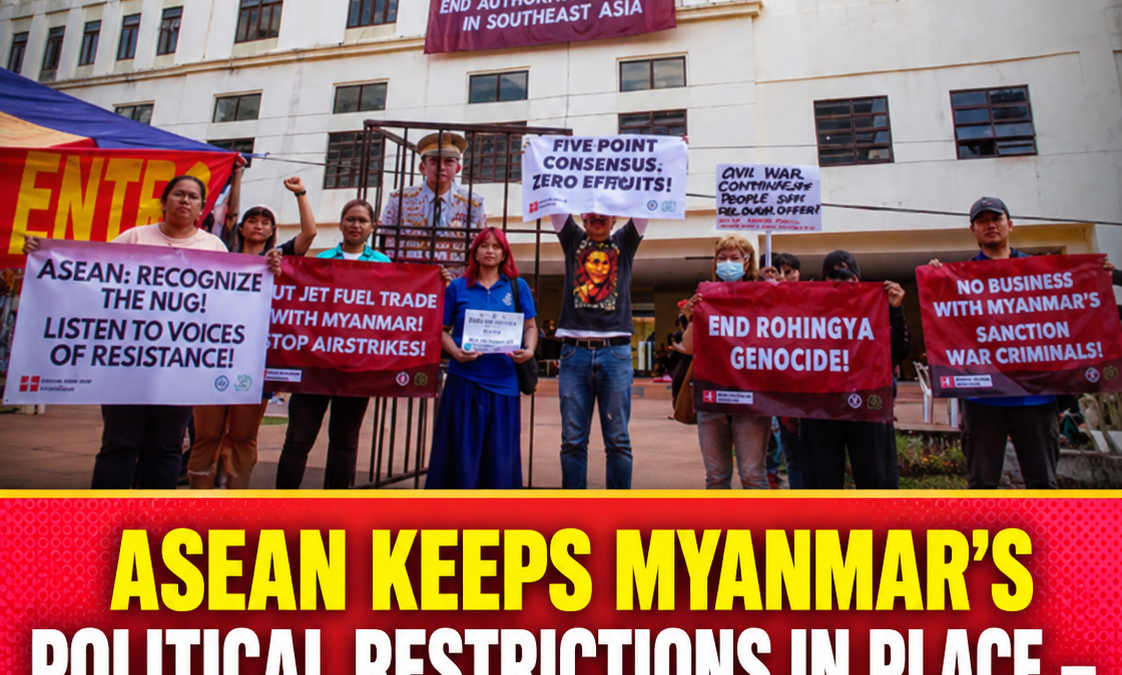
ASEAN leaders have maintained restrictions on Myanmar’s political representation at the bloc’s highest-level meetings, making further progress on the country’s peace process a condition for restoring full participation.
The decision, adopted at the 49th ASEAN Summit in Manila on Nov. 15, 2026, preserves the existing restrictions while introducing a phased approach that could eventually allow Myanmar to regain its full political representation.
The development is significant because ASEAN is attempting to maintain a common regional position while dealing with a crisis that increasingly affects humanitarian assistance, cross-border security, migration and cooperation among Southeast Asian countries. ASEAN Main Portal+1
ASEAN Maintains Restrictions but Leaves a Door Open
The decision adopted on Nov. 15 makes an important distinction between Myanmar’s membership in ASEAN and its political representation at the bloc’s most senior meetings.
Under paragraph 24 of the leaders’ decision, Myanmar will continue to have non-political representation at ASEAN Summits and ASEAN Foreign Ministers’ Meetings until meaningful progress is achieved in implementing the Five-Point Consensus.
However, the same provision explicitly states that Myanmar’s participation in other ASEAN sectoral ministerial bodies and mechanisms should remain unrestricted at all levels.
This means the restrictions do not amount to a suspension of Myanmar’s membership or a complete exclusion from ASEAN activities.
The distinction allows the regional organisation to maintain diplomatic and technical cooperation while withholding full political recognition at its highest-level meetings.
It also preserves an avenue for engagement without requiring ASEAN to abandon the conditions it has established for addressing the crisis. ASEAN Main Portal+1
The Five-Point Consensus Remains ASEAN’s Main Benchmark
The Five-Point Consensus, adopted by ASEAN leaders in April 2021, remains the central framework for the bloc’s response to Myanmar.
The Nov. 15 decision reaffirmed it as the main reference for addressing the country’s political crisis and called for its full implementation.
The latest assessment was not an endorsement of the progress achieved so far. In paragraph 14, ASEAN leaders expressed deep concern over insufficient implementation, while acknowledging limited progress in humanitarian assistance delivered through the ASEAN Coordinating Centre for Humanitarian Assistance on disaster management, known as the AHA Centre.
The leaders also urged the armed forces, security forces and armed groups to reduce violence and stop targeted attacks against civilians and civilian infrastructure.
They called for a sustained nationwide ceasefire to create conditions for humanitarian assistance and inclusive political dialogue.
This is an important distinction in ASEAN’s approach: diplomatic engagement continues, but the bloc has not declared that the conditions for restoring full political representation have been met. ASEAN Main Portal
Humanitarian Assistance Becomes a Measurable Part of the Response
One of the clearest developments recorded in the leaders’ decision concerns humanitarian operations.
ASEAN welcomed an AHA Centre monitoring mission to Myanmar on Oct. 28, 2026, led by the ASEAN Chair’s Special Envoy, Philippine Foreign Affairs Secretary Ma. Theresa P. Lazaro.
The mission marked the beginning of a month-long distribution of humanitarian assistance to more than 11,000 households.
The programme included four new priority townships that the AHA Centre had not previously reached.
ASEAN also noted Myanmar’s openness to expanding humanitarian access to additional areas.
The leaders called for assistance to reach internally displaced persons and other communities affected by armed conflict, based on the Joint Needs Assessment.
They also encouraged international partners to increase financial support for continued humanitarian operations.
These provisions matter because diplomatic agreements have limited practical value if assistance cannot reach people facing displacement, food insecurity and other consequences of prolonged conflict.
The effectiveness of the humanitarian response will therefore be an important indicator of whether regional cooperation can deliver tangible results. ASEAN Main Portal+1
Why the Myanmar Crisis Matters Beyond Its Borders
ASEAN’s concern extends beyond Myanmar’s domestic political situation.
Paragraph 28 of the November 15 decision specifically identifies human trafficking, drug trafficking, displacement, cyber threats, online scams and other security risks as areas requiring stronger regional cooperation.
This is particularly important because instability can create conditions in which criminal networks operate across national borders.
Online scam operations, fraudulent recruitment and trafficking risks can affect people from multiple ASEAN countries, making isolated national responses less effective.
WWC ONE MEDIA previously examined the regional campaign against online scams and the growing threat of organised digital fraud.
The issue also has an economic dimension. Prolonged instability can disrupt transportation, commercial activity, investment confidence and cross-border economic relationships.
Our earlier examination of Myanmar’s business environment and its struggling capital market illustrates why political stability matters to businesses operating in the country.
For ASEAN, these risks make Myanmar’s situation a regional concern involving security, humanitarian cooperation and economic stability.
ASEAN Introduces a Phased Path Toward Political Reintegration
Although the restrictions remain, the November 15 decision establishes a more explicit framework for considering Myanmar’s eventual return to full political representation.
Paragraph 25 calls for calibrated engagement through a phased and progress-based approach that considers developments on the ground.
It states that ASEAN may consider gradually restoring Myanmar’s full political representation, subject to sustained and concrete progress in implementing the Five-Point Consensus.
There is no fixed timetable for this restoration.
The wording also does not guarantee that Myanmar will regain full representation after a particular meeting or diplomatic engagement.
Instead, the decision places the responsibility on demonstrated progress.
This gives ASEAN room to adjust its engagement as circumstances change without immediately abandoning its existing restrictions.
It also means Myanmar’s political reintegration will remain dependent on the collective assessment of ASEAN member states.
For context on the regional organisation’s decision-making structure and its 11-member composition, see WWC’s explanation of what ASEAN is and why its regional decisions matter.
Singapore Will Inherit the Myanmar Issue in 2027
The Philippines’ role in the Myanmar process will continue through the remainder of its 2026 ASEAN chairmanship.
The leaders specifically welcomed the diplomatic efforts of Foreign Affairs Secretary Ma. Theresa P. Lazaro, who serves as the ASEAN Chair’s Special Envoy on Myanmar.
Her documented activities included visits to Nay Pyi Taw on Jan. 6 and Oct. 29, 2026, as well as engagements with different Myanmar stakeholders.
ASEAN also recognised the importance of coordinating with neighbouring countries, international organisations and the United Nations.
Paragraph 22 directs continued coordination between the previous, current and incoming ASEAN chairs to maintain policy consistency and ensure that the implementation of the Five-Point Consensus does not lose momentum during the leadership transition.
Singapore is scheduled to assume the ASEAN chairmanship in 2027.
The leaders also mandated ASEAN Foreign Ministers to monitor implementation of the November 15 decision and report developments at the next ASEAN Summit.
This means the Myanmar question will remain part of the bloc’s regional diplomatic agenda beyond the Philippines’ chairmanship.
What Happens Next?
The immediate priority is implementing the decisions adopted in Manila.
ASEAN will continue diplomatic engagement, monitor developments on the ground, support humanitarian operations and assess whether meaningful progress is being made under the Five-Point Consensus.
Three developments will be particularly important:
- Reduced violence: Whether the parties involved take concrete steps towards ending attacks against civilians and achieving a sustained ceasefire.
- Humanitarian access: Whether assistance can reach displaced communities and other populations requiring support without discrimination.
- Inclusive political dialogue: Whether meaningful engagement among relevant stakeholders can create conditions for a peaceful and durable settlement.
The next ASEAN Summit will provide another opportunity to assess progress.
For Myanmar, the decision preserves access to regional cooperation while maintaining restrictions on its highest-level political representation.
For ASEAN, the challenge is to demonstrate that continued engagement can produce practical improvements without weakening the conditions established by its collective peace framework.
The door to political reintegration remains open, but the November 15 decision makes clear that restoring full representation will require more than diplomatic assurances. It will depend on sustained and verifiable progress.
Frequently Asked Questions
1. Why is Myanmar restricted from full political representation at ASEAN meetings?
ASEAN has maintained non-political representation at its summits and foreign ministers’ meetings because of insufficient progress in implementing the Five-Point Consensus addressing Myanmar’s political crisis.
2. Did ASEAN suspend Myanmar’s membership?
No. Myanmar remains an ASEAN member. Its participation in other ASEAN sectoral ministerial bodies and mechanisms remains unrestricted at all levels under the November 15 decision.
3. Can Myanmar regain full political representation?
Yes. ASEAN may gradually restore full political representation if Myanmar demonstrates sustained and concrete progress in implementing the Five-Point Consensus.
4. What is the ASEAN Five-Point Consensus?
It is the regional framework adopted in 2021 to address Myanmar’s political crisis through an end to violence, dialogue, mediation, humanitarian assistance and engagement with relevant stakeholders.
5. What role does the Philippines play in resolving the Myanmar crisis?
The Philippines holds the 2026 ASEAN chairmanship. Foreign Affairs Secretary Ma. Theresa P. Lazaro serves as the ASEAN Chair’s Special Envoy on Myanmar and has undertaken diplomatic engagements and supported humanitarian initiatives.