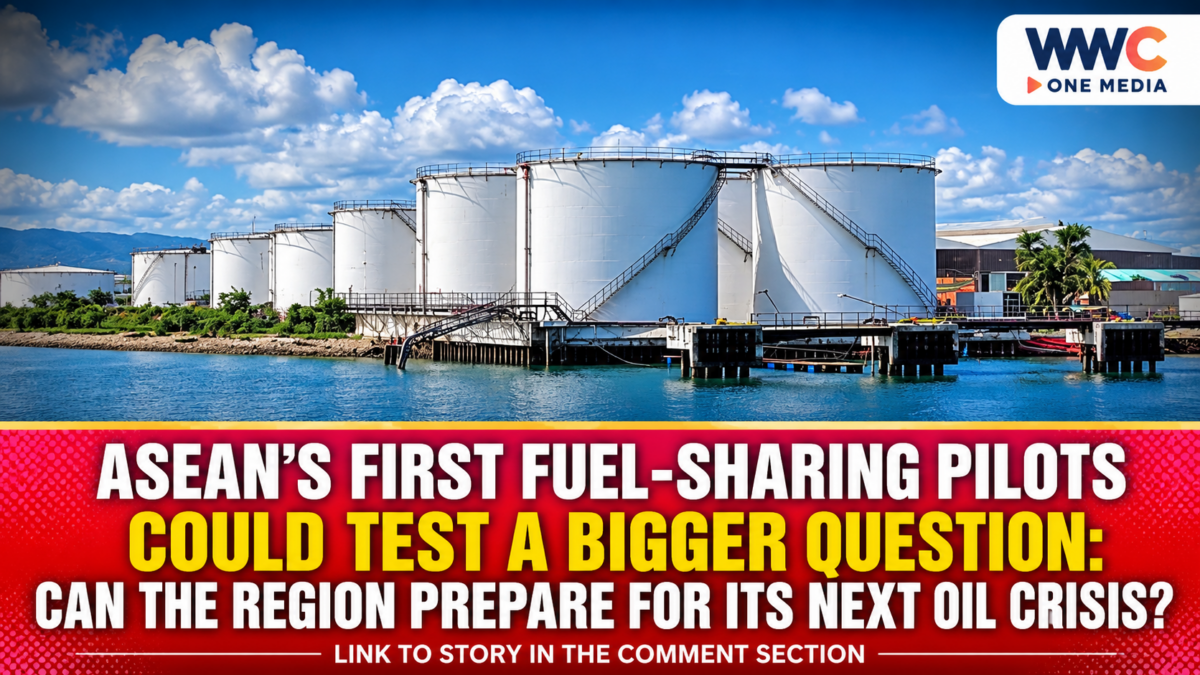
The Philippines is moving towards a practical test of emergency oil access with partners in Indonesia and Thailand, as regional institutions explore ways to make fuel available across borders when supply disruptions hit.
Two letters of intent signed in Manila on Nov. 14, 2026, involve PNOC Exploration Corporation (PNOC-EC), Indonesia’s PT Interport Mandiri Utama and The Shell Company of Thailand Limited. The Economic Research Institute for ASEAN and East Asia (ERIA) and the Indonesian Business Council (IBC) also signed as knowledge partners.
The proposed projects will examine whether existing storage facilities in the two neighbouring countries can support emergency oil access for the Philippines through an arrangement known as oil ticketing. Rather than immediately constructing a large shared stockpile, the approach would test whether a buyer can secure the right to obtain fuel stored elsewhere when an emergency occurs.
The distinction matters. ASEAN’s energy-security challenge is not simply how much oil the region can store. It is also whether countries can agree on access, payment, release conditions and delivery before a shortage becomes a crisis.
A practical test before a regional reserve
The Nov. 14 agreements are letters of intent, not proof that a functioning regional reserve is already in place.
ERIA’s announcement identifies two proposed pilot arrangements: PNOC-EC with PT Interport Mandiri Utama for cooperation involving Indonesia, and PNOC-EC with The Shell Company of Thailand Limited for cooperation involving Thailand.
The projects will explore oil-ticketing mechanisms and the possible use of existing storage facilities. Their stated purpose is to strengthen supply security and emergency preparedness in the region.
Under an oil-ticketing arrangement, a participating entity pays for the right to access oil held in another country’s storage facilities during an emergency, subject to conditions agreed by the parties. The model could reduce the need to build new storage facilities or purchase additional physical stocks upfront.
That does not mean fuel will automatically be released whenever a buyer requests it. The commercial terms, qualifying emergency conditions, available volumes, delivery arrangements and responsibilities of each participant still need to be worked out.
For the Philippines, the pilot could provide a way to examine access to supplies without first shouldering the full cost of building and maintaining a large reserve at home.
Why the Philippines needs more supply options
The country’s exposure to imported oil makes emergency access a significant concern.
ERIA’s Nov. 14 announcement says the Philippines imports 99 percent of its crude oil. It also places Thailand’s crude oil import dependence at 94 percent and Southeast Asia’s at about 66 percent in 2024.
These figures point to a regional vulnerability: when international supply routes are disrupted or prices become volatile, countries that depend heavily on imported petroleum can face pressure on their energy systems and economies.
A disruption can affect more than motorists. Fuel is essential to transport, logistics, manufacturing, agriculture and other activities that rely on moving people and goods. A prolonged shortage can therefore spread its effects through businesses and household expenses.
The Philippines has pursued other energy-security measures alongside regional cooperation. Its wider energy policy includes efforts to diversify supply and strengthen the resilience of the energy system. Readers can also examine the country’s broader energy transition through WWC ONE MEDIA’s coverage of renewable energy and the Philippines’ changing power mix.
The proposed ticketing arrangements would address a different but related issue: how to obtain petroleum products when ordinary supply channels are under pressure.
The savings case for cooperation
ERIA’s November 2026 issue paper, Operationalising ASEAN Joint Oil Stockpiling: From Policy Recommendations to Pilot Implementation, argues for a phased approach built around voluntary public-private projects.
Its analysis examines a scenario involving an additional 60 days of oil reserves across ASEAN. Under the scenario, increasing the share held as joint stocks from 10 to 30 days, while maintaining the same total reserve volume and five days of ticketed stocks, could reduce annual stockholding costs from US$2.80 billion to US$2.19 billion.
That is an estimated annual saving of US$610 million, or about 22 percent, under the more cooperative regional arrangement.
The figures are scenario estimates, not guaranteed savings or an approved ASEAN budget. Actual results would depend on how participating governments and companies structure the system, the cost of storage, the amount of oil committed and the conditions governing access.
Still, the analysis highlights why cooperation is being considered. Countries may be able to share some of the costs and infrastructure requirements instead of each trying to build an equally large emergency buffer independently.
For a country with limited fiscal room, a system that makes better use of existing commercial storage could be worth examining. But the financial case will only be meaningful if the arrangement can deliver fuel reliably when it is needed.
ASEAN already has a petroleum-sharing framework
The proposed pilots would not begin from a blank page. ASEAN has an existing regional framework: the ASEAN Petroleum Security Agreement (APSA).
The agreement was renewed in October 2025 and provides a framework for cooperation among member states on petroleum security. The ASEAN Centre for Energy serves as its secretariat and supports procedures under the Coordinated Emergency Response Measures.
The framework is intended to help ASEAN members respond to emergency petroleum situations. It is distinct from the proposed ticketing projects, which are exploring commercial access to oil held in storage facilities in other countries.
The difference is important. A regional agreement can establish principles and procedures, but practical cooperation still requires operational arrangements between governments and companies. The pilot projects could help identify what needs to be settled before emergency access can work outside a written framework.
The agreement also sits within ASEAN’s wider energy cooperation agenda, which includes regional power connectivity and gas infrastructure. These initiatives reflect the bloc’s effort to make energy supply more resilient through cross-border coordination.
What the pilots still need to prove
The proposed arrangements raise practical questions that cannot be answered by signing letters of intent alone.
First is availability. Participants need to establish how much oil can be set aside, what products will be covered and whether the stocks will remain accessible during a wider regional emergency.
Second is pricing and payment. An oil-ticketing model depends on commercial terms that define what the buyer pays for the access right and how the final purchase is priced when the fuel is released.
Third is delivery. Stored fuel has limited value to an importing country if transport, port capacity, shipping schedules and domestic distribution cannot move it quickly enough.
There is also the question of competing demand. Indonesia and Thailand may face their own supply pressures during a regional disruption. The agreements will need clear conditions governing access so that commitments are workable for both the host country and the buyer.
These are not reasons to dismiss the pilots. They are precisely the issues a pilot should test before governments consider a larger arrangement.
What happens next
ERIA and IBC said the letters of intent mark a step towards translating the regional stockpiling study into practical cooperation. The proposed projects will explore possible arrangements using existing facilities in Indonesia and Thailand.
The next meaningful milestones will be the details: the commercial terms, the volume of fuel potentially covered, the emergency conditions for access and the logistics for delivery to the Philippines.
Until those are established, the projects should be treated as exploratory pilots rather than a guaranteed source of emergency fuel or a fully operational ASEAN reserve.
For the Philippines, the value of the exercise will ultimately depend on whether it can turn regional cooperation into a dependable supply option. A reserve system is only as useful as the rules, infrastructure and commitments that allow fuel to reach the country when normal supplies are disrupted.
Frequently asked questions
What is ASEAN oil ticketing?
Oil ticketing is an arrangement in which a participating entity pays for the right to access oil stored in another country during an emergency, subject to agreed conditions.
Which countries are involved in the proposed Philippine pilots?
The proposed arrangements involve the Philippines, Indonesia and Thailand. PNOC-EC signed letters of intent with PT Interport Mandiri Utama and The Shell Company of Thailand Limited.
Are the pilots already operational?
The letters of intent were signed to explore possible cooperation. They do not, by themselves, establish that fuel is already reserved or available for immediate release.
What is the ASEAN Petroleum Security Agreement?
The ASEAN Petroleum Security Agreement is a regional framework designed to strengthen petroleum security and cooperation among ASEAN member states during supply emergencies.
Will the Philippines have to build a new oil reserve?
The proposed ticketing model is examining access to oil held in existing storage facilities. One potential advantage is that it could reduce the need to build new storage capacity or purchase additional stocks upfront, depending on the final arrangements.
EDITORIAL NOTE: WWC ONE MEDIA already published an Oct. 29 article covering the Philippines’ plans to secure overseas oil reserves and explore oil-ticketing arrangements. This Nov. 14 development is a substantial update to that same story. I recommend updating the existing article rather than publishing a separate post that could compete with it in search results.
Philippines Takes First Step Toward Overseas Emergency Oil Access — But Can ASEAN Make the System Work When Supplies Run Short?
The Philippines has taken a concrete step towards securing emergency petroleum access through storage facilities in Indonesia and Thailand, as regional partners begin exploring how oil held in one country could be made available to another during a supply disruption.
Two letters of intent signed on Nov. 14, 2026, involve PNOC Exploration Corporation (PNOC-EC), Indonesia’s PT Interport Mandiri Utama and The Shell Company of Thailand Limited. The Economic Research Institute for ASEAN and East Asia (ERIA) and the Indonesian Business Council (IBC) also signed the documents as knowledge partners.
The proposed projects will examine oil-ticketing arrangements that could give the Philippines access to petroleum stored in existing facilities abroad. The initiative is designed to explore a practical alternative to immediately building new storage infrastructure or purchasing all emergency stocks upfront.
The agreements are not yet operating fuel-supply contracts. They mark the start of work on the commercial, technical and logistical arrangements needed to make cross-border emergency access possible.
For the Philippines, the challenge is turning an agreement on paper into a dependable supply option. For ASEAN, the pilots could provide a practical test of whether regional energy cooperation can work when member states face competing demands for fuel.
Two proposed arrangements put Indonesia and Thailand in focus
The two letters of intent outline separate partnerships.
The first brings together PNOC-EC and PT Interport Mandiri Utama for a proposed Philippines–Indonesia arrangement. The second involves PNOC-EC and The Shell Company of Thailand Limited for a Philippines–Thailand project.
ERIA and IBC will contribute research expertise and help facilitate dialogue and information exchange among the stakeholders.
The proposed projects will explore the possible use of existing oil storage facilities in both countries. Under an oil-ticketing arrangement, a participating entity pays for the right to access oil held in another country’s storage facilities during an emergency, subject to agreed conditions.
This differs from immediately purchasing the entire volume and transporting it to Philippine territory. The arrangement could reduce the need for governments to build additional storage facilities and buy large quantities of fuel upfront.
However, the letters of intent do not establish how much fuel will be reserved, the precise price of access, or when supplies could be released. Those details will depend on the arrangements developed by the participants.
Why overseas fuel access matters to the Philippines
The Philippines remains highly exposed to disruptions in international petroleum supply.
ERIA’s Nov. 14 announcement places the country’s crude oil import dependence at 99 percent. It also estimates Thailand’s dependence at 94 percent and Southeast Asia’s overall at about 66 percent in 2024. These figures refer to crude oil import dependence, not the share of all petroleum products consumed by each country.
Such reliance makes supply diversification and emergency preparedness important. A disruption affecting international shipping routes, oil-producing regions or major suppliers can complicate procurement and increase costs for importing economies.
The consequences can extend beyond fuel stations. Petroleum is essential to transport, shipping, agriculture, manufacturing and logistics. If supplies become difficult to obtain, businesses may face higher operating costs, delivery delays and pressure on production.
The issue is not limited to whether the Philippines has fuel today. It is whether the country has enough options to obtain additional supplies if ordinary procurement channels are disrupted.
WWC ONE MEDIA has previously examined how global oil-market movements can affect Philippine fuel costs. Overseas access arrangements address the physical availability of petroleum, while international prices remain subject to market conditions.
ASEAN’s proposed model could reduce stockpiling costs
ERIA’s November 2026 issue paper, Operationalising ASEAN Joint Oil Stockpiling: From Policy Recommendations to Pilot Implementation, examines how national reserves, ticketing arrangements and jointly held stocks could work together.
One scenario considers an additional 60 days of oil reserves across ASEAN. It compares different ways of dividing the additional stocks among national reserves, ticketed supplies and joint stockpiles.
Under the national-led scenario, the reserve composition includes 45 days of national stocks, five days of ticketed stocks and 10 days of joint stocks. Its estimated annualised cost is US$2.80 billion.
Under the more cooperative scenario, the composition shifts to 25 days of national stocks, five days of ticketed stocks and 30 days of joint stocks. The estimated annualised cost falls to US$2.19 billion.
That represents an estimated reduction of about 21.9 percent in annualised stockholding costs.
The figures are modelled estimates, not guaranteed savings or an approved regional spending commitment. The paper also makes clear that the estimated economic benefits depend on a reference supply-disruption scenario occurring.
The broader argument is that ASEAN countries may be able to reduce duplication and make better use of existing infrastructure by combining domestic reserves with regional cooperation.
For countries with limited storage capacity or financial resources, this approach could offer another way to strengthen preparedness without requiring every government to build an equally large reserve.
ASEAN already has rules for emergency petroleum cooperation
The proposed pilots are connected to a wider regional effort to improve petroleum security.
The ASEAN Petroleum Security Agreement provides a framework for member states to cooperate during petroleum supply emergencies. Its provisions recognise voluntary and commercial-based assistance, as well as the possibility of joint stockpiling by countries prepared to make the necessary commitments.
The agreement defines a critical shortage as a shortfall of at least 10 percent of a member state’s normal domestic requirement lasting for a continuous period of at least 30 days.
It also provides for coordinated emergency response measures under which member states endeavour to supply petroleum to a country in distress, subject to negotiated terms and conditions.
This framework is important, but it should not be confused with the new commercial pilots. The agreement establishes a regional cooperation mechanism, while the proposed oil-ticketing projects are exploring specific arrangements involving companies and storage facilities in Indonesia and Thailand.
In practical terms, the pilots could help determine how emergency access works between participating entities before a larger regional system is considered.
The difficult questions come after the signing
The success of the proposed arrangements will depend on details that remain to be settled.
The first is the quantity and type of petroleum that could be made available. Diesel, gasoline and crude oil have different uses and supply chains. Any agreement will need to specify the products covered and the volume that can realistically be accessed.
The second is pricing. Participants must determine the cost of securing access, the purchase price when fuel is released and who carries expenses such as handling, insurance and transportation.
The third is availability during a regional crisis. Indonesia and Thailand could also face higher domestic demand or supply constraints during a major disruption. The agreements will need clear provisions to establish when the Philippines can exercise its access rights.
Delivery is another major consideration. Fuel stored abroad must still be transported, received and distributed. Port capacity, shipping schedules, customs procedures and domestic logistics could affect how quickly supplies reach Philippine users.
These are precisely the issues that pilot projects should examine. A reservation right has limited value if the fuel cannot be released and delivered when the emergency occurs.
The experience of Philippine consumers also shows why supply security and pump prices must be treated separately. As discussed in WWC ONE MEDIA’s report on the recent nationwide fuel-price rollback, retail prices can change sharply with international market conditions. Emergency access may help address physical supply risks, but it does not guarantee cheaper gasoline or diesel.
What happens next
ERIA and IBC said the signing of the two letters of intent marks a step towards translating the regional stockpiling study into practical cooperation.
The next stage is to develop the details of the proposed projects, including commercial terms, access conditions, potential storage arrangements and delivery procedures.
Until those details are confirmed, the Philippines should not treat the proposed facilities as fuel already reserved for immediate use. The initiative remains an exploration of possible emergency access rather than a fully operational regional stockpile.
The wider ASEAN effort will also depend on whether member states can align their national requirements, commercial interests and emergency-response procedures.
For the Philippines, the most important measure of success will not be the number of agreements signed. It will be whether the country can obtain and transport fuel reliably when normal supply channels are under pressure.
The pilots could provide an important test. But the real test will come when the region needs the fuel.