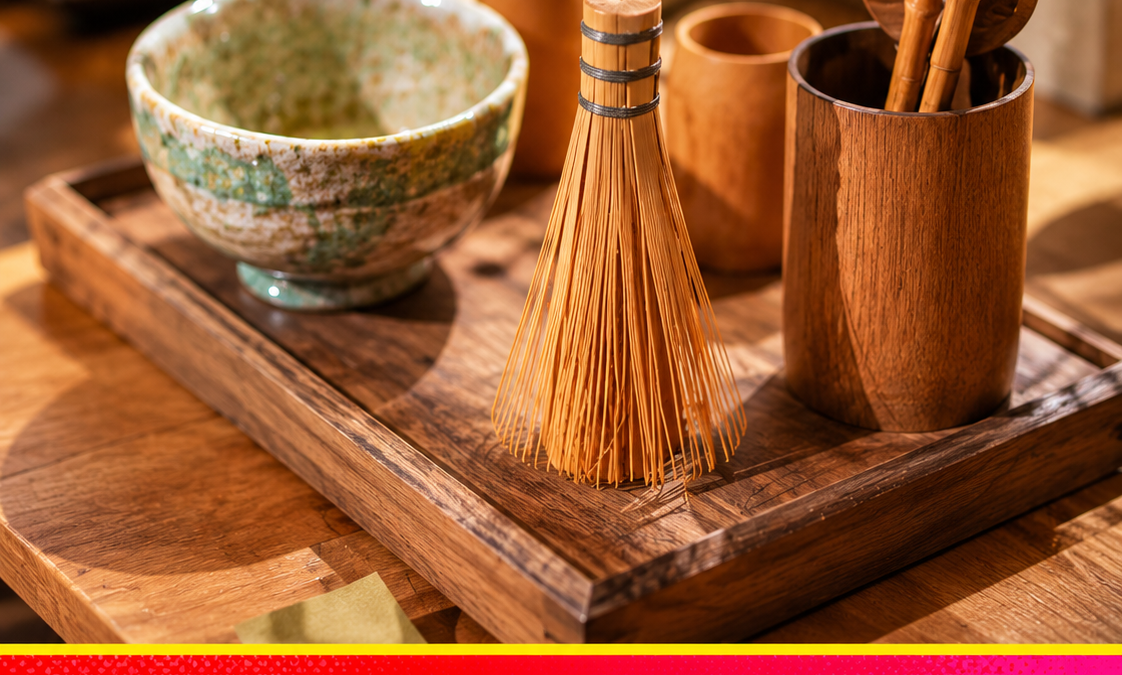
A Japanese matcha set can look like a simple collection of attractive bowls and bamboo accessories, but each piece has a specific purpose rooted in the preparation of powdered green tea. For Filipino buyers exploring the growing matcha trend, understanding those tools before spending money can help separate a practical starter kit from a decorative set that may not suit everyday use.
The essential pieces are the chawan, or tea bowl; chasen, or bamboo whisk; and chashaku, or tea scoop. A tea caddy may also be included, while more elaborate collections can contain trays, cloths and other implements used in formal tea preparation.
Japan’s own tourism and tea-culture references explain how these utensils work and why their design varies. The most useful buying decision, therefore, is not necessarily choosing the largest or most expensive set. It is choosing the pieces that match how the buyer intends to prepare and enjoy matcha.
Start with the three essential matcha tools
For someone making matcha at home, the first priority should be the tools that directly affect preparation.
The chawan is the bowl in which matcha is prepared and served. It is not simply a cup with a Japanese design. Its width, depth and shape affect how easily the powder can be mixed with water and whisked.
The chasen is the bamboo whisk used to combine the matcha and water. Its fine tines help distribute the powder and create the light foam commonly associated with whisked matcha.
The chashaku is a narrow scoop traditionally used to transfer matcha powder from its container into the bowl. It is generally made from bamboo and has a curved end.
These three items form the practical foundation of a home matcha set. Buyers who mainly want to prepare a daily drink can begin with them instead of purchasing a large collection of ceremonial accessories.
The Japan Tourism Agency’s guide to tea utensils explains that bowls, scoops and whisks have distinct roles, while their designs can vary according to tea traditions and schools. Japan Tourism Agency,Japan Tourism Agency
Matcha bowls are not all designed the same way
A common mistake when buying a chawan is choosing entirely on appearance.
Japanese tea bowls come in different sizes, shapes, finishes and materials. Some are deeper and thicker, while others are wider and shallower. Those differences can serve practical purposes.
The Japan Tourism Agency notes that deeper, thicker bowls are commonly used in winter because they help retain warmth. Wider, shallower bowls are often used in summer because they allow the tea to cool more quickly.
That means the best bowl depends partly on how and when it will be used. Someone preparing matcha regularly may prefer a bowl with enough room to whisk comfortably, a stable base and a rim that feels comfortable to hold.
Decoration is a matter of personal preference. A handmade appearance, distinctive glaze or traditional Japanese pattern may make a bowl more appealing, but these features do not automatically make it easier to use.
Buyers should also check whether the seller provides care instructions and confirms that the bowl is suitable for food and drink. If the item is intended for daily preparation, practical durability should matter as much as its appearance.
The bamboo whisk deserves particular attention
Among the pieces in a matcha set, the chasen is arguably the one buyers should inspect most carefully.
Its fine bamboo tines are responsible for mixing the powder with water. The Japan Tourism Agency describes how the whisk is used to blend matcha until the powder is incorporated and foam forms on the surface.
Not every whisk has exactly the same shape. The agency notes that some have straighter tines while others have more rounded tips, with preferences differing among tea schools.
For a beginner, the important considerations are whether the whisk is intact, whether its tines are evenly formed and whether it is suitable for the intended preparation style. A whisk with visibly damaged or missing tines may be less useful than one with a simpler appearance but sound construction.
Care also matters. The Japan Tea Export Council’s matcha preparation guide recommends soaking the whisk in hot water before use. This softens the bamboo and helps prepare it for whisking.
After use, avoid treating the chasen like an ordinary metal spoon or leaving it crushed inside a container. Allowing it to dry properly and storing it without forcing the tines together can help preserve its shape.
For buyers who want to explore the wider matcha market, WWC previously examined how rising international demand is affecting the competition between Japanese and Chinese matcha producers in its report on Japan’s position in the changing global matcha supply market.
Do you really need a tea caddy and other accessories?
A more elaborate matcha set may include a natsume, a small container traditionally used to hold matcha during tea preparation.
The caddy is useful in a formal tea setting, but it is not essential for every home user. Someone preparing a single serving each morning may already have a suitable airtight container for storing the powder.
Other accessories may include a chakin, or tea cloth, and a bon, or serving tray. These pieces can be useful for organising the preparation area and following a more traditional routine.
However, buyers should distinguish between equipment needed to prepare the drink and items included mainly for presentation. A set containing many accessories may look impressive, but that does not mean every piece will be used.
The Japan Tea Export Council’s guide identifies the chawan, natsume, chasen, chakin and chashaku among the utensils associated with enjoying matcha. It also explains that the tools have different functions rather than serving as interchangeable decorations. nihon-cha.or.jp
For someone starting out, a smaller set with a dependable bowl, whisk and scoop may offer better practical value than a large collection with accessories that remain unused.
What buyers in the Philippines should check before ordering
Online shopping makes Japanese-style matcha sets easy to find, but product descriptions do not always provide enough information to judge quality.
Before placing an order, buyers should look for clear photographs of the actual items, dimensions, materials and care instructions. For bamboo accessories, the seller should identify the material rather than relying on vague descriptions such as “Japanese-inspired”.
It is also worth checking whether the product is genuinely made in Japan or simply designed in a Japanese style. These descriptions are not equivalent. A Japanese aesthetic does not, by itself, establish the item’s country of manufacture.
If a seller advertises a set as handmade, buyers can ask who made it, where it was produced and whether the seller can provide details about the maker or workshop. Claims about origin and craftsmanship should be supported by product information rather than packaging alone.
The same care applies to matcha powder sold alongside utensils. A tea set and the tea itself are separate purchases, and an attractive bowl does not establish the quality, freshness or origin of the powder.
The growing international interest in matcha has also created a wider market for cafés, specialty products and Japanese-inspired food experiences. WWC has previously looked at the expansion of matcha-related activity in China’s growing matcha industry and its impact on local communities.
For Filipino consumers interested in Japanese food culture more broadly, the attention to presentation and seasonal detail can also be seen in the Japanese dining traditions featured in Yamazato’s kaiseki experience.
How to use the set once it arrives
A matcha set becomes more useful when buyers understand the basic preparation process.
The Japan Tea Export Council’s guide provides a practical sequence. It recommends measuring approximately 1.5 to 2 grams of matcha with a chashaku, adding a small amount of hot water and mixing carefully before adding more water.
The guide then describes whisking the mixture briskly until a fine foam with small bubbles appears. It also recommends sifting the powder first to make it easier to mix without lumps.
These instructions show why the three essential tools work together. The scoop measures the powder, the bowl provides room for mixing and the whisk distributes it through the water.
The process does not require an elaborate collection of ceremonial equipment. A basic set can be enough to begin learning the technique, while additional pieces can be purchased later if the user becomes more interested in traditional tea preparation.
What happens next
For first-time buyers, the sensible approach is to start with function rather than presentation. A comfortable chawan, a well-made bamboo chasen and a practical chashaku provide the foundation for preparing matcha at home.
Those who later become interested in formal tea practice can explore additional utensils, including a tea caddy, cloth and serving tray. The choice can also become more specialised as buyers learn about different tea traditions and the preferences associated with particular schools.
Japanese matcha culture is built around more than owning attractive equipment. Understanding what each piece does—and choosing tools that suit the way they will actually be used—makes a set a more worthwhile purchase.
Frequently asked questions
1. What should be included in a beginner Japanese matcha set?
A practical beginner set should include a chawan (tea bowl), chasen (bamboo whisk) and chashaku (tea scoop). A tea caddy and cloth are useful additions but are not essential for basic preparation.
2. Is a Japanese matcha bowl different from an ordinary cup?
A chawan is designed to provide room for preparing and whisking matcha. Traditional bowls vary in shape and depth, with some designs suited to retaining warmth and others allowing the tea to cool more quickly.
3. Why is a bamboo whisk used for matcha?
A chasen helps mix powdered matcha with water and creates foam on the surface. Its fine bamboo tines are designed for whisking rather than simply stirring.
4. Do beginners need a natsume tea caddy?
No. A natsume is a traditional container used during tea preparation, but beginners can start with the essential bowl, whisk and scoop. Proper storage for the matcha powder is a separate consideration.
5. How should a matcha whisk be prepared before use?
The Japan Tea Export Council’s guide recommends soaking the chasen in hot water before whisking. This softens the bamboo and helps prepare the whisk for use.