
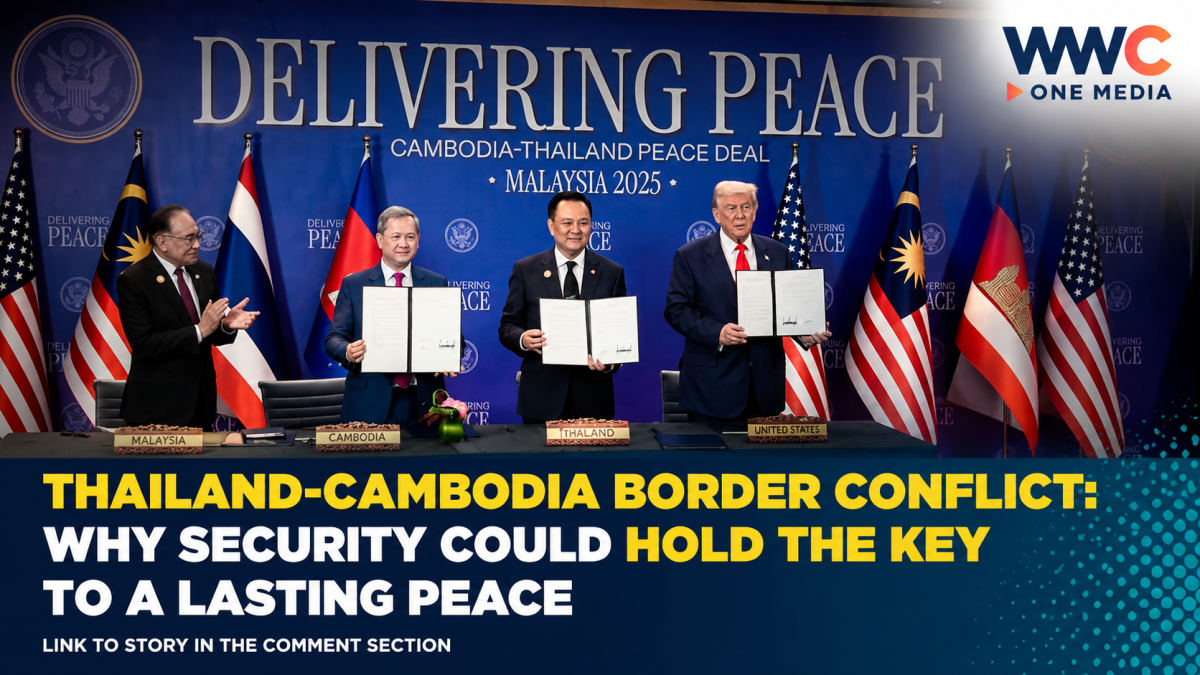
The guns may have fallen silent along much of the Thailand-Cambodia border, but the conflict is far from fully resolved.
The central challenge now is no longer simply negotiating another ceasefire. It is creating enough security, trust and verification on the ground to prevent a disputed incident from once again turning into a wider military confrontation.
That is the core argument behind a recent analysis published by The Diplomat: a durable settlement will require security arrangements that can survive political pressure, nationalist rhetoric and competing claims over disputed territory.
The warning comes as both countries continue to navigate the aftermath of devastating fighting in 2025 and a fragile ceasefire framework.
The conflict goes far beyond a line on a map
Thailand and Cambodia share an approximately 817-kilometer border, much of which has been affected by historical disagreements over demarcation.
The dispute has periodically erupted into violence, including major fighting in 2025 that involved artillery, rockets and Thai airstrikes. The fighting killed roughly 150 people across the two major rounds of clashes and displaced hundreds of thousands, according to reporting by Reuters.
The December 2025 ceasefire stopped large-scale fighting, but it did not settle the underlying territorial disagreements.
That distinction is crucial.
A ceasefire can stop soldiers from shooting.
It cannot, by itself, determine where the border should be.
Why security matters now
The biggest danger is that a relatively small incident could once again trigger a chain reaction.
A patrol confrontation, a landmine incident, construction near a disputed area, civilian protests or accusations of territorial encroachment could quickly become politically explosive.
Both governments therefore need mechanisms that allow incidents to be investigated and contained before national leaders or military commanders are forced into a confrontational response.
Thailand has repeatedly emphasized the importance of existing bilateral mechanisms, including the General Border Committee (GBC), Regional Border Committee (RBC) and Joint Boundary Commission (JBC). Bangkok says these mechanisms are intended to address border security, reduce misunderstandings and eventually advance survey and demarcation work.
Cambodia has similarly called for the JBC to resume work on surveying and demarcating disputed areas.
The problem is that the two sides disagree over how the dispute should ultimately be managed.
Thailand wants bilateral mechanisms. Cambodia wants a broader legal route.
This is one of the biggest obstacles to a permanent settlement.
Thailand has consistently favored resolving the land-border dispute through bilateral mechanisms.
Cambodia has increasingly sought international involvement when it believes bilateral negotiations are insufficient.
That difference has also appeared in the separate maritime dispute in the Gulf of Thailand.
In June, Cambodia launched a compulsory conciliation process under the United Nations Convention on the Law of the Sea, or UNCLOS, concerning overlapping maritime claims. Reuters reported that the disputed maritime area covers roughly 26,000 square kilometers and is believed to contain significant oil and natural-gas resources.
Thailand agreed to participate in the UN-backed process but maintained that other bilateral negotiations concerning the land border remained suspended.
The maritime dispute adds another layer to already strained relations.
The ASEAN factor
ASEAN also has an important role to play.
The regional bloc has already been involved in monitoring the ceasefire through an ASEAN Observer Team, designed to increase transparency and confidence between the two militaries.
That mechanism remains relevant in September 2026.
On September 1, an ASEAN Observer Team in Cambodia conducted field visits in Koh Kong province, including an inspection at Boundary Pillar No. 72. Cambodian authorities said the mission was intended to observe, verify and report on conditions along the border and strengthen transparency and mutual confidence.
The presence of outside observers is significant because Thailand and Cambodia continue to present competing accounts of events along the frontier.
Independent verification can therefore become a form of conflict prevention, rather than simply a post-conflict reporting mechanism.
But both sides still have sharply different narratives
The latest developments show just how difficult rebuilding trust will be.
Cambodia continues to accuse Thailand of violating Cambodian territory and has called for stronger implementation of the ceasefire and border-demarcation agreements.
Thailand rejects such allegations and says its forces are observing the ceasefire and operating within previously agreed arrangements.
Those competing narratives matter because public opinion has become deeply nationalistic on both sides.
Earlier analysis by CNA found that nationalism and domestic political pressures contributed significantly to tensions surrounding the border, while analysts warned that seemingly symbolic confrontations could carry the risk of escalation.
Border security is also an economic issue
The conflict has not only affected soldiers and border communities.
Trade, tourism, migrant labor and cross-border supply chains have all suffered from prolonged tensions.
The border dispute has also encouraged Thailand to strengthen physical security infrastructure.
Reuters reported in July that Thailand had completed the first section of a permanent border fence and planned additional fencing along selected portions of its 817-kilometer frontier. Thai officials described the project as a long-term security measure.
But physical barriers cannot solve a territorial dispute by themselves.
A fence can prevent movement.
It cannot create political agreement.
The real test: preventing the next crisis
The most important question for Thailand and Cambodia now may therefore be much simpler than the decades-old arguments over territory:
Can both sides build a system that prevents the next border incident from becoming another war?
That requires several things working simultaneously:
- Reliable military-to-military communication
- Effective ASEAN observation and verification
- Regular meetings under existing bilateral mechanisms
- Progress on border surveying and demarcation
- Protection of civilians living near disputed areas
- Clear procedures for investigating incidents
- Political restraint when nationalist pressure rises
- Continued diplomatic engagement rather than military escalation
The Diplomat’s broader argument is particularly relevant here: lasting peace cannot depend solely on political promises made in capitals. Security arrangements must work at the border itself, where soldiers and civilians encounter the consequences of unresolved claims.
A ceasefire is only the beginning
Thailand and Cambodia have already demonstrated that outside diplomacy can help stop fighting.
Malaysia played a central role in the 2025 ceasefire process, while the United States and China were also involved in diplomatic efforts. ASEAN subsequently became part of the monitoring architecture.
The two prime ministers also met in Cebu in May 2026 and agreed to pursue confidence-building measures and renewed dialogue. Philippine President Ferdinand Marcos Jr. helped facilitate that meeting in his capacity as ASEAN chair.
But diplomacy cannot remain confined to summit rooms.
For peace to become durable, it has to reach the villages, checkpoints and military positions along the frontier.
And that is why security may ultimately be the missing piece.
If Thailand and Cambodia can make the border more predictable, establish credible mechanisms for verifying incidents and gradually rebuild trust, diplomacy has a chance to resolve the deeper territorial dispute.
If they cannot, even a relatively minor confrontation could once again expose how fragile the peace really is.
The fighting may have stopped. The real battle now is to make sure it never starts again.
WWC ONE MEDIA G.A




Leave a Reply