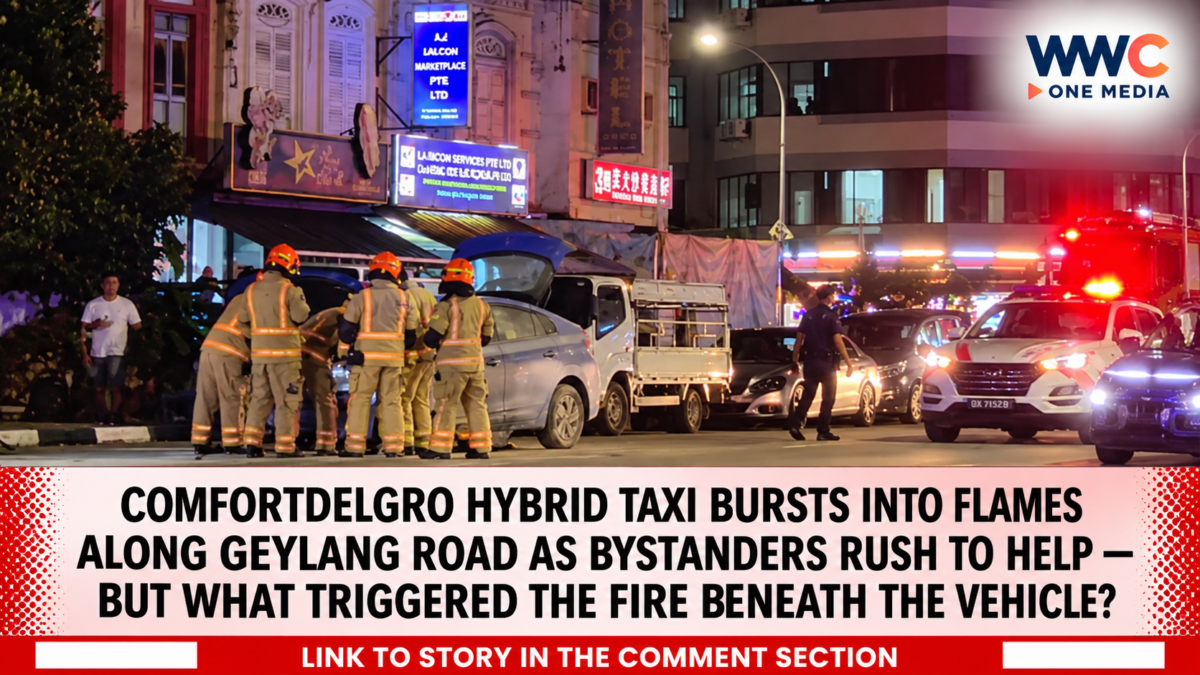
SINGAPORE — A ComfortDelGro hybrid taxi caught fire along Geylang Road on Wednesday night, November 11, prompting an emergency response after flames erupted underneath the vehicle near Lorong 35 Geylang.
The incident happened at approximately 9.05pm, with photographs and videos circulating on social media showing flames coming from the taxi’s undercarriage and emergency personnel arriving at the scene.
Fortunately, members of the public managed to extinguish the fire using a fire extinguisher before firefighters from the Singapore Civil Defence Force (SCDF) arrived. No injuries were reported.
The incident involved a Hyundai Ioniq hybrid taxi operated by ComfortDelGro.
Although the fire was brought under control without reported casualties, the incident has renewed attention on vehicle-fire risks, particularly involving cars that combine conventional combustion engines with electric-powered components.
ComfortDelGro confirmed that it was assisting with investigations to determine what caused the fire.
Authorities have not established whether the incident resulted from an electrical malfunction, overheating, a battery-related problem or another mechanical fault.
Flames Erupt Beneath ComfortDelGro Hybrid Taxi in Geylang
The fire broke out along Geylang Road, close to Lorong 35 Geylang, at around 9.05pm on November 11.
Images shared by the SG Road Vigilante Facebook page showed a ComfortDelGro taxi stopped along the roadside, with flames visible beneath the front section of the vehicle.
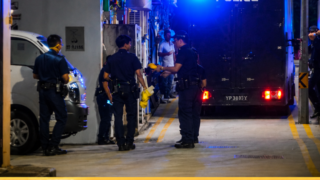
A separate video shared by Facebook user Rock Steady showed emergency vehicles, including at least one fire engine and two police fast-response cars, at the scene.
The vehicle’s bonnet was also seen open as firefighters inspected the affected areas following the fire.
According to SCDF, the blaze involved the undercarriage of the hybrid vehicle.
Members of the public had already used a fire extinguisher to put out the flames before firefighters reached the location.
The quick response helped contain the incident, and no injuries were reported.
However, the precise circumstances that triggered the fire remain under investigation.
Public Members Step In Before Firefighters Arrive
One of the most significant details of the incident was the involvement of members of the public in extinguishing the flames.
Rather than allowing the fire to spread while waiting for emergency responders, bystanders used a fire extinguisher to bring the situation under control.
Their intervention prevented the incident from developing into a more serious emergency.
Nevertheless, vehicle fires can be unpredictable, particularly when they involve electrical systems, fuel components or batteries.
Members of the public should avoid approaching a burning vehicle if the flames are spreading or the source of the fire is unclear.
The safest response is to move away, alert emergency services and allow trained firefighters to handle the situation.
The incident also demonstrates the importance of having accessible fire extinguishers in appropriate settings and knowing how to use them safely.
ComfortDelGro Says Safety Is Its Top Priority
ComfortDelGro acknowledged the incident following media inquiries and said the safety of its passengers, drivers and the public remains its top priority.
The transport operator confirmed that it was assisting with investigations to establish the cause of the fire.
However, the company has not announced a confirmed technical explanation for what happened to the Hyundai Ioniq hybrid taxi.
There is also no official finding establishing that the vehicle’s hybrid battery was responsible.
This distinction is important because a fire involving a hybrid vehicle does not automatically mean that its high-voltage battery caused the incident.
Hybrid vehicles contain several electrical and mechanical components, and investigators must determine where the fire originated before identifying its cause.
Until the investigation is completed, speculation about battery failure or a manufacturing defect should be avoided.
Singapore Recorded 226 Vehicle Fires in 2025
The Geylang incident comes amid continuing concerns about vehicle fires in Singapore.
According to SCDF’s 2025 fire statistics, Singapore recorded 2,050 fire calls during the year, including 226 vehicle fires.
The authority also reported four fires involving electric vehicles, accounting for approximately 1.77 per cent of vehicle fires.
These figures show that vehicle fires remain an important safety concern, although electric-vehicle fires represented a relatively small proportion of the recorded cases.
SCDF has identified ignition sources such as overheating and electrical faults within engine compartments as primary causes of vehicle fires in Singapore.
Such problems can develop when electrical components malfunction, mechanical systems generate excessive heat or other ignition sources come into contact with combustible materials.
However, these general statistics do not establish the cause of the ComfortDelGro taxi fire.
The investigation into the Geylang incident remains separate from the broader national vehicle-fire statistics.
Are Hybrid Vehicles More Vulnerable to Fires?
The Geylang taxi fire may raise questions among motorists about the safety of hybrid vehicles.
Unlike conventional petrol-powered cars, hybrids combine an internal combustion engine with an electric motor and a rechargeable battery system.
This combination allows the vehicle to use electric power under certain driving conditions while relying on its combustion engine when necessary.
However, hybrid vehicles also have additional electrical components and high-voltage systems that require proper maintenance.
A fire can potentially originate from different parts of a vehicle, including its engine compartment, wiring, fuel system or battery.
It would therefore be inaccurate to conclude that every hybrid vehicle fire is battery-related.
The Hyundai Ioniq involved in the Geylang incident is a hybrid model, but authorities have not confirmed which component was responsible.
The distinction between hybrid and fully electric vehicles is also important when discussing vehicle-fire statistics.
Both technologies use electrical systems, but their powertrains and battery configurations are different.
For motorists, the most important precaution is to follow manufacturer-recommended servicing schedules and have unusual electrical or mechanical problems checked by qualified technicians.
Singapore Has Seen Other Vehicle Fire Incidents
The Geylang taxi fire is not the only recent incident to raise questions about vehicle and battery safety in Singapore.
In November, a BMW caught fire along Orchard Road near the Istana, sending smoke into one of the country’s busiest commercial districts.
The fire involved the vehicle’s engine compartment, and members of the public attempted to help extinguish the flames before SCDF firefighters arrived.
No injuries were reported in that incident.
WWC ONE MEDIA previously covered the Orchard Road incident and the unusual eyewitness account involving a section of the burning vehicle.
Read: BMW Bursts Into Flames Near Singapore’s Istana as Bystanders Rush to Help.
Another incident involved a mobility scooter that caught fire at a busy junction in Yishun in October.
Preliminary investigations indicated that the fire likely originated from the scooter’s battery, although the exact cause had not been established.
Members of the public used a fire extinguisher to put out the flames before SCDF firefighters arrived.
Read: Mobility Scooter Catches Fire in Yishun, No Injuries Reported.
These incidents involved different types of vehicles and circumstances. There is no evidence connecting them to the Geylang taxi fire.
Nevertheless, they highlight why vehicle maintenance, electrical-system inspections and public awareness remain important.
ComfortDelGro Faces Other Transport Safety Questions Following Punggol Autonomous Vehicle Near-Misses
The latest taxi fire also comes during a period of heightened public attention on ComfortDelGro’s transport operations.
Earlier in November, the Land Transport Authority (LTA) directed ComfortDelGro to suspend U-turn testing for its autonomous vehicles at a Punggol junction following a near-miss involving another vehicle.
The incident occurred on November 5 during testing for an enhanced on-demand autonomous transport service.
Dashcam footage circulated online showing the autonomous vehicle turning into the path of an approaching vehicle.
LTA subsequently ordered the precautionary suspension while it investigated the incident.
The company said it was reviewing the circumstances with its autonomous-vehicle technology partner, Pony.ai, and LTA.
The autonomous-vehicle incident is unrelated to the Geylang taxi fire, but both developments have drawn attention to transport safety and the importance of investigating incidents before resuming normal operations.
Read: Grab’s Self-Driving Car Nearly Hits Schoolgirl in Punggol, Forcing LTA to Halt Some Tests.
ComfortDelGro has also faced operational challenges involving its taxi services.
In September, the company announced a temporary commission waiver for eligible drivers following a service disruption that affected some taxi terminals.
Read: ComfortDelGro to Waive Taxi Commissions After September 15 Outage Hit Singapore Drivers.
These developments involve separate operational matters and should not be interpreted as evidence of a wider mechanical or safety problem across the company’s fleet.
What Drivers Should Do When a Vehicle Catches Fire
The Geylang incident is a reminder that motorists should recognise potential warning signs and know how to respond when a fire develops.
Drivers should take immediate action if they notice smoke, flames, unusual burning smells or signs of overheating.
Important precautions include:
- Stop the vehicle in a safe location as soon as possible.
- Switch off the engine and evacuate all occupants.
- Move away from the vehicle and keep other people at a safe distance.
- Call Singapore’s emergency number 995 to request SCDF assistance.
- Do not open the bonnet fully if flames are visible underneath it.
- Never return to a burning vehicle to retrieve personal belongings.
- Avoid attempting to extinguish a large or rapidly spreading fire.
For hybrid and electric vehicles, drivers should not attempt to handle damaged high-voltage components themselves.
Even after visible flames disappear, a vehicle may still present risks if its battery or electrical systems have been damaged.
Emergency responders should be allowed to assess the situation and determine whether further precautions are necessary.
Investigation Underway as Questions Remain Over the Cause
While the fire has been extinguished and no injuries have been reported, the most important question remains unanswered: what caused the ComfortDelGro hybrid taxi to catch fire?
SCDF has confirmed that the blaze involved the vehicle’s undercarriage, while ComfortDelGro is assisting with investigations.
At this stage, there is no confirmed evidence pointing to a defective battery, electrical-system failure or manufacturing fault.
The incident has nevertheless renewed attention on the safety of vehicles operating on Singapore’s roads, particularly as hybrid and electric-powered transport becomes increasingly common.
The Geylang fire also demonstrates how important rapid emergency response can be when a vehicle catches fire in a public area.
For now, motorists should avoid drawing conclusions before investigators establish the actual cause.
The findings could provide important information about vehicle maintenance, electrical-system safety and the precautions needed to prevent similar incidents.
As investigations continue, one question remains: Was the Geylang taxi fire an isolated mechanical incident, or could it expose a vehicle-safety issue that other hybrid taxi operators and motorists should be watching closely?