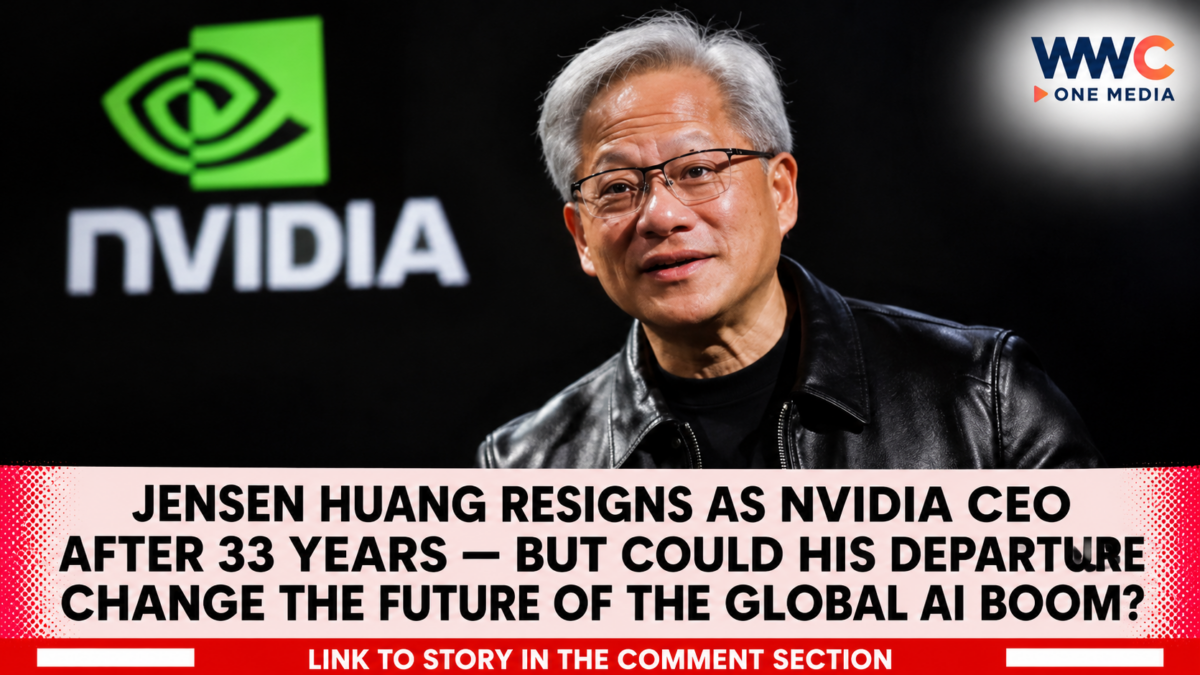
The artificial intelligence industry has been rocked by an extraordinary leadership shake-up after Nvidia co-founder Jensen Huang resigned as chief executive, president and board member, ending his 33-year leadership of the semiconductor giant he helped transform into one of the world’s most valuable companies.
Nvidia confirmed the departure on November 12, 2026, announcing that longtime Chief Financial Officer Colette Kress would take over as interim CEO while the board searches for a permanent successor. The company also appointed Harvey C. Jones, a longtime board member and former Synopsys chief executive, as its first-ever board chair.
The announcement marks a dramatic turning point for Nvidia, whose processors have become essential to the global artificial intelligence boom. Huang was not simply the company’s chief executive. He was its most recognisable public figure, leading its technology strategy, cultivating relationships with major customers and championing the massive investment in AI infrastructure.
His sudden exit raises a question with consequences far beyond Nvidia: can the world’s most influential AI chipmaker maintain its momentum without the founder who shaped its rise?
Jensen Huang’s Resignation Sends Shockwaves Through the AI Industry
Huang co-founded Nvidia in 1993 and spent more than three decades building it from a graphics-chip developer into a dominant supplier of advanced computing processors.
Its graphics processing units, or GPUs, are now widely used to train and operate artificial intelligence models, power data centres and support demanding scientific and industrial computing tasks.
Nvidia’s influence has grown alongside the enormous investments made by technology companies seeking to build AI infrastructure. Its products have become central to the plans of major cloud providers and leading AI developers.
That position helped turn Huang into one of the most influential executives in the technology industry.
His departure therefore represents more than an ordinary management change. It creates uncertainty over the company’s leadership, strategic direction and relationships with customers at a time when the AI industry is already facing questions about spending, debt and the long-term profitability of artificial intelligence.
Reuters reported that Nvidia shares fell sharply following the announcement, while rival semiconductor companies attracted investor attention. The market reaction reflects concerns about leadership uncertainty, although it does not establish that customers have abandoned Nvidia or that its competitive position has collapsed.
WWC ONE MEDIA previously examined the possibility of a leadership change in its report on Nvidia’s search for Jensen Huang’s replacement as its $4 trillion AI empire faced a leadership crisis.
Who Is Colette Kress, Nvidia’s New Interim CEO?
Nvidia has turned to an executive who knows the company and its financial operations inside out.
Kress joined Nvidia in September 2013 as executive vice-president and chief financial officer. She has overseen its finance organisation through an extraordinary period of expansion, becoming one of the company’s most familiar representatives during quarterly earnings announcements.
Before joining Nvidia, she held finance positions at Texas Instruments, Microsoft and Cisco, accumulating nearly 25 years of experience in the technology sector.
The scale of Nvidia’s growth during her tenure is striking. The company reported approximately US$4.13 billion in revenue in the fiscal year she joined. By fiscal 2026, revenue had climbed to approximately US$215.9 billion.
That expansion was driven by several factors, including demand for gaming graphics processors, data-centre computing and AI infrastructure. Kress helped oversee the financial side of that transformation, although the achievement reflects the work of Nvidia’s wider workforce and leadership team.
Nvidia said Kress would continue serving as CFO while holding the interim CEO position. The board will consider both internal and external candidates before naming a permanent chief executive.
The appointment provides immediate continuity, but it does not guarantee that Kress will retain the position permanently.
Why Did Jensen Huang Leave Nvidia?
Huang’s resignation came after mounting scrutiny over reports concerning his personal relationships and possible national-security implications.
Earlier in November, reports linked him to Alice Huang, a Chinese businesswoman formerly associated with Singapore-based technology company Megaspeed International. US authorities reportedly suspected that she had connections to Chinese intelligence.
The allegations raised concerns because Nvidia is a major supplier of advanced AI processors, some of which are subject to US export restrictions.
Huang acknowledged being unfaithful to his wife and apologised to his family and Nvidia employees. However, his admission of infidelity does not establish that he knowingly participated in espionage, violated export-control laws or compromised Nvidia’s technology.
The controversy intensified after The New York Times reported another alleged relationship involving Kimberly Powell, Nvidia’s vice-president of healthcare, who reportedly reported directly to Huang.
Reuters subsequently reported that Nvidia’s board had been considering his future amid the growing controversy.
The company had also begun an independent investigation into whether Huang had been targeted by a foreign intelligence operation.
These reports brought together several sensitive issues: executive conduct, corporate governance, national security and the oversight of advanced semiconductor technology.
It is important to distinguish allegations and reported intelligence assessments from proven wrongdoing. The public reporting does not establish that Huang knowingly helped transfer restricted technology to China.
WWC ONE MEDIA has covered the controversy in its report on Nvidia’s decision to hire a major corporate law firm to investigate Jensen Huang.
The US-China Chip Conflict Could Become More Complicated
Huang’s departure also raises questions about the future of Nvidia’s relationship with China.
The United States has imposed restrictions on the export of certain advanced semiconductor products because of concerns that powerful computing technology could strengthen China’s military and artificial intelligence capabilities.
Nvidia has previously argued that maintaining access to international markets is important for American technology companies competing against foreign rivals.
Huang was one of the most prominent advocates for preserving commercial opportunities in China while navigating US export restrictions.
Without him, Nvidia will need to demonstrate that its next leadership team can manage the company’s commercial interests while maintaining relationships with US regulators and policymakers.
The controversy involving Megaspeed has added further scrutiny to the company’s customer relationships and chip distribution arrangements. Reports have raised questions about whether advanced Nvidia processors may have reached restricted destinations through third parties.
However, allegations involving specific transactions must be assessed separately from Huang’s resignation. The departure itself does not prove that Nvidia violated export-control rules.
The issue could nevertheless have consequences for the company’s international business strategy, particularly as Washington and Beijing compete for leadership in advanced computing.
Nvidia’s AI Business Faces a Critical Leadership Test
Despite the controversy, Nvidia’s technological position remains significant.
Its GPUs, networking systems and CUDA software ecosystem have made it a major supplier to companies building AI data centres and developing advanced models.
Competitors such as Advanced Micro Devices and Broadcom are seeking to capture a greater share of the market. Other technology companies are also developing their own specialised processors to reduce dependence on Nvidia.
The leadership change could therefore create an opportunity for competitors if customers become concerned about Nvidia’s long-term direction or relationships with policymakers.
But a change at the top does not automatically erase Nvidia’s technological advantages.
The company has an extensive engineering workforce, established customer relationships and a substantial ecosystem of developers and software partners. Those strengths could help it maintain operations while the board selects a permanent leader.
WWC ONE MEDIA previously examined the market reaction in its report on Nvidia’s share-price decline as the leadership crisis sent AMD and Broadcom higher.
Investors will now be watching whether the transition affects Nvidia’s customer commitments, product development and financial outlook.
What Happens to Nvidia’s AI Investments and Partnerships?
Another major concern involves Nvidia’s expanding financial relationships with companies building AI infrastructure.
Nvidia has invested in and partnered with several businesses involved in data centres, cloud computing and AI development. These arrangements have attracted scrutiny because investments by chip suppliers in companies that subsequently purchase their products can raise questions about financial dependence and the sustainability of demand.
The Associated Press has reported that Nvidia’s financing strategy and partnerships with companies such as CoreWeave, OpenAI and Nebius have drawn attention from analysts concerned about potential financial risks.
These arrangements are not automatically improper. However, investors will want clearer evidence that demand for Nvidia’s products is supported by sustainable business activity rather than an investment cycle that depends heavily on companies financing one another.
Kress will inherit responsibility for communicating Nvidia’s financial position and maintaining confidence in its business model.
Her financial background may be particularly important as investors assess the risks associated with the enormous spending commitments behind the AI boom.
Nvidia’s November 17 Earnings Report Will Be Closely Watched
Nvidia is scheduled to release its third-quarter fiscal 2027 results on November 17, 2026, as previously planned.
The announcement will provide an early opportunity for investors to assess the company’s performance during the leadership transition.
Attention is expected to focus on data-centre revenue, demand for AI processors, supply capacity, customer spending and management’s outlook for the coming quarters.
The board has said that Nvidia’s operations, customer commitments and technology roadmap are expected to continue without interruption.
However, investors will want to see whether the company can maintain that stability under interim leadership.
The earnings announcement could also offer Kress an important opportunity to reassure shareholders that Nvidia’s business strategy remains intact.
A Historic Turning Point for the Company Behind the AI Boom
Huang’s departure closes a remarkable chapter in Nvidia’s history.
For 33 years, he led the company through major changes in computing, from gaming graphics to accelerated computing and artificial intelligence.
His leadership helped Nvidia become one of the most important companies in the global technology supply chain.
Now, Kress must help preserve that position while the board searches for a permanent successor and the company deals with the consequences of the controversy surrounding its former chief executive.
The immediate challenge is maintaining investor confidence, protecting customer relationships and ensuring that Nvidia’s technology roadmap continues without disruption.
The longer-term question is whether the company can build a leadership structure that is less dependent on one individual.
Nvidia’s future will not be determined by its CEO alone. Its engineers, products, software ecosystem, customers and business partnerships will remain central to its success.
But the departure of the man who built the company into an AI powerhouse is an unmistakable turning point.
As Colette Kress takes charge and Nvidia prepares for its next earnings announcement, will the company prove that its AI dominance can survive without Jensen Huang—or has the leadership crisis exposed a vulnerability that its competitors have been waiting years to exploit?